Showing posts with label World War II. Show all posts

Friday, May 25, 2018

Gone for Soldiers: Davis Stevens Pearson (1919 - 1945), Soldier

Davis Pearson is a fifth cousin of mine--we are both descendants of Jesse Warren, Sr.* His father died when Davis was six years old and his mother married a second time when he was eleven. Military and census records state that Davis completed only one year of high school before he had to help his step-father on the farm.

He enlisted in the U.S. Army on October 22, 1940, and was killed in action on January 21, 1945. I found this blurry photo of him on Findagrave.com.

[Davis S. Pearson. Source: Findagrave.com Memorial ID 3113374;
photo added by Rhunae Helms Cross]


Here's his name on the Army's casualty list for Hancock County, Georgia:

[Page 23 WWII Army and Army Air Force Casualty List - Fold3]


From this newspaper article in the Atlanta Constitution we learn that he was probably buried originally in Belgium** and his body was shipped home to Georgia in 1947.


[26 Oct 1947, page 62 - The Atlanta Constitution at Newspapers.com]


All of this left me wanting to know where Davis died because it isn't stated in any of the above records. Fortunately his mother's application for his headstone him as belonging to Company M of the 23rd Infantry Regiment.

[Ancestry.com. U.S., Headstone Applications for Military Veterans, 1925-1963 [database on-line]. Provo, UT, USA: Ancestry.com Operations, Inc., 2012. Original data: Applications for Headstones for U.S. Military Veterans, 1925-1941. Microfilm publication M1916, 134 rolls. ARC ID: 596118. Records of the Office of the Quartermaster General, Record Group 92. National Archives at Washington, D.C.Applications for Headstones, compiled 01/01/1925 - 06/30/1970, documenting the period ca. 1776 - 1970 ARC: 596118. Records of the Office of the Quartermaster General, 1774–1985, Record Group 92. National Archives and Records Administration, Washington, D.C.]


As part of the 23rd Infantry, here's what Davis experienced in the last eight months of his life beginning with the Normandy Invasion through his death during the Battle of the Bulge:
On 8 June, 1944, the Twenty Third Infantry landed on Omaha Beach with the first invasion forces. 
In slow, painful hedgerow fighting, the Regiment inched its way forward day after day against hard fighting enemy paratroop elements. St. Georges d'Elle, Hill 192 (which commanded St. Lo), St. Jean des Baisants, Etouvy, Vire, Truttemer le Grand and Tinchebray were scenes of bitter fighting up to August when the organized German resistance in Normandy collapsed. A short respite, the first one up to that time, was interrupted by an overnight motor march of 210 miles to Brest. From 21 August to 19 September the Regiment battled the 2nd German Paratroop Division which fanatically defended the surrounding hills and villages. Knowing that the fortress seaport, which housed German U-boats, was greatly needed by the Allies for the purpose of establishing supply routes into France, Hitler ordered the garrison to hold for at least 90 days. 
However, Brest, the scene of some of the most savage and bitter street fighting of the war, fell in 39 days. Formal capitulation of the Fortress to the 2nd Division occurred on 18 September, 1944. Its hard-driving leader, General Herman B. Ramcke, was captured the following day on the nearby Crozon Peninsula. 
Another rapid motor and train move of 720 miles on 30 September, 1944, saw the 23d Infantry crossing France and Belgium to new battle positions on the German border. Defensive positions were taken up along the Siegfried Line just north of Luxemburg.
The first ceremony of American troops on German soil was a 23d Infantry parade in November, south of St. Vith. Major General W.M. Robertson, Divisional Commander, presented decorations for heroism to officers and men of the Regiment. On 12 December, the Regiment moved 30 miles north to the vicinity of Sourbrodt, Belgium. 
The German break-through on 16 December found all three battalions of the 23d Infantry fighting savagely in the line. The failure of the enemy to accomplish a penetration in the division sector, despite repeated tank and strong infantry. attacks, upset the entire German plan of action to reach and cut off the vital supply nets at Liege. The Regiment stopped attack after bloody attack. 
This action was summed up by General Courtney Hodges, Commanding General of the 1st Army, who declared, "What the 2nd Division has done in the last four days will live forever in the history of the United States Army." 
During the period of 13 to 23 Jan. while attached to the First Division, the Regiment fought under the most severe climatic conditions. It spearheaded a drive that broke the determined enemy resistance in the vital Ondenval-Iveldingen Pass to clear the way for armored thrusts into St. Vith, Belgium. Sleet, rain and bitter cold froze the men's clothing to their bodies as they, struggled through waist-deep snow over rough terrain. The enemy forces, principally the 8th Regiment, 3rd Panzer Division, were decimated. So heavy were enemy losses in men and material that the 8th Regiment ceased to exist as a fighting force.***
Davis Pearson was one of the more than 19,000 American soldiers who died during the Battle of the Bulge. He's buried in Wisteria Cemetery in Union Point, Greene County, Georgia.


*Chapter and verse according to Ancestry.com


***This information is taken from an official booklet printed after V-E day and sent home to soldiers' families as found on the website LoneSentry.com.


© 2018 Copyright, Christine Manczuk, All Rights Reserved.

Wednesday, June 1, 2016

Gone for Soldiers: James Robert Slater (1919 - 1984), U.S. Navy

Uncle Jim, my birth mother's other brother, has consistently been overlooked in favor of his younger, more-favored sibling Jack and it's time for that to change.

Jim was a student at the University of Colorado in Boulder when he registered for the military draft under the Selective Service and Training Act, which required all male citizens between the ages of 21 and 35 to register for the military draft, beginning on October 16, 1940. This Act, the first peace-time draft in U.S. history, had been passed by Congress on September 6, 1940 and signed into law by President Franklin Franklin Roosevelt 10 days later. Jim was one of twenty million men who were required to register immediately.*


[James R. Slater 1940 draft registration, Fold3.com]

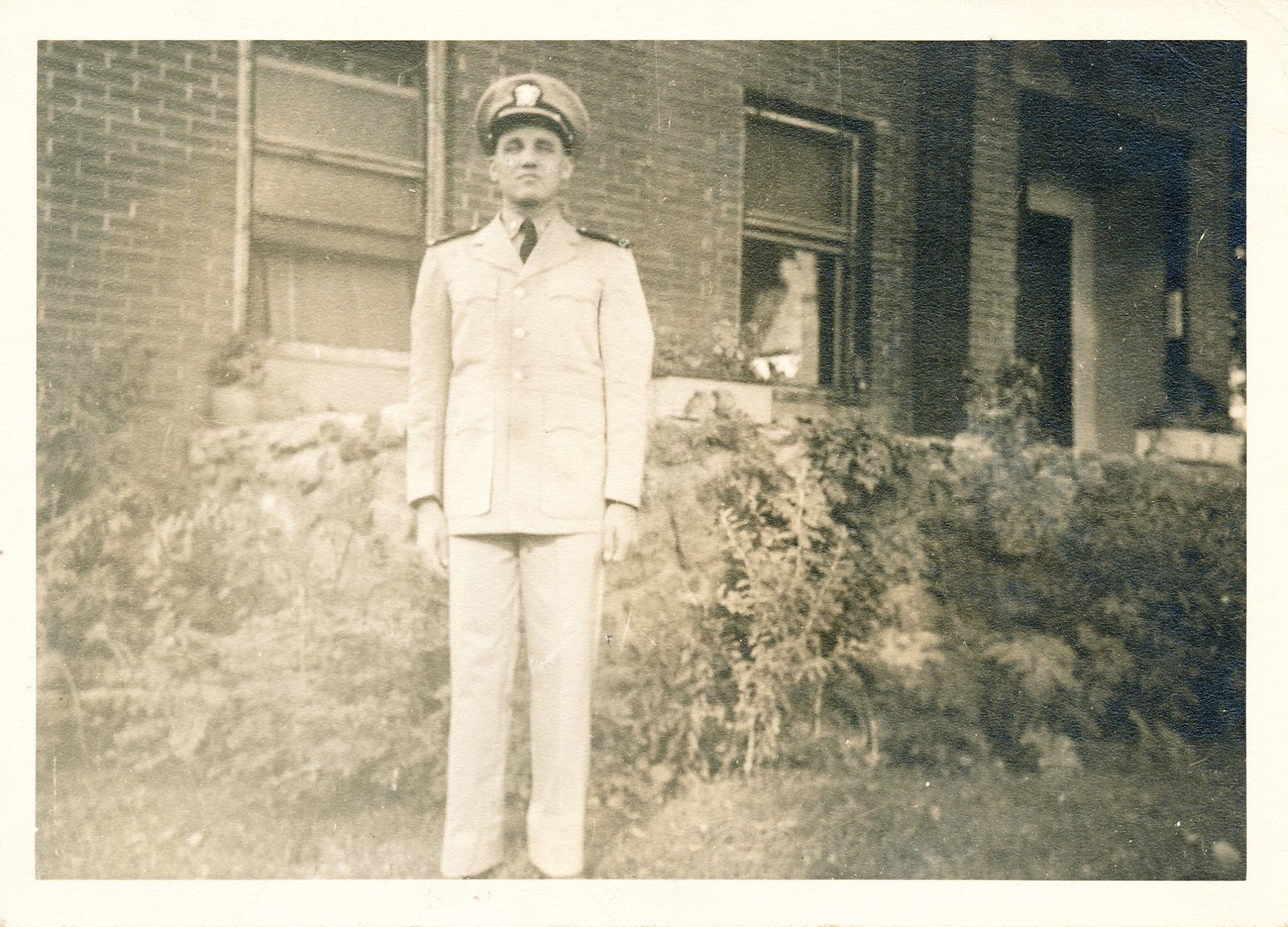
Jim didn't wait for his number to be called and enlisted in the U.S. Navy on June 15, 1942. He received a commission as a lieutenant j.g. and served aboard the aircraft carrier Yorktown (CV-10)**which was where he learned of his younger brother's death early in 1945.

[James Slater in uniform, courtesy of Olive Slater-Kennedy]


[James Slater, dress whites, courtesy of Olive Slater-Kennedy]

[James Slater in front of house in Niwot, courtesy of Olive Slater-Kennedy]

[Jim Slater in uniform, April 1945, courtesy of Olive Slater-Kennedy]


Jim was released from the Navy on March 22, 1946, but that wasn't the end of his military career. He re-einlisted on September 13, 1950, less than three months after the beginning of the Korean War. So far I haven't been able to find any information about this period of his service.

[James Slater U.S.N. i.d. card issued in 1950, courtesy of Olive Slater-Kennedy]

He left the Navy with the rank of Lieutenant Commander on July 5, 1953, about 3 weeks before the official end of the war.


*For an explanation of how the process worked, here's a link.
**There's a film (directed by William Wyler) that describes itself as "A Newsdrama of the Pacific" and was mostly shot aboard the Yorktown. It's available to watch in full here.


© 2016 Copyright, Christine Manczuk, All Rights Reserved.

Monday, May 30, 2016

Memento Mori: Memorial Day

My original intent for today was to re-post last year's Memorial Day tribute; next I thought I might highlight those individuals (most, but not all of them, my direct ancestors) whom I've posted about under my Gone for Soldiers label.

Then I recalled this photo of the air crew with my maternal uncle Jack Slater's notes written on the back. I don't know where it was taken, but assume that it must have been during his training as a B-17 pilot in the Army Air Corps. Not only does Jack list himself as the pilot here--and he was co-pilot on his three missions in Europe*--but close inspection of the lettering on the object to the left of the group reveals it to be a practice bomb.


[All courtesy of Olive Slater-Kennedy]

Here's my transcription of Jack's notes above:
Here we are, Crew 21 of the Bartholmess** Provisional Group. We are a typical combat crew - typical in that we represent all sections and elements of the country, in that we consider ourselves the best of the lot. We are the All American team of this or any other war year. We shall carry the war to the enemy, and hit him hard. Pardon me, if I sound like the proud parent, telling of his very ordinary children. We are, starting with the front row, reading left to right:
1. Pilot - You know me; I shan't describe myself.
2. Co-Pilot - Lt. Charles M. Guyler is at present newly-married. His wife, also from Pennsylvania, calls him "Chub". He is a level-headed, likeable young man of 25, an excellent pilot. I'd be lost without him.
3. Navigator - Lt. William R. Jones is the senior member at 33. A native Texan, he washed out as a pilot, and is the best Navigator in the group. Also married.
4. Bombardier - Lt. Jack L. Kipnis is at 26 still rather boyish. A Jewish boy from Brooklyn, he is a typical devil-may-care, efficient bombardier. Outwardly he seems to know only bombing and women.
5. Engineer - St Sgt Jackson G. Osborne has a mechanic's tasks. The boys call him "Bulldog", because of his noisy, husky egotism. He'd run the plane (and crew) if we'd let him. West Virginia (20).
6. Assistant Engineer - Sgt. Vito W. DiSabato is a native-born Italian with Latin good looks and personality. Lately from New York, he is also a waist gunner. He is 21.
7. Radio Operator - Sgt. Lowell T. Birdwell at 23 has been in the Army for 3 years. He has served in his native Texas and the Caribean [sic]. He is the "character" of the crew, very droll.8. Asst. Radio Operator - Allan V. Kangas is the baby at 19. Typically Scandinavian and a native born Finn. Very quiet. The Boys call him "Smiley" as he has no front teeth.
9. Cpl. Robert L. Lane is the Armorer - Ball turret gunner. He is 21, typically New England, the best gunner on the crew. Why the boys call him "Rabbit" I can't say. They also call him Jr. because he looks so young.
10. The tail gunner is Sgt. Ralph E. Martinez of Texas. Another quiet boy, well liked by us all. "Rocky" is also 21. Another excellent gunner.
Based on the information Jack has put in his notes, I was able to trace all of his fellow crew members except William R. Jones. Only Jack and Vito DiSabato didn't survive the war.

  • Charles Miller Guyler (1918-1991)
  • Jack L. Kipnis (1917-1978)
  • Jackson G. Osborne (1923-1981)
  • Vito W. DiSabato (1921-1944)
  • Lowell T. Birdwell (1919-1995)
  • Allan V. Kangas (1924-1994)
  • Robert L. Lane (1922-2111)
  • Ralph E.Martinez (1922-1981)

Thanks to the internet and YouTube I was able to locate several of the training films that Jack would have seen during his training.

[How to fly the B-17: Ground Operations
1943 US Army Air Forces Training Film World War II]

[How To Fly The B-17: Flight Operations
1943 US Army Air Forces Training Film World War II]


*Missions flown according to database at the American Air Museum in England.
29 Nov 1843 Bremen link here   plane name unknown 42-31171
30 Nov 1943 Solengin link here  Mayfly 42-3356
5 Dec 1943 Bordeaux/Merignac link here  Fighting Cock 42-3397
**I believe this refers to Lt. Col. Karl T. Barthelmess.


© 2016 Copyright, Christine Manczuk, All Rights Reserved.

Wednesday, May 18, 2016

Working on Wednesday: Victory Vacations Program

In response to an urgent call for students to help harvest crops in danger of being lost because of a lack of farm workers due to the war effort in 1942, Junior participated in the Sacramento Y.M.C.A.'s Victory Vacations Program at their Emergency Harvest Camp in Courtland, California, for which he was given the certificate below.*

[From my personal collection]

I wasn't able to find a newspaper story about his camp at Courtland but here's the Oakland Tribune's feature on their Y.M.C.A.'s harvest camp in Loomis.


[Oakland Tribune, June 22, 1942, page 13. Copyright © 2016 Newspapers.com]

In 1943 the U.S. Office of Education began a national Victory Farm Volunteer Program which was still active five years later. As the poster suggests, even some girls were allowed to join.

]
[Be a Victory Farm Volunteer in the U.S. Crop Corps.
Library of Congress Prints and Photographs Division Washington, D.C.]


*As far as I know, this is the only volunteer harvest work Junior did. I know that he was a Y.M.C.A. camp counselor during this period and due to his semi-rural upbringing, he would have been more familiar with farm work than most city kids.

© 2016 Copyright, Christine Manczuk, All Rights Reserved.

Monday, March 28, 2016

March Is Women's History Month: Vivian Claire Cadman Eddy (1921 - 2013), WASP Pilot, World War II

One day last month a friend and I decided to take one of our biweekly walks at Cabrillo National Monument on Point Loma. Afterwards, instead of coming directly home, we parked at Ft. Rosecrans National Cemetery and while we walked around the columbarium court this marker caught my eye and I promised myself I would research this woman's history.*

[My photo]

[Map of Vivian C Eddy's grave in Ft. Rosecrans National Cemetery; the National Cemetery Administration Nationwide Gravesite Locator]


Vivian Claire Cadman** was born in Fullerton, California, and fell in love with flying in her teens. By 1942 when she joined the Women Air Force Service Pilots (WASPS)*** Vivian already had her pilot's license. By the end of her service (as a civilian) she had flown at least eight North American P-51 Mustang fighter planes from their factory in Los Angeles to New Jersey and had been at the controls of almost every other pursuit fighter being made, including the Bell P-39 Aircobra she's pictured in below.

[Women Air Service Pilots]

[WASP pilot Vivian Eddy in the door of a P-39 Airacobra, 1945. Location unknown.]


Despite her experience, Vivian couldn't find a job as a pilot in the commercial air world so she became what she felt was the next best thing--a stewardess. Here's what she says about it in an interview quoted in Gallery of Legends:
"She joined American Airlines, where the job interviewer asked, 'Why do you want to be a stewardess?' 'Well, you won’t hire me as a pilot,' she answered. Every captain who learned she was a DC-3 pilot invited her to the cockpit to take the controls. She worries that she might still get in trouble with American for flying. (Not likely.)"
After Congress rejected a bill to formalize the WASPS' as a branch of the military in December of 1944, the program came to an end and all the women had to buy their own tickets home. They weren't eligible for veterans' benefits until 1978.

Finally in 2010, they were awarded America's highest civilian honor: the Congressional Gold Medal and Vivian was among the survivors who traveled to Washington, D.C. to receive it.****

[Vivian Cadman Eddy shows the Congressional Gold Medal she received for flying for the Women Airforce Service Pilots during World War II after a ceremony at the Capitol Visitor Center in Washington, D.C., March 10, 2010. During her service, Eddy delivered nine P-51 aircraft from California to New Jersey. All 1,102 women who served as civilian pilots under the direction of U.S. forces received the medal.
Department of Defense Photo Essay; DoD photo by Linda Hosek]


Read about Women's History Month here.


*She's not one of my relatives but I loved finding out about her story.
**More about Vivian Claire (Cadman) Eddy here and here. Here's her findagrave page.
***You can read more about the WASPs here and here.
****SD Tribune story (not mentioning Vivian) about WASPs getting Congressional Medal in 2010 here. 2009 UT story including Vivian here

© 2016 Copyright, Christine Manczuk, All Rights Reserved.

Thursday, July 2, 2015

Fantastic Find: The Kiss (1945)

I'm sure you've seen this image, captured by Alfred Eisenstaedt for Life magazine on August 14, 1945. It's always been assumed that it was snapped just after the official announcement of Japan's surrender in Times Square, New York City, just after 7:00 p.m. But was it?
[Alfred Eisenstaedt—Time & Life Pictures/Getty Images, found here]

Now, after lengthy analysis of this photo, others taken at the same time by Eisensteadt and another photographer, period photographs of Times Square generally, the construction of a scale model of the Square at the time and at least one eyewitness account, a professor of physics and astronomy at Texas State University in San Marcos together with a couple of friends have determined exactly when the event occurred.

The New York Times has the story here. Check it the evidence for yourself!

Like the our post about the Dead Horse Investigation, this great example of what can be discovered by determined analysis of a photograph.

© 2015 Copyright, Christine Manczuk, All Rights Reserved.
Monday, May 25, 2015

Memento Mori: Memorial Day

Harold "Hal" Delbert Currey, Jr. (1923-1945) Second Lieutenant, U.S. Army Air Corps. The co-pilot of a B-29 Superfortress based at North Field on Guam that was downed by enemy antiaircraft fire during a firebombing raid over Tokyo, his body remained unidentified for years after the war. He is buried in the National Memorial Cemetery of the Pacific in Honolulu, Hawaii

[From my personal collection]

[Rainbow over the National Cemetery of the Pacific. Photo U.S. Department of Veterans Affairs]


John "Jack" William Slater (1923-1944) Second Lieutenant, U.S. Army Air Corps. The co-pilot of a B-17 Flying Fortress based at Great Ashfield in Suffolk, England, that was badly damaged during a bombing raid on the Luftwaffe at Merignac Airfield in Bordeaux, and forced to make an emergency landing in the Bay of Biscay. Jack survived the landing but became separated from the rest of the crew. His body was found later and he is buried in the Ardennes American Cemetery in Neupré, Liege, Belgium.
[Courtesy of Olive Kennedy]

[The entrance to Ardennes American Cemetery in Belgium. Photo American Battle Monuments Commission]

I know that Harold and Bernice Currey, the parents who raised me, never visited their only son's grave.* And as far as I know, my maternal grandparents Harry and Anna Slater never went to Belgium to see Jack's grave either.

*When, after those years of uncertainty, the news arrived that Junior's body had been identified, Hawaii was chosen as his final resting place because Dad told Mother, "If you bring him here, you will have to bury me next to him."

© 2015 Copyright, Christine Manczuk, All Rights Reserved.