Richmond Worden*, my fifth great grandfather, served in the Vermont Militia under Seth Warner during the American Revolution.
[Ancestry.com. U.S., Revolutionary War Pension and Bounty-Land Warrant Application Files, 1800-1900 [database on-line]. Provo, UT, USA: Ancestry.com Operations, Inc., 2010. Original data: Revolutionary War Pension and Bounty-Land Warrant Application Files (NARA microfilm publication M804, 2,670 rolls). Records of the Department of Veterans Affairs, Record Group 15. National Archives, Washington, D.C.]
Richmond volunteered at several different times, serving in militias in Massachusetts and Vermont as this 1834 Massachusetts document describes:
[NARA M804. Revolutionary War Pension and Bounty-Land Warrant Application Files. Fold3.com]
But the index card shown at the top of the page only credits him with his service as a Green Mountain Boy.
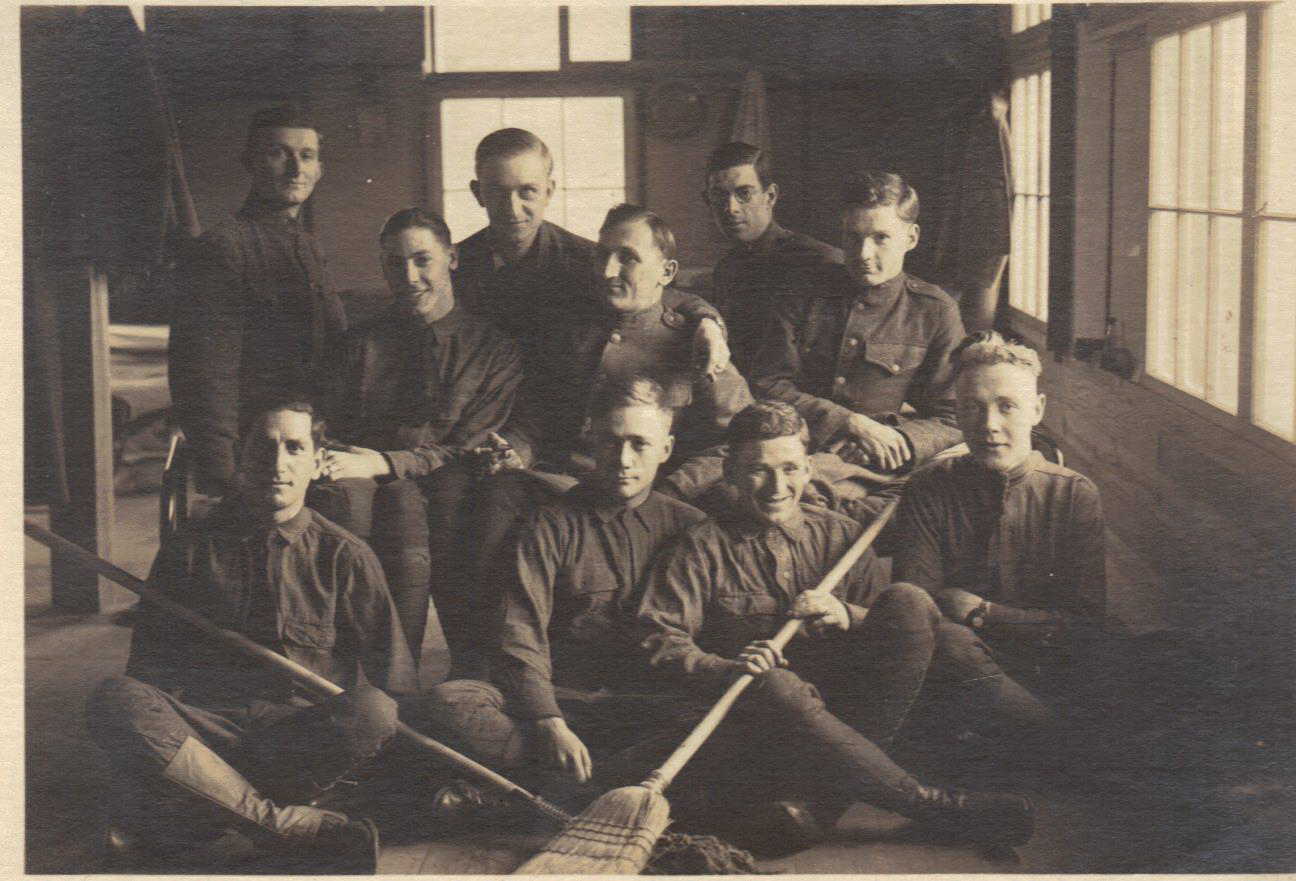
George Henry Thomas is the oldest son of Ashtabula (Lyle) and Seth P. Thomas, which makes him one of my third cousins, twice removed. He enlisted in the U.S. Army on August 2, 1918, as a private.* He rose rapidly to private, first class in early December, was named a corporal several weeks later, raised to a sergeant in January, 1919, ending as a sergeant 1st class in March and being honorably discharged on April 2, 1919. I haven't been able to learn if he was ever sent to Europe.
[George H. Thomas in suit, tie & jacket, undated; posted by VickieHill56 on an Ancestry.com tree.]
[Registration State: Ohio; Registration County: Gallia; Roll: 1832199. Source Information
Ancestry.com. U.S., World War I Draft Registration Cards, 1917-1918 [database on-line]. Provo, UT, USA: Ancestry.com Operations Inc, 2005. Original data: United States, Selective Service System. World War I Selective Service System Draft Registration Cards, 1917-1918. Washington, D.C.: National Archives and Records Administration. M1509, 4,582 rolls. Imaged from Family History Library microfilm.]
[Ancestry.com. Ohio Soldiers in WWI, 1917-1918 [database on-line]. Provo, UT, USA: Ancestry.com Operations Inc, 2005. Original data: The Official Roster of Ohio Soldiers, Sailors, and Marines in the World War, 1917-18. Columbus, OH, USA: The F.J. Heer Printing Co., 1926.]
[George H. Thomas in uniform; posted by VickieHill56 on an Ancestry.com tree.]
[George H. Thomas & friends in uniform; posted by VickieHill56 on an Ancestry.com tree.]
[George H. Thomas (top left) with Barracks buddies; posted by VickieHill56 on an Ancestry.com tree. ]
[George H. Thomas (front center) with WWI buddies, packed and ready to go; posted by VickieHill56 on an Ancestry.com tree. ]
When I first saw the Ancestry hint for this maternal third great grandfather, I didn't think it was likely because the event was in 1827 which seemed very early. I had forgotten that my Matthews ancestors moved from Tennessee to Sangamon County, Illinois, in 1818 (when Eli would have been about 14).
[Ancestry.com. U.S. Army Indian Campaign Service Records Index, 1815-1858 [database on-line]. Lehi, UT, USA: Ancestry.com Operations Inc, 2017. Original data: Index to Compiled Service to Compiled Service Records of Volunteer Soldiers Who Served During Indian Wars and Disturbances, 1815-1858; (National Archives Microfilm Publication M629, 42 rolls)]
Here's how the National Archives summarizes the events of the Winnebago Disturbances or War:
Resentment against lead mining operations on Winnebago lands east of the Mississippi River lead to hostilities. On June 26, 1827, four Winnebago Indians attacked a farm house at Prairie du Chien, Wisconsin, killing two men and scalping a child. To protect the miners and other settlers, four companies of volunteers were formed; the settlers requested additional support from Illinois and the regular U.S. Army. By September 1, 1827, most of the troops had reached the center of hostilities and although prepared for battle, only a few small skirmishes took place. Seven days later, surrounded by troops, the Winnebago chiefs surrendered and agreed to hand over the six Indians responsible for the attacks.
Eli married Susan Hanon in 1823 so he would have been a young householder when the call came to Illinois militia groups to form up in response to the "Winnebago Disturbances."
I found Eli's name in the Illinois State Archives, giving his term of service as a little over a month:
[Database of Illinois Winnebago War Veterans]
It doesn't look as if he saw very much, if any, active hostilities before being discharged.
Charles Durfee is a fourth cousin, once removed, from my great great grandmother Martha Heath Hardy's line. The common ancestor we both share is John H. Hardy whose 1854 Alabama will I covered last week.
The Hardy clan moved from Alabama to Texas after the Civil War and most stayed there but somehow his mother Anna found her way to South Dakota where she married Aaron B. Durfee in 1916. Charles, their second child, was born two years later.
Charles was listed as a midshipman at the Naval Academy at Annapolis, Maryland, appointed on June 11, 1938, from North Dakota.
[Ancestry.com. U.S., Select Military Registers, 1862-1985 [database on-line]. Provo, UT, USA: Ancestry.com Operations, Inc., 2013. This collection was indexed by Ancestry World Archives Project contributors.
Original data: United States Military Registers, 1902–1985. Salem, Oregon: Oregon State Library.]
He entered the Marine Corps as a 2nd Lieutenant in January of 1942 and was raised to the temporary rank of Captain a year later, serving in the Pacific Theater where he distinguished himself at the Battle of Tarawa, winning the Navy Cross.
[13 Mar 1944, Page 4 - Rapid City Journal at Newspapers.com]
Three months later he was killed during the invasion of Saipan and was awarded the Silver Star posthumously.
[12 Jul 1944, Page 4 - Rapid City Journal at Newspapers.com]
Here's a U.S. Army film about the assault on Saipan.
[Battle of Saipan, Marianas Islands 1944 (1949) US Army; Pacific Island Hopping, World War II]
Here are the details of his actions as given in the citations for the medals:
He's buried in the Black Hills National Cemetery in Sturgis, South Dakota.
[Ancestry.com. U.S. National Cemetery Interment Control Forms, 1928-1962 [database on-line]. Provo, UT, USA: Ancestry.com Operations, Inc., 2012. Original data: Interment Control Forms, 1928–1962. Interment Control Forms, A1 2110-B. Records of the Office of the Quartermaster General, 1774–1985, Record Group 92. The National Archives at College Park, College Park, Maryland.]
Davis Pearson is a fifth cousin of mine--we are both descendants of Jesse Warren, Sr.* His father died when Davis was six years old and his mother married a second time when he was eleven. Military and census records state that Davis completed only one year of high school before he had to help his step-father on the farm.
He enlisted in the U.S. Army on October 22, 1940, and was killed in action on January 21, 1945. I found this blurry photo of him on Findagrave.com.
[Davis S. Pearson. Source: Findagrave.com Memorial ID 3113374;
photo added by Rhunae Helms Cross]
Here's his name on the Army's casualty list for Hancock County, Georgia:
[Page 23 WWII Army and Army Air Force Casualty List - Fold3]
From this newspaper article in the Atlanta Constitution we learn that he was probably buried originally in Belgium** and his body was shipped home to Georgia in 1947.
[26 Oct 1947, page 62 - The Atlanta Constitution at Newspapers.com]
All of this left me wanting to know where Davis died because it isn't stated in any of the above records. Fortunately his mother's application for his headstone him as belonging to Company M of the 23rd Infantry Regiment.
[Ancestry.com. U.S., Headstone Applications for Military Veterans, 1925-1963 [database on-line]. Provo, UT, USA: Ancestry.com Operations, Inc., 2012. Original data: Applications for Headstones for U.S. Military Veterans, 1925-1941. Microfilm publication M1916, 134 rolls. ARC ID: 596118. Records of the Office of the Quartermaster General, Record Group 92. National Archives at Washington, D.C.Applications for Headstones, compiled 01/01/1925 - 06/30/1970, documenting the period ca. 1776 - 1970 ARC: 596118. Records of the Office of the Quartermaster General, 1774–1985, Record Group 92. National Archives and Records Administration, Washington, D.C.]
As part of the 23rd Infantry, here's what Davis experienced in the last eight months of his life beginning with the Normandy Invasion through his death during the Battle of the Bulge:
On 8 June, 1944, the Twenty Third Infantry landed on Omaha Beach with the first invasion forces.
In slow, painful hedgerow fighting, the Regiment inched its way forward day after day against hard fighting enemy paratroop elements. St. Georges d'Elle, Hill 192 (which commanded St. Lo), St. Jean des Baisants, Etouvy, Vire, Truttemer le Grand and Tinchebray were scenes of bitter fighting up to August when the organized German resistance in Normandy collapsed. A short respite, the first one up to that time, was interrupted by an overnight motor march of 210 miles to Brest. From 21 August to 19 September the Regiment battled the 2nd German Paratroop Division which fanatically defended the surrounding hills and villages. Knowing that the fortress seaport, which housed German U-boats, was greatly needed by the Allies for the purpose of establishing supply routes into France, Hitler ordered the garrison to hold for at least 90 days.
However, Brest, the scene of some of the most savage and bitter street fighting of the war, fell in 39 days. Formal capitulation of the Fortress to the 2nd Division occurred on 18 September, 1944. Its hard-driving leader, General Herman B. Ramcke, was captured the following day on the nearby Crozon Peninsula.
Another rapid motor and train move of 720 miles on 30 September, 1944, saw the 23d Infantry crossing France and Belgium to new battle positions on the German border. Defensive positions were taken up along the Siegfried Line just north of Luxemburg. The first ceremony of American troops on German soil was a 23d Infantry parade in November, south of St. Vith. Major General W.M. Robertson, Divisional Commander, presented decorations for heroism to officers and men of the Regiment. On 12 December, the Regiment moved 30 miles north to the vicinity of Sourbrodt, Belgium.
The German break-through on 16 December found all three battalions of the 23d Infantry fighting savagely in the line. The failure of the enemy to accomplish a penetration in the division sector, despite repeated tank and strong infantry. attacks, upset the entire German plan of action to reach and cut off the vital supply nets at Liege. The Regiment stopped attack after bloody attack.
This action was summed up by General Courtney Hodges, Commanding General of the 1st Army, who declared, "What the 2nd Division has done in the last four days will live forever in the history of the United States Army."
During the period of 13 to 23 Jan. while attached to the First Division, the Regiment fought under the most severe climatic conditions. It spearheaded a drive that broke the determined enemy resistance in the vital Ondenval-Iveldingen Pass to clear the way for armored thrusts into St. Vith, Belgium. Sleet, rain and bitter cold froze the men's clothing to their bodies as they, struggled through waist-deep snow over rough terrain. The enemy forces, principally the 8th Regiment, 3rd Panzer Division, were decimated. So heavy were enemy losses in men and material that the 8th Regiment ceased to exist as a fighting force.***
Davis Pearson was one of the more than 19,000 American soldiers who died during the Battle of the Bulge. He's buried in Wisteria Cemetery in Union Point, Greene County, Georgia.
On this day 153 years ago, 90,000 soldiers from the Army of the Potomac marched down Pennsylvania Avenue on the first of two days of military parades to celebrate the Union victory.*
[Mounted officers and unidentified units on Pennsylvania Avenue, May 1865. Source: Library of Congress]
And where was Dick Worden, my great great grandfather, at the time? Was he one of the marchers in Washington D.C.?
Alas, no.
After being invalided out shortly after Vicksburg in 1863, he had reenlisted early in the next year and went back to his old Company G of the 24th Iowa Infantry Regiment, then part of General Sheridan's Army of the Shenandoah in Virginia, which was in Georgia when the Grand Review took place.
*The men from General Sherman's Army of Georgia, 60,000 strong, traveled the same route the next day.
**Either Savannah or Augusta.
He was born in rural Morgan County, Georgia, which is nowhere near the ocean but Josiah chose to enlist in the U.S. Navy in 1917.
[Ancestry.com. Georgia, World War I Service Cards, 1917-1919 [database on-line]. Provo, UT, USA: Ancestry.com Operations, Inc., 2013. Original data: Georgia Adjutant General’s Office. World War I Statements of Service Cards. Georgia State Archives, Morrow, Georgia.]
I found a photograph of his ship, the U.S.S. San Francisco, at the Library of Congress.
[U.S.S. San Francisco. Detroit Publishing Company photograph collection (Library of Congress)]
He must have found life at sea attractive because four months after his discharge from the Navy he applied for his Seaman's Protection Certificate in New Orleans.*
*You can see a picture of Josiah (who is my second cousin, twice removed) in this earlier post.
In this last installment of the letter written by my great uncle Pete Slater he detailed his experience in the advance troops of the Meuse-Argonne Offensive* which ended on the day the armistice was signed and "the big show was over."
[29 May 1919, Page 8 - The Severyite at Newspapers.com]
Continuing with the third part of Pete Slater's letter to his great uncle describing his experiences on the battlefields of France during World War I. Up to this point in his deployment he had not seen much action but that changed. During this action all the officers and half of the men in his company had been killed.
[22 May 1919, Page 10 - The Severyite at Newspapers.com]
Here ise the second of a series of articles from the The Severyite of a letter sent by my great uncle George Logan "Pete" Slater to his great uncle Albert Ross Tomlinson back in Kansas describing his experiences during World War I.
[15 May 1919, Page 8 - The Severyite at Newspapers.com]
In my post last week I shared a clipping from The Severyite with a letter my maternal great uncle George Logan "Pete" Slater wrote to his uncle A.R. Tomlinson* just before he was shipped off to France and lamented that we didn't know more about Pete's wartime experiences.
I spoke too soon.**
This week I found a series of articles in the same newspaper referring to another letter Pete wrote to his uncle from Germany four months after the Armistice was signed.
[8 May 1919, Page 8 - The Severyite at Newspapers.com]
Come back next week for the next installment.
*Alfred Ross Tomlinson (1847-1923) was Pete's maternal grandfather's brother.
**Hint: I've found that relying on a single search on Newspapers.com doesn't turn up everything on the subject you're searching for. Every time I repeat my search I get new hits. It pays to try and try again!