Showing posts with label War of 1812. Show all posts

Monday, January 8, 2018

My Connection to the Battle of New Orleans: William T. Slater (About 1794 - 1847)

Today marks the 203rd anniversary of the famous battle won by American forces under the command of Andrew Jackson. That didn't affect the outcome of the War of 1812 because a peace treaty had already been signed although the news hadn't reached either army in the field. The victory made Jackson wildly popular and led to his eventual election as our seventh President in 1828.

[The battle of New Orleans for the piano forte; Composer P. Ricksecker. Published and sold at G. Willig's Music Store, 1816.
Source: Library of Congress]

According to Slater family stories shared by my cousin Sue, William T. Slater, our maternal third great grandfather, was part of the British invasion forces. It's been assumed that he was a sailor because the legend is that he deserted by going over the side of the ship. We know he was from Yorkshire, but Slater is a very common name and I haven't been able to find any convincing records of him in British archives.

He's the most recent of my foreign born ancestors--all the others seem to have gotten here well before the American Revolution.

[Ancestry.com]


© 2018 Copyright, Christine Manczuk, All Rights Reserved.

Wednesday, June 28, 2017

Gone for Soldiers: Samuel Avery (1790 - 1853), Soldier

Although it's clear that this paternal 3X great grandfather served in the South Carolina Militia during the War of 1812 (along with his brothers William and Thomas), I'm not sure what that service entailed.

[Index to Compiled Service Records of Volunteer Soldiers Who Served During the War of 1812;
The National Archives. Source: Fold3]


[Muster rolls of the soldiers of the War of 1812 : detached from the Militia of North Carolina in 1812 and 1814. Ancestry.com]

It's getting late here in France and we're about to start dinner so I'm going to postpone further research into what Samuel did in the war until a later date.

By the way, the Charleston County Public Library's blog The Charleston Time Machine has a useful post about finding veterans of the War of 1812 in South Carolina.

© 2017 Copyright, Christine Manczuk, All Rights Reserved.

Wednesday, June 7, 2017

Gone for Soldiers: Lyman Worden (1790 - 1883) Soldier

Several months ago I posted about Lyman Worden's 1880 interview by a local newspaperman and promised to look into what this maternal 4X great grandfather did during his three-month service during the War of 1812. Today's the day I fulfill that commitment.

In 1813 Lyman and his young family were living in Cayuga County when he was called into service with the New York militia.

Source: NYS Historic Newspapers, Image provided by: SUNY Oswego]


Here's a contemporary view of Fort Niagara from the British side of the river where Lyman's company camped for a week.

[Fort Niagara taken from the British side of the river at Newark.  William Strickland, 1787-1854, engraver. Published - Philadelphia, 1814 Oct. 
Source: Library of Congress]

And here's Fort George (from the American side) where his company spent an undisclosed amount of time but it couldn't have been very long as his whole time in the militia lasted no more than three months.

[View of British Fort George from U.S. Fort Niagara, c.1811 (LAC)]

And here's a portrait of the American General George McClure mentioned in Lyman's interview.


You can find more information about Fort George here and here; read about the events of the War of 1812 on the Niagara River here; and learn about the Native American involvement during the war here


© 2017 Copyright, Christine Manczuk, All Rights Reserved.

Wednesday, May 31, 2017

Gone for Soldiers: Isaac Leonard (About 1790 - 1862), Soldier, Part II

As we discovered in an earlier post, Isaac Leonard served as a private in Captain Asal Power's company of New York Militia in Jefferson County during the War of 1812.

[Ancestry.com. New York, War of 1812 Payroll Abstracts for New York State Militia, 1812-1815 [database on-line]. Provo, UT, USA: 2013. Original data: War of 1812 abstracts of payrolls for New York State militia ("payroll cards"), 1812–1814. Series B0810 (23.5 cu. ft.). New York (State). Adjutant General’s Office. New York State Archives, Albany, New York.]


But this appears to be the only militia record for Isaac which covers less than a month of service, so I wondered what was going on at that time. Although there had been several battles at Sacket's Harbor (on Lake Ontario) in Jefferson County earlier in the war, histories didn't note any actions during the period between October 12 and November 8, 1814.

[Sackets Harbor, NY during the War of 1812. U.S. Naval Historical Center]

But persistence paid off and I found a county history published in 1854 that explains the situation.

 
[A history of Jefferson County in the state of New York by Franklin Benjamin Hough, 1822-1885.
Publisher Albany, J. Munsell; Watertown, N.Y., Sterling & Riddell, 1854. Source: Internet Archive..]

Using that information I was able to find this contemporary newspaper report published in the Paris, Kentucky, Western Citizen.


[Saturday, November 5, 1814   Paper: Western Citizen (Paris, Kentucky)   Volume: 7   Issue: 41   Page: 2. This entire product and/or portions thereof are copyrighted by NewsBank and/or the American Antiquarian Society. 2004.Source: GenealogyBank.com]


The war ended in December 1814 with the signing of the Treaty of Ghent, although that wasn't known until several months later.

There's now a state park at Sackets Harbor.


© 2017 Copyright, Christine Manczuk, All Rights Reserved.

Wednesday, April 12, 2017

Gone for Soldiers: Isaac Leonard (About 1790 - 1862), Soldier

Isaac Leonard served as a private during the War of 1812, but so far I haven't explored what he did. As you can see from the list below there were two Isaac Leonards in New York and this is an attempt to sort out which one is my ancestor.
[New York, Index of Awards On Claims of the Soldiers of the War of 1812 [database on-line].]


Fold3 has 4 service records for an Isaac Leonard in New York State, each one for a different regiment.


Since there's no indication that "my" Isaac Leonard was a musician and the payroll record for the musical Isaac (below) states that he was a deserter which makes it unlikely that any later claim of his for reimbursement would be successful so I think we can discount the fourth record.


The next Isaac Leonard is listed as "In service at N.Y. City" which doesn't seem likely for someone who probably resided some distance away from N.Y.C.


This Isaac Leonard served in Captain Asel Power's company commanded by Lt. Col. Calvin Britain. 

[Ancestry.com. New York, War of 1812 Payroll Abstracts for New York State Militia, 1812-1815 [database on-line]. Provo, UT, USA: 2013. Original data: War of 1812 abstracts of payrolls for New York State militia ("payroll cards"), 1812–1814. Series B0810 (23.5 cu. ft.). New York (State). Adjutant General’s Office. New York State Archives, Albany, New York.]


Researching these two officers let me to this publication by the State of New York in which we learn that they were located in Jefferson County. Until now the earliest known date for my ancestor was an 1816 land purchase that described him as a resident of Hounsfield in Jefferson County.


The following extract is from the 1812 section.

[Documents of the Senate of the State of New York, Volume 10. New York (State). Legislature. Senate - E. Croswell, 1902
Government publications. Source: Google Books.]

Now that I know what regiment he served in, next time I'll see what we can find out about his experiences in the War of 1812.


© 2017 Copyright, Christine Manczuk, All Rights Reserved.

Wednesday, February 17, 2016

Gone for Soldiers: Samuel L. Avery (1790 - 1853), Soldier

This paternal third great grandfather was born in Cumberland County, North Carolina, but grew up across the border in Chesterfield County, South Carolina, where his family moved when he was very young.

[In 1814 Chesterfield was in the Cheraw District (outlined in blue in this map). The State of South Carolina: from the best Authorities, By Samuel Lewis. W. Barker, sculp. Source: David Rumsey Historical Map Collection.]


And that's where Samuel L. Avery and Mary Thornton were married on June 18, 1808. Two years later he appears at the top of the first of these two pages from the 1810 U.S. Census. (Note that his surname is spelled Avera here; the shift to using Avery appears to have occurred a few years later.)

[Year: 1810; Census Place: Chesterfield, Chesterfield, South Carolina; Roll: 60; Page: 571; Image: 00293; Family History Library Film: 0181419. Ancestry.com. 1810 United States Federal Census [database on-line]. Provo, UT, USA: Ancestry.com Operations, Inc., 2010. Images reproduced by FamilySearch. Original data: Third Census of the United States, 1810. (NARA microfilm publication M252, 71 rolls). Bureau of the Census, Record Group 29. National Archives, Washington, D.C.]


Sources* agree that Samuel, together with two of his younger brothers, Thomas and William, served as privates in the 3rd (Alston's) South Carolina Militia. during the War of 1812. Here's a general description of the role played by South Carolina's troops:
"The troops in the War of 1812 were basically of two kinds - the regular army, known as regulars, and the militia. The regulars were entirely volunteers. All men belonged to the militia, but not all militias were called into service. Those who were actually enrolled were known as the detached militia; they were obtained preferably by volunteers from the total militia or by conscription if not enough volunteered. The militia in the past had been thought of as a body of men only used for home defense, but in the War of 1812 they were not only used at home but were also sent out of the state to aid at other danger points."
Samuel's name is also on the 1814 muster rolls for Craven County, South Carolina, but it appears that he could afford to hire a substitute.

[Section: Muster roll of the detached militia, organized in August, 1814. Ancestry.com. Muster rolls of the soldiers of the War of 1812 : detached from the Militia of North Carolina in 1812 and 1814 [database on-line]. Provo, UT: Ancestry.com Operations Inc, 2005. Original data: Muster rolls of the soldiers of the War of 1812 : detached from the Militia of North Carolina in 1812 and 1814. Raleigh, N.C.: C.C. Raboteau, 1851.]


[Pitt County Genealogical Quarterly, August 1996, page 4. Copyright Pitt County Family Researchers. This item is presented courtesy of Farmville Public Library for research and educational purposes only.]


Department of the Army Pamphlet,  Leonard L. Lerwell, 1954. (PDF)]


By 1819 the Avery family had left South Carolina for Alabama and moved on to Winston County, Mississippi, by 1835 where my great great grandfather John Warren Avery was born.


*Two online sources are South Carolinians in the War of 1812 and Alston's 3rd Regiment SC Militia on RootsWeb.


© 2016 Copyright, Christine Manczuk, All Rights Reserved.

Wednesday, February 3, 2016

What Is the "U.S., Definitive List of Slaves and Property, 1827-1828" Database Just Released on Ancestry?

I just noticed that Ancestry released a new database originating from the National Archives and Records Administration (NARA), "U.S., Definitive List of Slaves and Property, 1827-1828".


It took me a while to actually figure out what this database was covering.  I had to start by looking up what "indemnify" meant.  According to Merriam-Webster:


indemnify
1  to secure against hurt, loss, or damage2  to make compensation to for incurred hurt, loss, or damage 
indemnification
a) the action of indemnifyingb) the condition of being indemnified


So what prompted this collection of data in the first place?

According to the NARA catalog entry:

DUring the War of 1812, the British took possession of a large amount of American property, including slaves, some of whom were voluntary fugitives, while others were taken in predatory excursions. Article I of the Treaty of Ghent, signed on December 24, 1814, contained provisions for restoration of "all territory, places, and possessions" taken by either party during the war. A dispute, however, arose between American and British officials about interpretation of this provision as it affected slaves. The dispute was referred, by article V of the convention signed on October 20, 1818, to the Emperior [sic] of Russia for arbitration. The Emperor's decision, APril 22, 1822, favored the United States. Having settled this point, a convention was signed on June 30, 1822, by the United States and Great Britain providing for a commission of two members from each country, a commissioner, and an arbitrator who would determine the average value of slaves and the validity of property claims. Langdon Cheves and Henry Seawell were appointed U.S. commissioner and arbitrator, respectively. 
Although the commssion [sic], which met in Washington, August 25, 1823, agreed on some points, it soon ran into insurmountable difficulties. On November 13, 1826, a new convention was signed in which Great Britain agreed to pay $1,204,960 in satisfaction of all claims under award of the Emperior [sic] of Russia. 
An act of March 2, 1827 (4 Stat. 219), provided for establishment of a domestic claims commission to examine and determine the validity and amount of award, if any, claimants should receive. Langdon Cheves, Henry Seawell, and James Pleasants were appointed commssioners [sic]. Aaron Ogden served as clerk. The commission met in Washington on July 10, 1827. A total of 1,060 claims were decided before it adjourned on August 31, 1828.

So which states exactly were covered?
Virginia, Georgia, Maryland, and Louisiana had the most slave claims, followed by Mississippi, Alabama, South Carolina, District of Columbia, and Delaware.  Image 2 from U.S., Definitive List of Slaves and Property, 1827-1828:  Definitive List of Slaves and Property on Ancestry.

An example of the list, with the slave owners, the enslaved that the British allegedly carried off, the enslaved's value, and a note of the proof:
Image 7 from U.S., Definitive List of Slaves and Property, 1827-1828:  Definitive List of Slaves and Property on Ancestry.


I'm not sure how, or even if, I can apply this dataset in my own research, but regardless this looks like an interesting new release.


ETA:  Maya Davis (Research Archivist, Maryland State Archives) and her colleagues used the the data for case studies on the fate of some of these slaves.  Blog post about her presentation here.


© 2016 Copyright, Christine Manczuk, All Rights Reserved.

Wednesday, November 25, 2015

Working on Wednesday: William T. Slater (About 1790? - 1847), Deserter, Farmer, Justice of the Peace

Up until 1818 when William Slater applied for naturalization in Jefferson County, Indiana, all the information we have about this maternal 3rd great grandfather comes from family stories that I haven't been able to verify.*

According to Slater family lore, William first arrived in the United States on a ship that was part of the British invasion fleet that attacked New Orleans in 1814-15, and at some point he went over the side of the ship and never looked back.

It's been presumed that William was a sailor in the Royal Navy but I think it's possible that he could have been a marine or a soldier in the British Army.**

[Painting depicting the Naval Battle of Lake Borgne, Louisiana, between U.K. and U.S. forces in the War of 1812, by Thomas L. Hornbrook (active 1836-1844). (Image Courtesy of the U.S. Naval Academy Museum, Annapolis, Maryland.) Found on Naval History Blog. ]

We can't find him in the 1820 U.S. Census but on July 20th of that year he married (Emily) Jane Wilson in Crawford County, Indiana, and the couple's eight oldest children were born in that state. By 1830, they were living in farther west in Pike County.

[1830; Census Place: Jefferson, Pike, Indiana; Series: M19; Roll: 26; Page: 373; Family History Library Film: 0007715. Ancestry.com. 1830 United States Federal Census [database on-line]. Provo, UT, USA: Ancestry.com Operations, Inc., 2010.  Images reproduced by FamilySearch. Original data: Fifth Census of the United States, 1830. (NARA microfilm publication M19, 201 rolls).
Records of the Bureau of the Census, Record Group 29. National Archives, Washington, D.C.]


But their ninth child, my great great grandfather George W. Slater (1832-1899), was born in Illinois, signalling the family's move to Lawrence County*** where they remained through 1840. (Their last two children were born there also.)


[Year: 1840; Census Place: Lawrence, Illinois; Roll: 63; Page: 171; Image: 345; Family History Library Film: 0007643. Ancestry.com. 1840 United States Federal Census [database on-line]. Provo, UT, USA: Ancestry.com Operations, Inc., 2010. Images reproduced by FamilySearch. Original data: Sixth Census of the United States, 1840. (NARA microfilm publication M704, 580 rolls).
Records of the Bureau of the Census, Record Group 29. National Archives, Washington, D.C.]


By 1843 the Slaters had moved again, this time in the northeastern corner of South Audubon Township in Montgomery County, Illinois. Three years later William was elected the first Justice of the Peace so he must have been a respected citizen.

[History of Montgomery County, Illinois, Illustrated Atlas Map Of Montgomery County, Ill. Carefully Compiled from Personal Examinations and Surveys. 1874. Published by Brink, McCormick & Co., of Illinois. Duval & Hunter, Lithographers, Philada, Pa.
Source: David Rumsey Historical Map Collection.]


William T. Slater died in 1847; his place of burial is unknown.

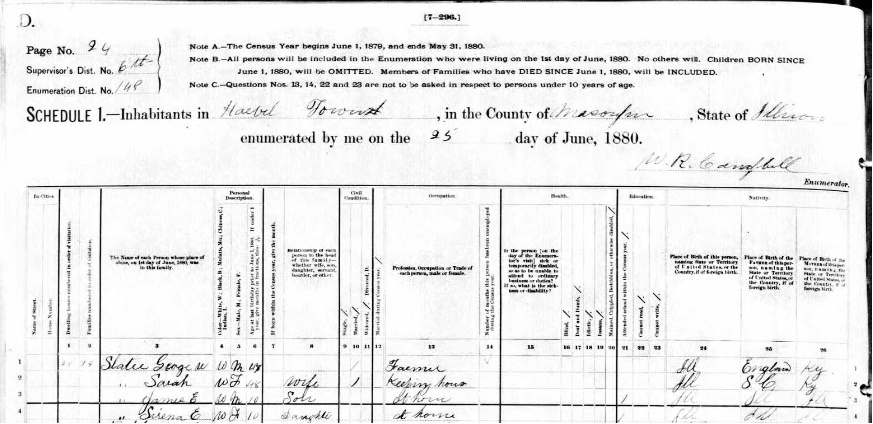
Family tradition has one more bit of information about William, asserting that he was born in Yorkshire. Unfortunately there are a lot of Slaters in Yorkshire so that hasn't helped locate a birth record for him. As this 1880 U.S. Census record shows, his children list his place of birth as "England."

[Year: 1880; Census Place: Harvel, Montgomery, Illinois; Roll: 237; Family History Film: 1254237; Page: 283D; Enumeration District: 149; Image: 0567. Ancestry.com and The Church of Jesus Christ of Latter-day Saints. 1880 United States Federal Census [database on-line]. Provo, UT, USA: Ancestry.com Operations Inc, 2010. 1880 U.S. Census Index provided by The Church of Jesus Christ of Latter-day Saints. Original data: Tenth Census of the United States, 1880. (NARA microfilm publication T9, 1,454 rolls). Records of the Bureau of the Census, Record Group 29. National Archives, Washington, D.C.]


*Yet. (But not for lack of trying.) And we're assuming that he didn't change his name after his unauthorized departure from the Royal Navy.
**I didn't grow up as a Slater and I've only heard this story once, from my cousin Susan. If the belief that William was a sailor is based on his desertion by "going over the side" that doesn't take into account the fact that all Royal Navy ships had marines on board or that the British Army troops had all arrived by ship too.
***Where William's father-in-law John Wilson had bought land in 1825.


© 2015 Copyright, Christine Manczuk, All Rights Reserved.

Thursday, July 30, 2015

Have You Donated to "Preserve the Pensions" (Pensions of 1812)?


Have you donated to War of 1812 Pension Digitization Project yet?
The Pension Records from the War of 1812 are among the most requested documents at the National Archives. Unfortunately, these fragile documents are in urgent need of digitization. In support of this monumental task of digitizing 7.2 million pages, Ancestry.com has provided a dollar for dollar matching grant, so every dollar you contribute will make four more pages accessible and free for everyone.
I mentioned this project late last year.  They have now raised 50% of the money needed!
Ancestry.com has generously stepped up and agreed to cover costs to digitize HALF of the War of 1812 pension records. So every dollar donated will actually go twice as far.
At a cost of $0.45 per digitized page, your tax-deductible gift of $45 would normally digitize 100 pages, but with the help of Ancestry.com it will digitize 200 pages. Your contributions can be made in the name of your ancestor.
Time is of the essence. These documents are fragile and need to be digitized quickly to preserve the best possible image of each page.


© 2015 Copyright, Christine Manczuk, All Rights Reserved.

Wednesday, December 3, 2014

Preserve the 1812 Pensions

The War of 1812 Pension Digitization Project has been going on for a while now.  I can't wait until it's finally done!

I have already donated some money towards the project in honor of two of my known War of 1812 soldiers, Jesse Sill and Thomas Lynchard.  The time period between the late 1700's through the 1830's represents a sizable gap in my understanding of my ancestors, and I think once this project is done it will help shed considerably more light on some people in that era.


© 2014 Copyright, Christine Manczuk, All Rights Reserved.