Friday, October 3, 2014

Famous Friday: Thomas Warren, the House of Burgesses, and the Warren House

What were you doing when you were 22?

My 8th great grandfather, Thomas Warren (abt 1625 - 1670), became a member of the House of Burgesses in Jamestown, Virginia, on 1 Oct 1644, at the age of 22 [1].  He would go on to serve at numerous times in 1645, 1658-59, 1662-1663, and 1666. [2]   His ability to reach this office at such a young age was no doubt due to his family's gentry status back in his native Kent, England.

The House of Burgesses set a crucial tradition for a popularly elected legislative (law-making) assembly in the English colonies early on.  The Virginia government in Thomas Warren's time was somewhat recognizable as it took a similar arrangement the Federal Government and the various states have today:
  • a Governor, 
  • the Governor's Council (precursor to today's Virginia Senate as well as the Virginia Supreme Court), and
  • the House of Burgesses (precursor to the Virginia House of Delegates),
or in other words,
  • Governor
  • State Supreme Court
  • State Senate
  • House of Representatives.
In fact, later members of the House of Burgesses include George Washington, Thomas Jefferson, and Patrick Henry [3].  Their experiences in this body helped shape their ideas and views on governance, and greatly informed their decisions on the structure of the new government of the United States [4].

There is a place called the Warren House on Smith's Fort Plantation (.pdf map), across the river from Jamestown in Surry County, Virginia.  It was long thought to have been built and occupied by Thomas Warren, but evidence in the 1930's indicated the house that now stands was built sometime in the 1760's and was originally inhabited by the Surry County Clerk, Jacob Faulcon.
From what I gather Thomas Warren did buy land in that spot around 1651 from Thomas Rolfe (famous son of Pocahontas) [5], but no structure of his making and habitation is left to visit.


[1] Boddie, John Bennett. 1966. Colonial Surry. Baltimore: Genealogical Pub. Co., 67.
[2] Ibid.
[3] Gottlieb, M. S. House of Burgesses. (2012, November 6). In Encyclopedia Virginia. Retrieved from http://www.EncyclopediaVirginia.org/House_of_Burgesses.
[4] Ibid.
[5] Boddie, John Bennett. 1966. Colonial Surry. Baltimore: Genealogical Pub. Co., 66.


© 2014 Copyright, Christine Manczuk, All Rights Reserved.

Thursday, October 2, 2014

Just Judith and Puggy: People in the 1850 Census who were born in Africa

Laura Ingalls (later Wilder) in North Hero, Redwood, Minnesota in 1875. [1]

Abraham Lincoln in Springfield, Sangamon, Illinois in 1850. [2]

Thomas Edison in West Orange, Essex, New Jersey in 1900. [3]

Iconic figures in American history.  Well documented lives.  You can look up pictures of them and read books about them.  They are known people.

I've looked up a few famous people in the US Censuses.  Marilyn Monroe, Ayn Rand.  Sometimes Ancestry.com features a few famous people to be found.  There is a whole blog, Famous Census Records, devoted to looking up famous people, and there are a multitude of TV programs devoted to famous people's ancestries.

It's a bit jarring to see these fascinating and complicated people reduced to names, facts, and figures on an impersonal census sheet.

On the other hand, there are the people largely invisible to US censuses before 1870, a large minority known more for their unwilling mass participation in the "peculiar" institution of slavery than for their various personal life stories.  Of course, most people living in the United States before the 1850 census were similarly under-represented, whether free or slave, as the 1790-1840 censuses only listed the head of household.

However, the gap between this representation of slave and free becomes stark starting with the 1850 census, where all household members are listed--except for the separate Slave Schedules, in 1850 and 1860, where the names of the slave owners were listed, and the slaves subsequently listed anonymously by age, color, and sex.

Here is an example of how my 3rd great grandfather Jesse T. S. Warren's 1850 Slave Schedule in Cotton Valley, Macon, Alabama, appeared.  You see his name, and then all the slaves.  Just look at all those empty spaces where names could should have been written!  If I had been there and asked J. T. S. what their names were he'd be able to tell me immedately.  I am still researching  J. T. S. Warren and hope (against hope) that someday I may be able to also determine who the blank-space people are listed below him, at least some of them.


[Description: Alabama, Macon, District 21. Source Information: Ancestry.com. 1850 U.S. Federal Census - Slave Schedules [database on-line]. Provo, UT, USA: Ancestry.com Operations Inc, 2004. Original data: United States of America, Bureau of the Census. Seventh Census of the United States, 1850. Washington, D.C.: National Archives and Records Administration, 1850. M432, 1,009 rolls.]

Every time I look at these schedules I feel like tearing my hair out.  The problem of slavery itself put aside, it's just aggravating knowing what a difference it would have made to researchers and genealogists to have had names penciled in each of those empty boxes.  Every last one of those people had a name.  Scholarship into wills, diaries, and other sources can sometimes tease out the identities of some of these nameless people, but most of them will remain anonymous and unknown forever.

Well, I can't conjure up the names to these people any more than the next person, but it did make me appreciate (and wonder about) the black people who DO appear in the 1850 and 1860 censuses.

I've read my share of Middle Passage accounts.  Horrendous.  It was bad enough for people who wanted to come to America to make the journey by boat, but unbelievably bad for those who didn't even want to go (or even knew where they were going).  But some people lived through it.  Who were the particular individuals who survived such a voyage?  Some of them appear, by name, in the 1850 Census.

To me, that is a kind of famous.

I'll start this week with Judith and Puggy.  No last names.  Just Judith.  Just Puggy.  They lived in Warren County, Georgia (District 90).

Judith is on line 14 below:


[Year: 1850; Census Place: Division 90, Warren, Georgia; Roll: M432_86; Page: 164A; Image: 335]

Judith is listed as 110 (!) (b abt 1740), female, black, and born in Africa (possibly S. Africa, as it looks like an "S" before the Africa).  No profession listed.  She is the only black person listed on that page.

Puggy is on line 22 below:


[Year: 1850; Census Place: Division 90, Warren, Georgia; Roll: M432_86; Page: 165A; Image: 337]

Puggy is listed as 70 (b abt 1780), female, black, and born in Africa.  No profession listed.  Everyone on the page is black (or mulatto).  Everyone around her has a last name, unlike her.

I find it interesting that both women were just listed by their first name, while everyone around them had a last name.  What significance, if any, did that have?

I obviously need to do some more research in Warren County, Georgia concerning free blacks.  Consider that this is in ante-bellum Georgia, and here are black people actually listed in 1850!  Wow.


[1] "Minnesota, State Census, 1875," index and images, FamilySearch (https://familysearch.org/pal:/MM9.1.1/MKNR-9HM : accessed 02 Oct 2014), Laura C Ingalls in household of C P Ingalls, North Hero, Redwood, Minnesota; citing p. 63, line 6, volume R - 1, State Library and Records Service, St.Paul; FHL microfilm 0565727.
[2] Source Citation: Year: 1850; Census Place: Springfield, Sangamon, Illinois; Roll: M432_127; Page: 120A; Image: 247.
[3] Source Citation: Year: 1900; Census Place: West Orange, Essex, New Jersey; Roll: 968; Page: 20A; Enumeration District: 0184; FHL microfilm: 1240968.


© 2014 Copyright, Christine Manczuk, All Rights Reserved.

Wednesday, October 1, 2014

Mind the Gap!

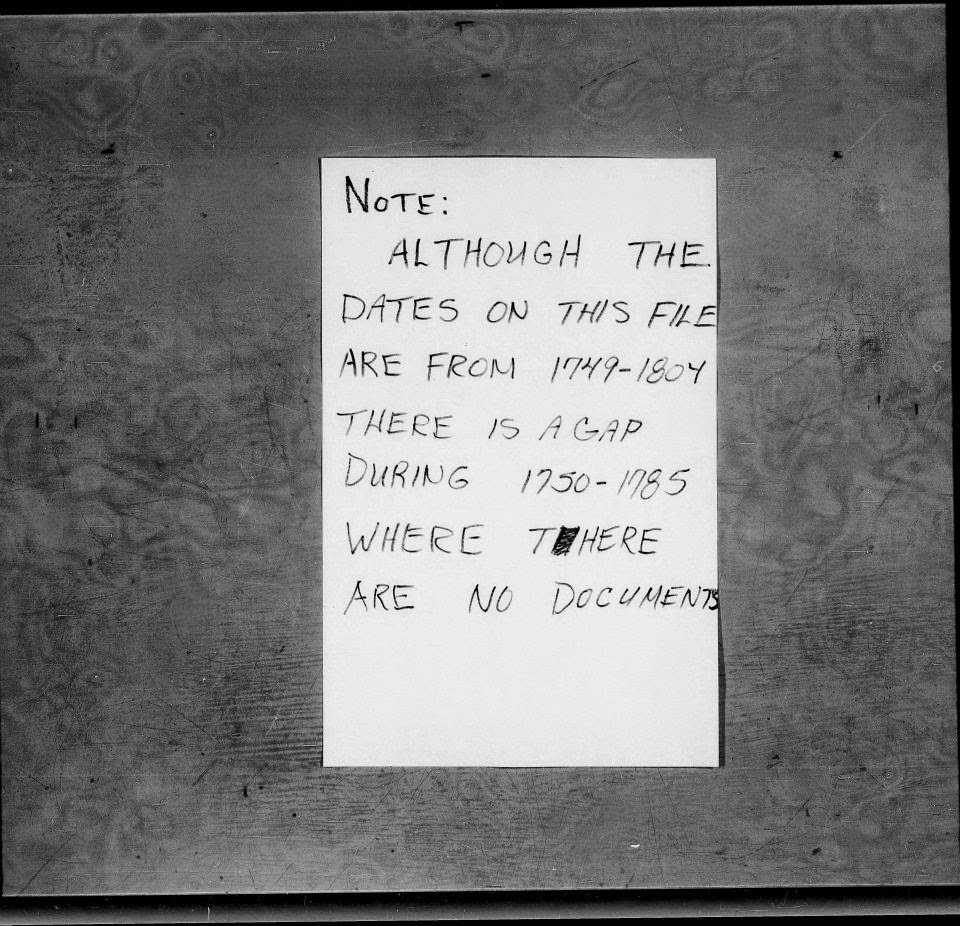
Over the years, I've found a lot of information using FamilySearch.org, especially in their unindexed legal and probate records. But sometimes what I'm looking for just isn't there.


And of course, any records regarding the ancestor I was researching had fallen into the gap.

Source: "New Jersey, Probate Records, 1678-1980," images, FamilySearch (https://familysearch.org/pal:/MM9.3.1/TH-1971-29796-21995-69?cc=2018330&wc=MM1F-8T6%3A1259783228 : accessed 05 Nov 2013), Burlington > Miscellaneous probate records 1749-1804 file no S > images 6 through 9 of 873.

© 2014 Copyright, Christine Manczuk, All Rights Reserved.

Monday, September 29, 2014

Shattered Dreams: Hannah Snow and the loss of a Mayflower ancestor

All your life you are told you are related to Robert E. Lee.  Your great-great-great grandmother was a Cherokee princess.  You are a Mayflower descendant.  

My case was the latter.  It was one of the few things I really DID know, that I was a descendant of Stephen Hopkins.  Except the evidence has proven this isn't true.  Oh no!  I became yet another victim along the boulevard of shattered (ancestral) dreams!

My 2nd great grandmother, Mary Jane "Jennie" Tibbetts, was a great granddaughter of Benjamin Tibbetts and Hannah Snow.  Jennie's half-sister, May (Tibbetts) Jarvis, an influential Tibbetts genealogist, contended  in the 1930's that Hannah was Hannah Snow, daughter of Captain John Snow and Hannah Larrabee.  Jarvis claimed that the Hannah Snow who married Benjamin Tibbetts was a descendant of Stephen Hopkins of the Mayflower.


[Section: Vol. I. 6th generation.  Ancestry.com. Henry Tibbetts of Dover, New Hampshire, and some of his descendants [database on-line]. Provo, UT: The Generations Network, Inc., 2005.
Original data: Jarvis, May Tibbetts,. Henry Tibbetts of Dover, New Hampshire, and some of his descendants. San Diego, Calif.,: unknown, 1934-1939.]

Descendants of this Tibbetts/Snow union have since tried to file for membership to the Mayflower Society using this lineage, and have been rejected for decades, with the explanation that Hannah was Hannah Rose, not Hannah Snow.

Why?

An 1889 article in The Bangor Historical Magazine contended that Hannah was Hannah Rose (parentage unknown).  Furthermore, the Hannah Snow who was the daughter of John Snow and Hannah Larrabee had married Timothy Kemp.  This is easily verified in Harpswell, Maine records (I will show this later in this article).

So, who WAS Mrs. Hannah Tibbetts (1773 - 1844), wife of Benjamin Tibbetts (1769-1853)?  

I contend that the Hannah who married Benjamin Tibbetts was Hannah Snow, and was the daughter of Phillip Snow and Abigail Townsend.

Benjamin Tibbetts, Hannah's husband,  was in Ohio, Hancock, Maine in the 1800 Census (Ohio was later renamed Corinth in 1811).  Here is the list of the inhabitants, with the place they emigrated to Ohio from helpfully added by the census taker (and I noted the parents and wives of selected people):    

[Year: 1800; Census Place: Ohio, Hancock, Maine; Series: M32; Roll: 7; Page: 169; Image: 92; Family History Library Film: 218677; digital image courtesy of Ancestry.com.]


  • William Lankester (emigrated from Kennebec)
  • Icabod Clark (emigrated from St Johns)
  • Elisha Mayo (emigrated from Kennebec, married to Abigail Tibbetts, sister of Benjamin Tibbetts)
  • Lem'l Tozier (married Sarah Lancaster, his parents were John Tozier and Sarah Pattee, emigrated from Kennebec)
  • Benjamin Tibbetts (emigrated from Goldsboro)
  • Asahel Skinner
  • Dan'l Skinner
  • Josiah Simpson (emigrated from Nottingham)
  • Robert C(?) Campbell
  • Jer'h Rose (Jeremiah Rose married Sarah Snow, his parents were Joseph Rose and Mary Pattee) (emigrated from Kennebec)
  • Jon'a Snow (married to Mary Tibbetts, emigrated from Goldsboro)
  • Edward Wilkins (emigrated from Boston)
  • Levi Bradley
  • Philip Snow (emigrated from Kennebec)
  • Daniel Budge
  • Pecalus Clark (emigrated from Cornish)

In my research on the men listed above I discovered a VERY interesting fact about Phillip Snow.  He married Abigail Townsend in 1772 and their first daughter was Hannah Snow, born on 21 March 1773 in Hallowell, Kennebec, Maine.  
Source Citation: Maine State Archives; Cultural Building, 84 State House Station, Augusta, ME 04333-0084; Pre 1892 Delayed Returns; Roll #: 93.

Mrs. Hannah Tibbetts, I'm presuming the wife of Benjamin Tibbetts, was listed as born on 21 March 1772 in the Corinth book on births and deaths. Citation:http://www.angelfire.com/me2/cori nthhistorical/juliecorinth/RecordOfBirthsDeaths.html  (need to get a better source of this record)

The Philip Snow in the 1800 Census had emigrated from Kennebec, and was living in the same small community as Benjamin Tibbetts.  Furthermore, Philip and Abigail Snow's daughter Sarah Snow had married Jeremiah Rose, who was living in the same community as well.  Philip Snow was a son of Jonathan Snow and Sarah LNU, and descended from the Snow family of Woburn, Middlesex, Massachusetts.  

The Jonathan Snow in the 1800 census above was the son of Capt John Snow and Hannah Larrabee, and ultimately from a different line of Snows than Philip.  I believe that this lead to May Jarvis's confusion about Hannah Snow's parents.  To have two Snow men with different lineages in the same area is confusing enough, but then Benjamin Tibbetts' sister Mary Tibbetts was married to Jonathan Snow of Harpswell (and thus Benjamin was the brother-in-law, not husband, of the Harpswell Hannah Snow). 

The source used to show Hannah was not a Hannah Snow is the The Bangor Historical Magazine, 1889, Volume 4, page 21. "William Tebbets, Senior and Family." (note: David W. Haynes is not the author but the subject of another article lower down on the page).  "BENJAMIN, m. Hannah Rose; moved to Indiana." 


May Jarvis saw this record in the 1920's/1930's when she was compiling her Tibbetts genealogy and dismissed it out of hand.  She had been told that Hannah was a Snow, not a Rose.  

I personally spent quite a bit of time researching possibly relevant Roses in Maine, and while I found some compelling leads in York County, Maine, was not able to prove to myself or others that Hannah was a Rose.  The fact that Benjamin Tibbetts' 1800 Census neighbor Phillip Snow had had a daughter Hannah Snow (who was born on the same day and month as the one listed as Mrs. Hannah Tibbetts in the Corinth births and deaths book) convinced me of Hannah's true identity.

I suspect that the reason Hannah was referred to in the Bangor article as a Rose might be due to the fact that Hannah's likely sister, Sarah Snow, married Jeremiah Rose.  Thus Hannah MAY have been referred to as Sarah Rose's sister, as Sarah was probably called Sarah ROSE after marriage, and thus the confusion (possibly).  So in other words, someone could say "Benjamin Tibbetts married Hannah, Sarah Rose's sister, and moved to Indiana."  The person writing it down might erroneously have put down Hannah ROSE, Sarah's married name, instead of Sarah and Hannah's maiden name, Snow.

Many Tibbetts descendants have taken May Jarvis at her word and tried to apply to the Mayflower Society through Hannah Snow.  The problem is, the evidence does not back up the claim that the Hannah Snow who married Benjamin Tibbetts was the daughter of Capt. John Snow of Harpswell, Maine.  Thus, the Society always rejects those applications through that line.  Hannah, the daughter of Capt John Snow and Hannah Larrabee/Leatherby of Harpswell, Maine, married Timothy Kemp.

Hannah Snow (daughter of Capt John Snow and Hannah Larrabee)
b. 22 Jan 1772 (according to Harpswell Births, Book 1, p.1)

Hannah (who married Benjamin Tibbetts)
b. 21 Mar 1772 (according to Corinth, Maine early records, transcribed available at http://www.angelfire.com/me2/corinthhistorical/juliecorinth/ltidbits.html) need a better citation/source

Those are different birthdates.

Furthermore, while there is as yet no marriage record found concerning Benjamin Tibbetts, there is both an intention to marry and a marriage record for the Hannah Snow in Harpswell marrying Timothy Kemp:

Harpswell Marriage Intentions: Oct. 3, 1795 Timothy Kemp and Hannah Snow

Brunswick, Maine, Records, vol. 1, p. 475: Dec. 3, 1795 Timothy Kamp married to Hannah Snow 

Hannah's children with Timothy Kemp are recorded this way in the Harpswell Births, Book 1, p. 22 (verbatim):

Timothy Kemp his children born of Hannah his wife daughter of Capt. John Snow. (names of children follow)

William H Waite (of Wilmington, DE), in Genealogies of Mayflower Families, Vol. III, published 1985 (page 583-584, available on Ancestry) had already disproven May Jarvis' claim that her ancestress was the Harpswell Hannah Snow:


It is disappointing to lose such an interesting ancestor such as Stephen Hopkins, but I believe that when one door closes, another door opens.  Phillip Snow and Abigail Townsend should be the focus of Tibbetts/Snow descendants.


© 2014 Copyright, Christine Manczuk, All Rights Reserved.

Saturday, January 25, 2014

My direct ancestors who were alive during the American Civil War

Most of my ancestors were already in the US by the time the Civil War broke out.  I am always surprised at how many direct ancestors we have only going back 150 years.

Some of the men were directly involved in the war and everyone else was affected in some way.  Elizabeth Robinson died in late December 1860, a few others during the war (Catherine Messinger, Timney Watts, Abner Webb, Isaac Leonard, possibly Elizabeth Taylor) and one over a month after the end (Elizabeth Jordan).

In the United States:

James Monroe Hartley (1846-1904)
George Washington Hartley (1805-1880)
Rebecca Paul (1806-1901)
Mary Jane Tibbetts (1852-1940)
Henry Charles Tibbetts (1826-1902)
Mary Burnight (1803-1863)
Catherine Messinger (1827-1862)
Mary Martha Miller (1800-1871)
William Henry Harrison Nosler (1840-1914)
John Nosler (1800-1864)
Martha Snavell (1776-1871)
Esther Loretta Rittgers (1844-1887)
Jacob B Rittgers (1800-1879)
James Chappell Warren Sr (1854-1924)
Jesse Thomas Simeon Warren (1825-1894)
Timney P Watts (1805-1863)
Martha Heath Hardy (1834-1886)
Sarah Heath Chappell (1810-after 1870)
Nannie Elizabeth Freeman (1857-1934)
Henry Hill Freeman (1815-1887)
Elizabeth Jordan (1787-1865)
Mary Elizabeth Turner (1823-1890)
Tracy Darrow Porter (1863-1945)
Orville Porter (1838-1916)
William Porter (1796-1868)
Martha Shepard (1800-after 1870)
Lydia Wilcox (1775-1869)
Matilda Biddle (1846-1927)
Benjamin BR Biddle (1808-1882)
Mariah Evans (1814-1899)
Ruth Holt (1791-1867)
John Warren Avery (1835-abt 1899)
Mary Thornton (1793-1871)
Celestine Herrod (1836-1921)
Susanna Wells (abt 1800-after 1870)
Lewis Logan Slater (1855-1905)
George W Slater (1832-1899)
Sarah M Matthews (1832-after 1910)
Susan Hanon (1805-1884)
Rufina Ellen Tomlinson (1863-1943)
George M Tomlinson (1839-1922)
Catharine Gaskill (1804-1874)
Elizabeth Taylor (1845-abt 1863)
Thomas Taylor (1808-1890)
Sarah Lynchard (1819-1879)
Jesse David Webb (1860-1935)
Abner Webb (1835-abt 1862)
Elizabeth Robinson (1782-1860)
Mercy Anna Darling (1835-1915)
David Darling (1805-1889)
Mary Polly Gates (1805-1883)
Willet Orlando Worden (1843-1912)
Porter Worden (1814-1891)
Lyman Worden (1791-1883)
Hannah Leonard (1816-1887)
Isaac Leonard (1780-1863)
Delilah Grove (1846)-1925)
Frederick Grove (1812-1882)
Leah Bixler (1813-1900)

----------------------

In Norway/Sweden:

Berdines Rasmussen Fister
Rasmus Pedersen Fister
Peder Faltinson
Randi Pedersdottar Folsvig
Anna Pedersdottar Oye
Gustav Anderssen Bergehuin (possibly)
Lisabet Odsdottar
Aad Knutson Bakke
Mette Halvorsdottar Lillerod

© 2014 Copyright, Christine Manczuk, All Rights Reserved.

Saturday, June 29, 2013

Update on the update for Solomon Hartley and Mary Gwinnup

Since my last update I was contacted by a researcher who was researching for descendants of Mary Gwynap's son Joseph Onetto.  This proved fruitful.

Joseph "Joe" Onetto Jr (1797-1851), my 3rd great grand uncle, married Martha Lame.  Her father was Caleb Lame/Lane, a blacksmith.  Analysis of the Philadelphia directories revealed something interesting--Caleb Lame was living with George Hartley, rigger/mariner, in 1802 at Noble above Front.  

I believe this significantly bolsters my theory that George Hartley was a brother (or relation of some sort) to Solomon Hartley.  Joe Onetto was Solomon's stepson, and likely the only father he would have known, so that would make George Hartley an uncle for Joe.  It seems Caleb was a friend of the family, and Joe likely met his future wife through this connection, possibly also as an apprentice to Caleb??   

Joe appeared to have been a blacksmith associated with rivers/water (Phladelphia, Columbia (in Lancaster, PA), Harrisburg, and Jersey County, IL).  He had also done a Seaman's Protection Certificate in 1823.  It seems he his profession was an amalgam of his family--shipwrights (Gwinnup), mariners (Hartley), and blacksmiths (Lame/Lane).


In addition to the Caleb Lane/Lame connection, the researcher also pointed me to the 1800 Philadelphia Catholic baptism record for Joseph and John Onetto, sons of "Anthony Onetto and Mary Dea, his wife, Catholics".  I am unsure about the Dea part, as right below there is a record for a Mary Dea, daughter of "Andrew Dea and his wife Bridget Collins", and I can't help but wonder if this is an error original to the record (I only have the transcribed info, not the original info) or an error in transcription.  Or maybe there is no error and I am totally missing something in Mary's past?  I worked on Andrew Dea and Bridget Collins and found no obvious connection to Mary Gwinnup/Gwynap.

But Dea confusion aside, this record revealed that Mary had had another son, John Onetto (b abt 1799), who most certainly died before 1810 (no indication of a boy that age in the household).  It is interesting that Joe's first son was named John.  I had hitherto not been able to figure out where the John name came from, now I suspect it was for Joe's little brother.  The record also seems to point to Mary's daughter Elizabeth not being born yet.

-------------------

Ancestry has released more tax records for Pennsylvania and I found more info on William Guinop (and variant spellings), a shipwright and I believe Mary Gwynap/Gwinnup's father (but that still remains speculation, so please note that as such).

SPECULATION!  Mary Gwinnup MAY be the daughter of William and Elizabet (Orner/Oner) Guinop.  There is a William Guinop who marries Elizabeth Orner at St. Michael's and Zion Church (Mary marries Onetto at this same church in 1796).  William is found in tax records in Northern Liberties from 1779 to 1789, and is also in the 1790 Census.  He appeared to be a shipwright.  In 1786 he lived next to Michael Orner ("old"), who I believe is likely father to Williams wife Elizabeth.

I find no further record of him beyond 1790, and it seems quite likely he went across the river to Camden, New Jersey to live, as the family story is that Mary's parents lived there.  The loss of the New Jersey federal census records before 1830 is disastrous for my research at this point, and are also why I consider association between Mary Gwinnup and William to speculative, because I do not know what I am missing.  It is truly a loss.

I feel much more confident about the following info:

Mary had 2 sisters, Ann and Elizabeth.

One sister, Ann Gwinnup (??-??), married an English Hartley, first name unknown, who was a widower with 2 sons.  It is not known to me what Ann did or if she ever had children of her own.   I believe she was supposed to live in Philadelphia.  It is quite likely that one of her stepsons (or possibly natural sons) had contact with her nephew Joseph Kelting (see sister Eliabeth's son below), as Joseph Kelting had correspondence with a Joseph Hartley in Washington DC, who had been born in Wilmington, DE.  Kelting referred to Hartley as his nephew??   This Hartley was the son a Milton Hartley, born abt 1815 in Pennsylvania and found in 1830 in Wilmington, DE (Milton's wife Elizabeth later lived back in Philadelphia).

Another sister, Elizabeth Gwinnup (1786-1874) appeared to have had quite a full life.  She must have had boundless energy.  Her first husband was Simon (or Simeon) Johnson (1781-abt 1817), a mariner.  Family story is that she owned and ran privateers during the War of 1812, and that Simon died from complications of imprisonment by the British.  I have yet been unable to substantiate any of this.  Many of the War of 1812 records are still being scanned on Fold3, so I hope at some point to be able verify all of this.  I sure hope it is true, it is so interesting!!

Elizabeth had one son with Simon, Joseph Almon Kelting (1811-1904)(supposedly his name was changed to inherit land in Germany/Europe, I don't quite understand the story as yet).  Like his his mother, I believe he must have had boundless energy.  He was schooled in Philadelphia, New Jersey, and Wilmington, Delaware (see Ann Gwinnup above for a Hartley connection in Wilmington).  He became a sailor as a young man and sailed in the Mediterranean.  I believe he rejoined his widowed mother, living the Columbus, Ohio area, by 1830 (where he learned the carpenter trade), and in 1832 married Elizabeth Martin in Cincinnati.  He had Hartley relations in the Cincinnati area already (1st cousin George Washington Hartley was out in Cincinnati by 1829).  It is interesting to note that both Joseph Kelting and George Washington Hartley lived out in Missouri in 1833 (I think Independence), but both went back East by the following year, with Kelting back in Cincinnati and GW Hartley in Jersey County, IL (just north across the river from St Louis, Missouri).

Elizabeth Gwinnup lived in Columbus, Ohio for an undetermined amount of time.  I wish I knew why she was there.  The family story is that she went out to Indian Territory/Utah in 1832/1833 (possibly had gone out with her son and the Hartleys to Missouri about that time??), but by 1838 she was back in Philadelphia, married to widower James Hunt (1770-1850).  They were married for 12 years, until his death.  I cannot find her between the years 1850 and 1863, but in 1863 she moved out to San Bernardino, California, to live with her son.  He had become a businessman and Mormon sometime after 1833, and eventually became a judge and legislator in Utah, before he grew tired of the rigors of that life and went to California with his family to retire.  Elizabeth died there in 1874.

Mary Gwinnup went through quite a bit herself.  Likely born about 1775, she first married a man with the last name Clegg.  Nothing else is known about him except that he died soon after.  I can only guess when she married but it is possible that it was around 1793-1794.  In 1794 the Philadelphia city directory did mention a yellow fever epidemic, so it is entirely possible that he died of this, but ultimately it is unknown.

Mary married Antonio "Anthony" Joseph Oneto/Onetto on May 4, 1796, in the St. Michael's and Zion Church in Philadelphia (where her putative parents married decades previous).  She had Joseph Onetto (1797-1851) and John Onetto (b 1799), who were both baptized in July 1800 in a Catholic Church in Philadelphia.  Since Mary's daughter Elizabeth "Betsey" Onetto (1800-1885) was born that year in Deerfield Township, Cumberland County, New Jersey (according to her death record), it is not clear to me if Mary and Anthony lived in New Jersey or Philadelphia at that time.  I find it interesting that they married in a Protestant church but baptized their children in the Catholic faith.  Mary's son George Hartley's obit indicated that he was brought up by a Quaker lady.  Certainly he was apprenticed to a Quaker shoemaker to learn his trade.   He became a Methodist and did some preaching but ultimately became digusted by organized religion in general.

Beside the marriage and baptism records I find no other record of husband Anthony.  I have speculated that he was born in Genoa, Italy, as his son's daughter, Mazaretta, had her father Joseph "Joe" Onetto born in Genoa (that may have been a conflation of the two men, although it is also possible that Mary and Anthony went to Itay in the late 1790's).  A cursory Google search shows that Oneto's were in that general vicinity.  Anthony died some time before 1803 (after at least 5 years of marriage), when Mary married her 3rd husband, and son John likely died before the 1810 Census.

Widowed Mary Onetto married Solomon Joseph Hartley (1775-1815), according to family story in Jersey City, New Jersey about 1803-1804.  This would be across the river from New York city.  Why this place is beyond me.  Perhaps one or the other spouses had family there?  Mary was said to have come from Scottish ancestry and had early New York ancestors, so possibly on her side.  She brought to the marriage at least 2 children (it is unknown if John had died by then).  It is unknown if he had any previous wives or children.  About that same time he got a Seaman's Protection Certificate, indicating that he was born in the area that is now Pittsburgh, about 1775.

This brings me to the curious story of the Polish Hartleys.

I have come to the conclusion that Solomon Joseph Hartley was born (abt 1775) in Pittsburgh, Pennsylvania,  to George Hartley (probably born about 1740), a laborer from Danzig/Gdansk, Poland.  Unless they were ultimately of English origin, I think it unlikely that Hartley was their original name.  I suspect they Anglicized their name, whatever it was.  How frustrating.  I am unsure how to proceed from such a blank slate!  Although, I'll explain in a minute a direction I can take.

George Hartley, a rigger/mariner who worked in Philadelphia around the same time as Solomon was most certainly a brother, most likely the "William" Hartley that Tibbetts genealogist May Tibbetts Jarvis referred to as being the brother in the area about 1815.  This George was born abt 1763 in Danzig/Gdansk, to George Hartley (per Seaman's Protection Certificate).  I would not have connected George and Solomon at all but two of Solomon's sons, George W and Abner, both said their father was either from Germany or Poland in the 1880 Census(Gdansk has been in both countries over its history).  I think it likely he was born to newly emigrated George Hartley and his unknown wife in Pittsborough, with 12 year old brother George and possibly other siblings around.  The fate of the elder George Hartley and his unidentified wife are completely unknown.

Apparently Poland was going through a period of being partitioned off between Austria, Prussia, and Russia.  It seems to me that it is likely that George Hartley elder and family migrated to the colonies to escape the political problems in Prussia/Poland, so I can narrow down their journey somewhere between 1763 and 1775.  If they came over with their Polish name that would be helpful, as Polish immigrants were few and far between up to that point, although if they had Germanic names I still have a lot of sorting to go through.  Still I know to look for a younger and older George, or possibly Georg, Jerzy, or Jurek.  One thing the son George Hartley said on his Seaman's Protection Certificate was that he was from Danzig but had come from Amsterdam (I am assuming he took a ship from Danzig to Amsterdam, and from Amsterdam to the colonies, although it is unclear if this was when he was a child or in 1794 when he had the certificate done).  It is possible the family went back and forth from Europe to the colonies and back, although I would think they would just stay in America.


I am unsure if the George Hartley, brother of Solomon, is the same one who dies in Philadelphia in 1824.   If he did then he is most likely the George Hartley who married Ann Bates, who died a few years later.  If these are indeed the same guys then I might have a breakthrough on other descendants on that Hartley line, as that George Hartley had a son Samuel Hartley who was a silversmith and moved to Rappahannock County, VA, and is well documented from the 1840's onward.

© 2014 Copyright, Christine Manczuk, All Rights Reserved.

Thursday, April 28, 2011

Update on Solomon Joseph Hartley

I was able to round out Solomon Hartley's life in Philadelphia quite a bit more recently when I discovered a truly wonderful site, The Greater Philadelphia GeoHistory Network. Be still my heart.

"The purpose of the Greater Philadelphia GeoHistory Network is to gather geographic materials useful for the study of historic Philadelphia and its region.
This site contains thousands of old maps, property atlases, city directories, industrial site surveys, and other items documenting the history and development of the city from the 1600s through today."

City directories, linked from archive.org!  Yes!  I had been looking for those city directories for a year and didn't realize they were on archive.org.  Now I could track him over time, and he was there indeed.

1807 Hartly Solomon, rigger, Emlen's court

1808 Hartly Solomon, rigger, Emlen's court

1810 Soloman Hartley rigger 43 Coates'

(1810 Federal Census shows him in the Northern Liberties, Philadelphia area, which is where these addresses are)

1811 Soloman Hartley rigger 43 Coates'

(no 1812 city directory available from the site)

1813 Hartley Solomon rigger 49 Browne

1814 Hartley Solomon, mariner back 49 Browne
 
 
What is especially interesting to me is George Hartley who also appears in the city directories.  I have a working theory that the George Hartley whose 1794 Seamans Protection Certificate I found was a relative, possibly father or brother of Solomon, due to proximity, profession, and Polish background.  I'm starting to veer more toward the George Hartley in the city directories is most likely an older brother of Solomon.  Here are his listings:
 
1798 Hartley George, mariner, Duke st

1799 Hartley George, rigger, Duke st

1800 Hartley George, rigger Duke st

(1800 Federal Census has Geog Hartley in the Northern Liberties (East), Philadelphia area, which is where these addresses are, and household is 1 male under 10, 1 man 16-25 (Solomon??), 1 man 26-44, 1 girl under 10, 1 girl 10-15, 1 woman 26-44)

1802 Hartley George, rigger, Noble above Front & Steinmetz wharf

1803 Hartley George, rigger, Noble above Front & Steinmetz wharf

1804 Hartley George, rigger, Noble above Front & North wharves near Callowhill

1805 Hartley George, rigger, Noble above Front & North wharves near Callowhill

1806 Hartley George, rigger, Noble above Front & North wharves near Callowhill

1807 Hartley George, rigger, Noble above Front & North wharves near Callowhill

1808 Hartley George, rigger, Noble above Front & North wharves near Callowhill

1809 Hartley George, rigger, Noble above Front & North wharves near Callowhill

1810 Hartley George, rigger Warder's wharf & 16 Noble

(Can't find in 1810 Census)

1811 Hartley George, rigger Warder's wharf & 16 Noble

1812 not available on the site, or possible wasn't done that year?

1813 Hartley George, rigger Bright's wharf and 16 Noble

1814 Hartley George, rigger Bright's wharf ad corner Key's alley and Second

1815 not available or wasn't done??

1816 Hartley George, rigger Bright's wharf

1817 Hartley George, rigger Bright's wharf

[Bright's Wharf is between Race and Vine]


I don't find any more on George Hartley. He would possibly be about 51 or so in 1817.


According to our family stories, Solomon had a brother William, but nothing else is known other than that he was in either Philadelphia or Camden, NJ in 1815 (most likely for his brother Solomon's funeral?).  I did find one possibility for him in 1797:

1797  Hartley Wm. mariner, south fourth, between Plumb and Shippen st.


© 2014 Copyright, Christine Manczuk, All Rights Reserved.