Showing posts with label Revolutionary War. Show all posts

Wednesday, January 17, 2018

Working on Wednesday: William Sill (1757 - 1851), Farmer, Veteran

William Sill (or Sills) is one of my maternal fifth great grandfathers. He was residing in Allegheny County, Pennsylvania, by 1800 according to the Pennsylvania Septennial Census of that year which only gives the most general information.

[Year: 1800: Ancestry.com. Pennsylvania, Septennial Census, 1779-1863 [database on-line]. Provo, UT, USA: Ancestry.com Operations, Inc., 2012. Original data: Septennial Census Returns, 1779–1863. Box 1026, microfilm, 14 rolls. Records of the House of Representatives. Records of the General Assembly, Record Group 7. Pennsylvania Historical and Museum Commission, Harrisburg, PA.]


We know he owned land in Versailles Township and he's mentioned several times in The Pittsburgh Weekly Gazette. The first reference shows us that he paid his taxes in 1806:

[Pittsburgh Weekly Gazette, 3 March 1807. Newspapers.com]


In the next mention of William Sill that I found he was listed as one of the neighbors of a William Richardson who was in the process of losing his land. The description of Mr. Richardson's property gives us clues to the location of my ancestor's land holdings.

[Pittsburgh Weekly Gazette, 12 May 1807. Newspapers.com]


Early in 1808 his name appears as the lead defendant in a court case scheduled for the January term. I don't know what the cause of the suit was.

[Pittsburgh Weekly Gazette, 15 January 1808. Newspapers.com]


The 1810 federal census lists him in Versailles Township. (His son Jesse Sills is my direct ancestor.)

[Year: 1810; Census Place: Versailles, Allegheny, Pennsylvania; Roll: 44; Page: 340; Image: 00178; Family History Library Film: 0193670. Ancestry.com. 1810 United States Federal Census [database on-line]. Provo, UT, USA: Ancestry.com Operations, Inc., 2010. Images reproduced by FamilySearch. Original data: Third Census of the United States, 1810. (NARA microfilm publication M252, 71 rolls). Bureau of the Census, Record Group 29. National Archives, Washington, D.C.]


In 1811 his name appears in another bankruptcy case, this time as a court-appointed custodian of the "certain goods, chattels and effect" of John Hill, a fellow resident of Versailles Township.

[Pittsburgh Weekly Gazette, 9 August 1811. GenealogyBank.com]


The 1820 U.S. Census once again shows William and his son Jesse living in Versailles Township.

[1820 U S Census; Census Place: Versailles, Allegheny, Pennsylvania; Page: 189; NARA Roll: M33_97; Image: 107. Ancestry.com. 1820 United States Federal Census [database on-line]. Provo, UT, USA: Ancestry.com Operations, Inc., 2010. Images reproduced by FamilySearch.
Original data: Fourth Census of the United States, 1820. (NARA microfilm publication M33, 142 rolls). Records of the Bureau of the Census, Record Group 29. National Archives, Washington, D.C.]


Although I haven't found any mention of William Sill in the 1830 U.S. Census, we know he was still living in Versailles Township from the following newspaper clipping and we also learn that Jesse Sill was facing a forced sale of his land.*

[Pittsburgh Weekly Gazette, 26 October 1830. Newspapers.com]


By the date of the 1840 federal census, it appears that William was living in Jesse Sill's household.

[Year: 1840; Census Place: Versailles, Allegheny, Pennsylvania; Roll: 441; Page: 520; Family History Library Film: 0020536. Ancestry.com. 1840 United States Federal Census [database on-line]. Provo, UT, USA: Ancestry.com Operations, Inc., 2010.  Images reproduced by FamilySearch. Original data: Sixth Census of the United States, 1840. (NARA microfilm publication M704, 580 rolls). Records of the Bureau of the Census, Record Group 29. National Archives, Washington, D.C.]


William Sill died in 1841 and is buried next to his wife Jane in the McKeesport and Versailles Cemetery. Next time I'm going to try to figure out what's behind this record:**

[Ancestry.com. Pennsylvania, Veterans Burial Cards, 1777-2012 [database on-line]. Provo, UT, USA: Ancestry.com Operations, Inc., 2010. Original data: Pennsylvania Veterans Burial Cards, 1777–2012. Digital Images, 3–5. Pennsylvania Historical and Museum Commission, Bureau of Archives and History. Harrisburg, Pennsylvania.]

As far as I can tell, William never applied for the 1832 pension which would give us details of his service.


*You can find a definition of the legal term "venditioni exponas" here.
**There are records for at least two men named William Sill and I'm not certain which refer to my ancestor.


© 2018 Copyright, Christine Manczuk, All Rights Reserved.

Wednesday, December 20, 2017

Gone for Soldiers: Valley Forge Anniversary

It's now 240 years since my paternal great grandfather Abraham Heath (c. 1740-c. 1807) went into winter quarters at Valley Forge, Pennsylvania) with the rest of George Washington's Continental Army.

[March to Valley Forge - William Trego, Philadelphia, 1883. This painting is now in the collection of The Museum of the American Revolution]


My ancestor's term of enlistment in the Virginia Line of the Continental Army ended in February so he didn't spend the entire winter in Valley Forge. You can read about his life after he went home here and learn the terms of his 1807 Warren County, Georgia, will here.

And here's a reminder of how I'm descended from Abraham Heath:

[Ancestry.com]


© 2017 Copyright, Christine Manczuk, All Rights Reserved.

Wednesday, November 22, 2017

Gone for Soldiers? Richard Richardson, Senior & Richard Richardson, Junior

While in search of more information about my Tomlinson upline I came across this paragraph about my 6X great grandfather Richard Richardson and one of his sons, also named Richard.* It appeared in a 1912 reference book (which has been reprinted several times) and, although I can find evidence for Junior's support of the American Revolution, so far I haven't been able to locate anything about my ancestor's expulsion from by the Quakers because of an involvement in the earlier war.

[Ancestry.com. Colonial Families of the USA, 1607-1775 [database on-line]. Lehi, UT, USA: Ancestry.com Operations, Inc., 2016. Original data: Mackenzie, George Norbury, and Nelson Osgood Rhoades, editors. Colonial Families of the United States of America: in Which is Given the History, Genealogy and Armorial Bearings of Colonial Families Who Settled in the American Colonies From the Time of the Settlement of  Jamestown, 13th May, 1607, to the Battle of Lexington, 19th April, 1775. 7 volumes. 1912. Reprinted, Baltimore: Genealogical Publishing Co., Inc., 1966, 1995.]

I'm going to see what I can discover about this and report back in a later post.


*Richard, Junior, seems to have undertaken the administration of his father's 1761 will after the named executors refused to act in that capacity.


© 2017 Copyright, Christine Manczuk, All Rights Reserved.

Tuesday, March 14, 2017

David Darling (1761-1839) Applies for 1832 Revolutionary War Pension

My fifth great grandfather David Darling served in the Revolutionary War for 6 months.  In 1832 he went into the Court of Common Pleas in Cortland County to apply for a pension for his service.


Page 5 of David Darlin/Darling's pension file.  Service statement of David Darlin to clerk Samuel Hotchkiss on 2 Oct 1832 (Pvt., Capt Hitchcock, Col Sprout, Massachusetts), pension application file W25519, Revolutionary War Pension and Bounty-Land Warrant Application Files; Publication M804, Record Group 15, National Archives at Washington, DC; digital image, Fold3 (https://www.fold3.com/image/1/14437057 : 14 Mar 2017).


State of New YorkCortland CountyOn this 2e day of October personally appeared in open court before the Court of Common Pleas now sitting David Darlin a Resident of Virgil in the County of Cortland and State of New York and aged Seventy one years the 21st of October next who being duly Sworn according to law doth on his oath makes the following declaration in order to obtain the benefit of the act of Congress passed the Seventh June 1832 

That he entered the Servis[sic] of the united States under the following named officers and and[sic] Served as herein Stated 

I enlisted at Menden Woster[sic] County in the State of Massachusetts under Capt Luke Hitchcock and was in Col Sprouts Regiment and General Glovers Brigade and Served at fishkill the fore port of the time and the Rest of the time at west point both in the State of New York and I enlisted for Six months and Served the time out and was discharged at west point I enlisted in September 1777 General Washington and General Lee were both at west point a part of the time. I have no documentary evidence and that I know of no other evidence or person whose testimony I can procure who can testify to my servis
I hereby Relinquish every claim whatsoever 

page 6 of the pension file.


to a pension and annuity except the ???? and declares that his name is not on the Pension Roll of the agency of any state
Sworn and Subscribed this day and year aforesaid 
Samuel Hotchkiss Jr(?) Clerk 

his
David x Darlin
mark


Edited to add: My mother had done a post on just this topic last year, but apparently I had to do my own! lol


© 2017 Copyright, Christine Manczuk, All Rights Reserved.

Wednesday, March 1, 2017

Gone for Soldiers: Abraham Heath (About 1740 - 1807), Soldier (Part VII)

Abraham Heath, a paternal fifth grandfather, must have been very happy to see the end of February 1778 because it marked the end of his two years enlistment in the Virginia Line of the Continental Army. There's no indication that he considered remaining with the army and had probably already left before Baron von Steuben began to drill the troops.

[A Winter Encampment is Valley Forge National Historical Park's official orientation film, currently shown daily in the park theater. It is an overview of the historical events that took place at Valley Forge during the 1777-1778 winter encampment in the American Revolution.]


You can read my earlier posts about Abraham Heath's military service here: Part IPart IIPart IIIPart IVPart V, and Part VI.

Next time we'll look into Abraham's life after his military service.


© 2017 Copyright, Christine Manczuk, All Rights Reserved.

Wednesday, December 21, 2016

Gone for Soldiers: Abraham Heath at Valley Forge

Two hundred and thirty-nine years ago this week (December 19, 1777) Abraham Heath (c.1740-c.1807),* a private in the Virginia line of the Continental Army, found himself in winter quarters** with the rest of Washington's Army in Valley Forge, Pennsylvania.

[Valley Forge—Washington & Lafayette, 1856. Engraving, 7½ x 10½ inches (image). Henry Bryan Hall (1808–1884), after Alonzo Chappel (1828–1887). Martin, Johnson & Co., Publisher.
Photo Credit: David Bishop Skillman Library, Lafayette College, Easton, PA]

During my ancestor's time at Valley Forge his commanding officer was General George Weedon. In the map below you can see the location of the 6th Virginia Regiment's encampment.


["Encampment at Valley Forge 1778" by George W. Boynton (engraving) - Sparkes, Jered "The Life of George Washington" Boston: Tappen & Dennet 1843"The Cooper Collections of American History" (uploader's private collection)Scanned by the uploader, Centpacrr..
Licensed under PD-US via Wikipedia htps://en.wikipedia.org/wiki/File:Encampment_at_Valley_Forge_1778.jpg#/media/File:Encampment_at_Valley_Forge_1778.jpg]


Abraham's term of service was over in February of 1778 and as far as we know he went home to his wife and family (including my direct ancestor, his daughter Sallie Heath Chappell) as soon as he was mustered out.


*My paternal fifth great grandfather--I wrote a series of posts about what we know of his military experiences from the records in 2015Part IPart IIPart IIIPart IVPart V, Part VI
 .
**You can learn more about the huts built by the soldiers at Valley Forge here.


© 2016 Copyright, Christine Manczuk, All Rights Reserved.

Wednesday, May 4, 2016

Gone for Soldiers: David Darling (1761 - 1839), Soldier

[Panoramic view of West Point, New York showing American encampments on the Hudson River, Published in: The American Revolution in drawings and prints; a checklist of 1765-1790 graphics in the Library of Congress / Compiled by Donald H. Cresswell, with a foreword by Sinclair H. Hitchings. Washington. Source: Library of Congress Geography and Map Division Washington, D.C.]

Most of the 58 pages in this maternal 4th great grandfather's file in the National Archives* relate to his widow Mercy Phillips' ten-year struggle to prove that she and David Darling were actually married so she could collect the pension due her.

But David's original declaration is included giving us his story of military service during the Revolution. Note that his surname is spelled Darlin here.

[Revolutionary War Pension, Massachusetts. fold3.com]
Here is my transcription of the above pages:**

Original Declaration
State of New York
Cortland County        on this 2nd day of October personally appeared in open court before the Court of Common pleas now sitting David Darlin a Resident of Virgil in the County of Cortland and State of New York aged Seventy one year the 21st of October next who being duly Sworn according to law doth on his oath makes the following declaration in order to obtain the benefit of the act of Congress passed the Seventh June 1832 
That he entered the Service of the united States under the following named officers and and Served as herein Stated 
I enlisted in Menden Woster County in the State of Masachusetts under Capt Luke Hitchcock and I was in Col Sprouts Regiment and General Glovers Brigade and Served at fishkill the fore part of the time and the Rest of the time at west point both in the State of New York and I enlisted for Six months and Served the time out and was discharged at west point I enlisted in September 1777 General Washington and General Lee were both at west point a part of the time. I have no documentary evidence and that I know of no other evidence or person whose testimony I can procure who can testify to my Service.
I hereby Relinquish every Claim Whatever to a pension or annuity except the present and declares that his name is not on the Pension Roll of the agency of any State
Sworn and Subscribed this                               his
day and year aforesaid                            David Darlin
                                                                        mark

Supplemental Information, Undated***
I was born in Menden Masachusetts 1761 
I have no Record in my possession of my age but there is a Record of my age in Gouchester in the State of Rhodeisland 
I lived in Menden Masachusetts when called into Service and have lived in Gochester Rhodeisland about twenty four year and Since that in Norwitch New York and for the last twelve years in Virgil New York 
I enlisted
General Washington and General Lee were with the army at west point
I do not Remember the names of any particular Regiment 
I Received a discharge it was Signed by Luke Hitchcock and I have lost it
I am Known to Roswell Craw David Snider Daniel Price and all the inhabitants of the east part of Virgil and Elder Ambrose Burlingame and Gorton Parker
Below is the official brief in David Darlin's pension case summarizing his service. He was awarded $20 per annum, retroactive to March 4, 1831.

[Fold3.com]

[Fold3.com]

And here is the entry recording the David's final pension payment in 1839. He's buried in Virgil Rural Cemetery.
[Fold3.com]

My connection to this ancestor is through my maternal grandmother Anna Delilah Webb (Slater), the daughter of Jesse David Webb whose mother, Mercy Ann Darling, was this David Darling's granddaughter through his son, another David Darling (1805-1895).

*And available for viewing online through fold3.com.
**The grammar, spelling and lack of punctuation are in the original.
***This page doesn't appear to be part of the David's original declaration.


© 2016 Copyright, Christine Manczuk, All Rights Reserved.

Wednesday, November 4, 2015

Gone for Soldiers: John Grove (1769 - 1851), Soldier?

According to this state grave registration card, John Groves, my maternal fourth great grandfather, served as a private (4th class) in the York County, Pennsylvania, Militia. Or did he?

[front]

[reverse]

[Ancestry.com. Pennsylvania, Veterans Burial Cards, 1777-2012 [database on-line]. Provo, UT, USA: Ancestry.com Operations, Inc., 2010. Original data: Pennsylvania Veterans Burial Cards, 1777–2012. Digital Images, 3–5. Pennsylvania Historical and Museum Commission, Bureau of Archives and History. Harrisburg, Pennsylvania.]

The Pennsylvania Historical & Museum Commission's Archives for the York Revolutionary War Militia states that there were two Battalions formed, one in 1777 and the other in 1780. My ancestor John Grove would have been only about 11 at the time of the 1780 muster.

The source referred to on the reverse of the grave registration records is available online through the Internet Archive and there is indeed a John Grove on a list of privates serving in the York Township Militia on October 14, 1780 (although as far as we know John was living with his parents in Shrewsbury Township at the time). What appears to be the same man is also listed on a muster several years later as a Private "4th Class" in York Township.


As far as we know, John Grove never applied for a pension as a Revolutionary War veteran even though he would have been eligible under the terms of the 1832 Pension Act so we have no testimony from him about his service.

I can't help but wonder if my ancestor really served in the Militia or if there was another, older John Groves who has been forgotten.


© 2015 Copyright, Christine Manczuk, All Rights Reserved.

Wednesday, October 21, 2015

Gone for Soldiers: Abraham Heath (About 1740 - 1807), Soldier (Part VI)

After their defeat by the British at Germantown, Private Abraham Heath, along with the rest of Washington's Continental Army, marched off to spend the winter at Valley Forge. While he was there the Virginia troops were under the command of General George Weedon. Abraham's term of service was due to expire in February 1778 and I'm sure he was looking forward to his release.

lith and publ. by P. Haas, Wash. City. Haas, Philip, active 1837-1863, lithographer, about 1843.
Library of Congress Prints and Photographs Division Washington, D.C.]

["Encampment at Valley Forge 1778" by George W. Boynton (engraving) - Sparkes, Jered "The Life of George Washington" Boston: Tappen & Dennet 1843"The Cooper Collections of American History" (uploader's private collection)Scanned by the uploader, Centpacrr..
Licensed under PD-US via Wikipedia htps://en.wikipedia.org/wiki/File:Encampment_at_Valley_Forge_1778.jpg#/media/File:Encampment_at_Valley_Forge_1778.jpg]


We first learned about Abraham Heath's service through The Valley Forge Muster Roll* which led us to take a closer look at his records in the National Archive.

[The Muster Roll record for Abraham Heath]

Below is the Muster Roll of Captain Nathaniel Fox's Company for the month of December 1777 with Abraham listed fourth from the bottom of the right column.

[Regiment : 06th Regiment, 1776-1778 (Folders 165-177); 6th Regiment, 1778-1779 (Folders 178-180). Ancestry.com. U.S., Revolutionary War Rolls, 1775-1783 [database on-line]. Provo, UT, USA: Ancestry.com Operations, Inc., 2007. Original data: Revolutionary War Rolls, 1775-1783; (National Archives Microfilm Publication M246, 138 rolls); War Department Collection of Revolutionary War Records, Record Group 93; National Archives, Washington. D.C.]


You can read my earlier posts about Abraham Heath's military service here: Part I, Part II, Part III, Part IV, Part V.

*Although we knew that he had been an active participant in the Revolution, we thought that he had served in the Virginia militia.


© 2015 Copyright, Christine Manczuk, All Rights Reserved.

Sunday, October 4, 2015

Gone for Soldiers: Abraham Heath (About 1740 - 1807), Soldier (Part V)

After the Continental Army failed to stop General Howe's invading army, the British captured Philadelphia on September 26, 1777. To block an assault on the city by the Colonials, who were camped about 30 miles to the northwest, Howe divided his army, sending 9,000 of his troops to Germantown. Hoping to take advantage of the situation, General Washington, with his army of 11,000 men, decided on a coordinated simultaneous assault using four columns to engulf the British defenders.* General Nathaneal Greene** led the column attacking the British right on the morning of October 4, 1777.

The Colonial Army surprised the Howe's forces and at first victory seemed at hand but at the end of five hours the Rebels were forced to withdraw and after reinforcements arrived from Philadelphia, the British pursued them for nearly eight miles.

[A Sketch of the Battle of German. Tn., 4th October 1777, where the rebels were repulsed. 1777.
Source: Library of Congress, Maps Division  http://hdl.loc.gov/loc.gmd/g3824p.ar134400]


[Battle of Germantown, Museum of the American Revolution. In 1782 Italian artist Xavier della Gatta painted this imagined scene of the Battle of Germantown, most likely for a British officer. On the right is his rendering of the Benjamin Chew House, where troops from the 40th British regiment held off the attacking Americans in some of the bloodiest fighting of the battle.]


But the American's near success at at Germantown together with the British Army's defeat at Saratoga by General Horatio Gates only two weeks later probably helped convince the French government to become our allies.

Next stop: Valley Forge.


*For a detailed description including maps as the battle progressed, look here. You can find a more general view of the battle including more information and pictures of the Chew House (Clivedon) in the painting above here. Here is a transcription of the Virginia Gazette article and a letter describing the battle.
**Whose division included Abraham Heath's 2nd Virginia Brigade. He is listed in a muster roll for September, October and November as "in Hospital" but we don't know if he was sick or wounded, or how long he was there.


© 2015 Copyright, Christine Manczuk, All Rights Reserved.

Wednesday, September 16, 2015

Gone for Soldiers: Abraham Heath (About 1740 - 1807), Soldier (Part IV)

After being the last troops to leave the Brandywine battlefield on the night of September 11, 1777, Private Abraham Heath and the rest of the soldiers of Major General Nathaneal Greene's Division joined the retreating Continental Army which regrouped around midnight at the town of Chester, 14 miles away. The next day Washington ordered the Army to leave for Germantown, a 19-mile march which included crossing the Schuylkill River at the Middle Ferry Bridge (now the site of the Market Street Bridge in modern Philadelphia).

[Detail from "PhiladelCampaignHessianMap". Licensed under Public Domain via Commons - https://commons.wikimedia.org/wiki/File:PhiladelCampaignHessianMap.jpg#/media/File:PhiladelCampaignHessianMap.jpg]

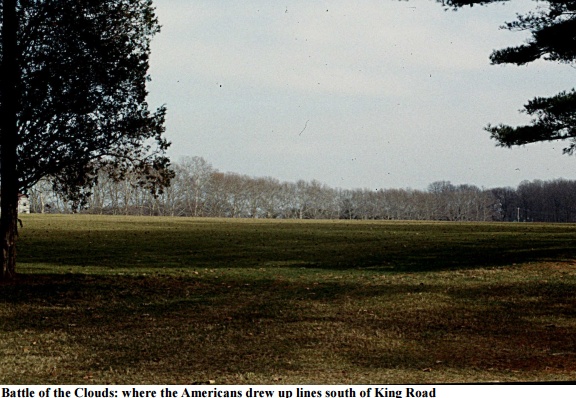
After allowing his men several days rest, on September 14th and 15th General Washington ordered his Army back toward the British forces in a 21-mile march which ended near Malvern with his troops spread over a front three miles long between Warren Tavern and White Horse Tavern. The British Army attacked on September 16th* but the engagement was interrupted by a violent storm (hence the name "Battle of the Clouds") and the American troops moved on toward Yellow Springs.

You can learn all about the Battle of the Clouds here (including an animation)** and here (including lots of modern photos) [PDF]. Unfortunately it's not clear which troops belong to Greene's Division (but if it maintained its earlier position at the back of the army, it would be comprised of the three Continental Brigades which follow the artillery into battle).


["They Passed This Way," PDF. National Park Service]


*It's pure happenstance that this is being posted today, on the 238th anniversary of the Battle of the Clouds.
**These links also include information about the Battle of Paoli, also known as the Paoli Massacre, but the Continental soldiers involved were in Major General Anthony Wayne's Division so it's highly unlikely that Abraham Heath was present.


© 2015 Copyright, Christine Manczuk, All Rights Reserved.

Friday, September 11, 2015

Fantastic Find: Revolutionary War Soldier Owen Madden's Songbook

You may have noticed that there was a fifer and drummer in my ancestor Abraham Heath's company of the 6th Virginia Regiment.


To better understand the vital role of these musicians, you can read what historian John U. Rees has to say on the subject here.

"The position of a fifer or drummer was not necessarily an easy one to fill. They were expected to learn the many tunes played in the army, from popular melodies like "Roslyn Castle" to practical beats such as "Water Call" or "Roast Beef." In an eighteenth century army music was used to transmit orders and to regulate the daily routine of the soldiers. In camp the reveille and tattoo denoted the beginning and end of the soldier's day. Other calls signaled the men to assemble for meals or for detachments to gather wood and water. If the army was ordered to march the routine of the troops prior to setting off, and the accompanying music, was adjusted accordingly. While on the move music provided a cadence to regulate the rate of march, and in battle drums and fifes could transmit or supplement the commands of the officers and would hopefully bolster the morale of the soldiers to some degree."

The Museum of the American Revolution has added a number of video in which their intern Matt Skic plays his fife along to a tunebook in their collection that was owned by Owen Madden, a fifer in the 3rd New York regiment.


[Scale Pages]


[Peggy's Brandy]

[Putman's Height]

[The 7 Stars]


[Boston March]


While I can't guarantee that the 6th Virginia Regiment's fifer Reuben Tucker played any of these tunes, it's great to hear the sort of sounds that Private Heath and his fellow soldiers would have heard daily.

© 2015 Copyright, Christine Manczuk, All Rights Reserved.

Gone for Soldiers: Abraham Heath (About 1740 - 1807), Soldier (Part III)

On this, the 238th anniversary of the Battle of Brandywine, I'm paying tribute to my ancestor Abraham Heath.

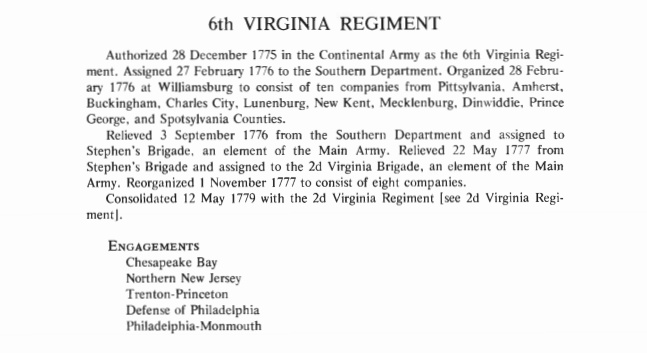
Although I believe that Abraham Heath joined the 6th Virginia Regiment at the time of its formation in February of 1776, the earliest army records that still exist for him date from April of 1777, which means that we don't have supporting documentation for his presence at the first three engagements in the list below* and as his term of service ended in February, 1778, he didn't participate in the Battle of Monmouth. In light of this, I've decided to focus on the Philadelphia Campaign. The two maps below are from Hessian and British sources.


["PhiladelCampaignHessianMap". Licensed under Public Domain via Commons - https://commons.wikimedia.org/wiki/File:PhiladelCampaignHessianMap.jpg#/media/File:PhiladelCampaignHessianMap.jpg]

[Progress of the army from their landing till taking possession of Philadelphia.Library of Congress Geography and Map Division Washington, D.C.]
The first meeting between General Howe's forces and those of General Washington was on September 11th at Chadd's Ford on the Brandywine River (or Creek, take your pick) where the Continental Army attempted to block the British advance on Philadelphia. The videos below explain what happened on the day that saw the largest battle of the war.


[Overall Battle of Brandywine Map]

[2nd Virginia Brigade]


Private Heath's regiment was assigned to the 2nd Virginia Brigade under General George Weedon in May of 1777, and the Brigade, whose initial position in the line of battle facing is shown above, was part of Major General Nathanael Greene's division. At the end of the day Greene's forces were the last to leave the field, having delayed the British assault long enough to enable the rest of the Continental Army to retreat after their defeat. Although Washington's army had lost the battle, the British had not managed to destroy it.


My question is: Was my ancestor present at the Battle of the Brandywine? From the payroll of the 6th Virginia Regiment for September of 1777, we can see that Abraham Heath (#29) received his pay for the month and wasn't listed as a casualty. Although he was listed as sick in earlier reports, it's my understanding that a sick soldier typically remained with his company (unless he was hospitalized) so I think there's a good chance that Abraham stood beside his fellows facing the oncoming enemy troops at the end of that long, hot day.


The British Army hadn't succeeded in its efforts to crush the rebellion at the Brandywine and would face the Continental Army again. I'm going to try to sort out where my paternal fifth great grandfather Abraham Heath might have been in future posts.


Note: More on the Philadelphia Campaign here, and for an over-view of the entire Revolutionary War, the National Park Service has a day-by-day calendar. If you ever find yourself in the area, here are driving tours of the battleground.

*6th Virginia Regiment information taken from The Continental Army by Robert K. Wright, Jr. available as a PDF at the U.S. Army Center of Military History here.

© 2015 Copyright, Christine Manczuk, All Rights Reserved.