Tuesday, October 7, 2014

Talented Tuesday: Marvel Skeels

Marvel Skeels (1901-1989) was my grandfather's 1st cousin (and my 1st cousin 2x removed).  She was a singer and musician who was born in Oregon but went on to live and work in New York City from the late 1930's to at least the 1950's.  This is a picture of her in the late 1930's:

[Marvel Skeels, likely in New York, from my private collection]

This is her with my grandfather George Hartley and his mother Minnie (Nosler) Hartley, Marvel's aunt, who were on a tour of the East Coast.  Marvel's mother was Minnie's sister, Alberta Evaline "Birdie" (Nosler) Skeels.

[Minnie (Nosler) Hartley, Marvel Skeels, and George Hartley, likely New York in the late 1930's.  Marvel and George are referred to as "two fine lads" which seems an inside joke.]

After she had retired to San Diego she taught me to play piano when I was young.  This is one of those cases where I could just kick myself now for never having asked her anything about her life.  Ah, the selfishness of youth.  She was a great teacher and very nice lady, if a bit of an enigma.  She held class in her immaculate apartment, and in her bedroom she had a large poster of a Hindu spiritual leader or yogi (I don't remember the name).  I have found records of her traveling to Europe in 1936, but now I wonder if she ever made the trip to India?   Her father William Nosler had been a Methodist Episcopal minister among other things, and I don't know if she had rejected that religion or just included the spiritual guru in her life?

© 2014 Copyright, Christine Manczuk, All Rights Reserved.

Monday, October 6, 2014

Mappy Monday: A Few Resources for County Boundary Changes

Geography and maps are an integral part of genealogy.  My own huge colonial American ancestry makes understanding British and American political boundaries necessary, in particular county boundaries and how they have changed over time.

My first exposure to a work dedicated to county boundary changes in the United States was William Dollarhide's classic Map Guide to the U.S. Federal Censuses, 1790-1920.

[cover as seen on Amazon.com's page]

Created primarily to use in conjunction with each of the federal censuses during that time period, this book is great for anyone wishing to visualize the growth of the United States and the individual counties.  Knowing where your ancestors lived helps you locate additional information about them, and oftentimes you can locate records about a place in 2 different counties, either because one county was shaved off a larger "parent" county, or because of their past or present proximity to each other.

The maps in this book show at a glance why your ancestors could stay in the same place over time and yet change counties.  It also shows how it would be impossible for your 4th great grandfather to have been born in Sac County, Iowa in 1790, as that county (and state) hadn't been created yet.  Well, they may have been born at the exact present location of Sac County, Iowa if they were Native American or possibly French, but then it would have been called something else.

Is the date range from 1790-1920 too limited for your research?

The MAPofUS Historical Atlases and Maps of U.S. and States is an online source of maps that includes not only the US maps from 1790-1920, but also includes British colonial boundaries in America.  Each state has "rotating animated maps" that can go back to the 1600's in the eastern states like Virginia.  There is also a selection of David Rumsey maps for each state.


© 2014 Copyright, Christine Manczuk, All Rights Reserved.

Monday is for Mothers

The young woman in this heavily retouched portrait is my maternal great great grandmother Elizabeth Taylor* who was born in Ohio, possibly Cincinnati, around 1845.

By 1856 she and her family had moved to Washington County, Iowa, where she married George Marion Tomlinson on Christmas Eve in 1860.

Her only child, my grandmother Rufina Ellen Tomlinson, was born on 13 January 1863 and that's the last indisputable fact we have about Elizabeth.

When George Tomlinson registered for the draft in July of 1863 he is listed as married so we can infer that his wife was still living. He married again in 1866 and didn't move to Colorado (where this photograph was done) until sometime after 1885.

Everything we know about Elizabeth comes from two U.S. Censuses (1850 and 1860), one Iowa State Census (1856) and her marriage record. She probably died before her 21st birthday and we've had no luck finding a death or burial record for her.

So you can imagine how exciting it was to find this portrait of her!

*Which of course makes her my daughter Christine's 3x great grandmother.

Photograph courtesy of Olive Kennedy.

© 2014 Copyright, Christine Manczuk, All Rights Reserved.

Saturday, October 4, 2014

Book Shelf: Letters from Alabama

In 1838 a young British naturalist named Phillip Henry Gosse traveled to Dallas County, Alabama, to study the flora and fauna there (especially the insects). He supported himself by teaching the children of local planters in their log cabin schoolhouse in a forest clearing. While much of the book is dedicated to the plants and animals he saw, there are also some vivid descriptions of life on the frontier, not all of them flattering.

He stayed in Alabama for about eight months and published "Letters from Alabama" in London in 1859.

While I don't have any ancestors who lived in Dallas County, my fourth great grandfather Henry Avery had moved to Alabama by 1819 and died in Bibb County in 1836. I feel certain that his style of life wasn't that much different from Gosse's neighbors.

It's possible to get a copy of this book from many vendors, including Amazon.com, but it's also available as a Google book for free.


© 2014 Copyright, Christine Manczuk, All Rights Reserved.

Friday, October 3, 2014

Famous Friday: Thomas Warren, the House of Burgesses, and the Warren House

What were you doing when you were 22?

My 8th great grandfather, Thomas Warren (abt 1625 - 1670), became a member of the House of Burgesses in Jamestown, Virginia, on 1 Oct 1644, at the age of 22 [1].  He would go on to serve at numerous times in 1645, 1658-59, 1662-1663, and 1666. [2]   His ability to reach this office at such a young age was no doubt due to his family's gentry status back in his native Kent, England.

The House of Burgesses set a crucial tradition for a popularly elected legislative (law-making) assembly in the English colonies early on.  The Virginia government in Thomas Warren's time was somewhat recognizable as it took a similar arrangement the Federal Government and the various states have today:
  • a Governor, 
  • the Governor's Council (precursor to today's Virginia Senate as well as the Virginia Supreme Court), and
  • the House of Burgesses (precursor to the Virginia House of Delegates),
or in other words,
  • Governor
  • State Supreme Court
  • State Senate
  • House of Representatives.
In fact, later members of the House of Burgesses include George Washington, Thomas Jefferson, and Patrick Henry [3].  Their experiences in this body helped shape their ideas and views on governance, and greatly informed their decisions on the structure of the new government of the United States [4].

There is a place called the Warren House on Smith's Fort Plantation (.pdf map), across the river from Jamestown in Surry County, Virginia.  It was long thought to have been built and occupied by Thomas Warren, but evidence in the 1930's indicated the house that now stands was built sometime in the 1760's and was originally inhabited by the Surry County Clerk, Jacob Faulcon.
From what I gather Thomas Warren did buy land in that spot around 1651 from Thomas Rolfe (famous son of Pocahontas) [5], but no structure of his making and habitation is left to visit.


[1] Boddie, John Bennett. 1966. Colonial Surry. Baltimore: Genealogical Pub. Co., 67.
[2] Ibid.
[3] Gottlieb, M. S. House of Burgesses. (2012, November 6). In Encyclopedia Virginia. Retrieved from http://www.EncyclopediaVirginia.org/House_of_Burgesses.
[4] Ibid.
[5] Boddie, John Bennett. 1966. Colonial Surry. Baltimore: Genealogical Pub. Co., 66.


© 2014 Copyright, Christine Manczuk, All Rights Reserved.

Thursday, October 2, 2014

Just Judith and Puggy: People in the 1850 Census who were born in Africa

Laura Ingalls (later Wilder) in North Hero, Redwood, Minnesota in 1875. [1]

Abraham Lincoln in Springfield, Sangamon, Illinois in 1850. [2]

Thomas Edison in West Orange, Essex, New Jersey in 1900. [3]

Iconic figures in American history.  Well documented lives.  You can look up pictures of them and read books about them.  They are known people.

I've looked up a few famous people in the US Censuses.  Marilyn Monroe, Ayn Rand.  Sometimes Ancestry.com features a few famous people to be found.  There is a whole blog, Famous Census Records, devoted to looking up famous people, and there are a multitude of TV programs devoted to famous people's ancestries.

It's a bit jarring to see these fascinating and complicated people reduced to names, facts, and figures on an impersonal census sheet.

On the other hand, there are the people largely invisible to US censuses before 1870, a large minority known more for their unwilling mass participation in the "peculiar" institution of slavery than for their various personal life stories.  Of course, most people living in the United States before the 1850 census were similarly under-represented, whether free or slave, as the 1790-1840 censuses only listed the head of household.

However, the gap between this representation of slave and free becomes stark starting with the 1850 census, where all household members are listed--except for the separate Slave Schedules, in 1850 and 1860, where the names of the slave owners were listed, and the slaves subsequently listed anonymously by age, color, and sex.

Here is an example of how my 3rd great grandfather Jesse T. S. Warren's 1850 Slave Schedule in Cotton Valley, Macon, Alabama, appeared.  You see his name, and then all the slaves.  Just look at all those empty spaces where names could should have been written!  If I had been there and asked J. T. S. what their names were he'd be able to tell me immedately.  I am still researching  J. T. S. Warren and hope (against hope) that someday I may be able to also determine who the blank-space people are listed below him, at least some of them.


[Description: Alabama, Macon, District 21. Source Information: Ancestry.com. 1850 U.S. Federal Census - Slave Schedules [database on-line]. Provo, UT, USA: Ancestry.com Operations Inc, 2004. Original data: United States of America, Bureau of the Census. Seventh Census of the United States, 1850. Washington, D.C.: National Archives and Records Administration, 1850. M432, 1,009 rolls.]

Every time I look at these schedules I feel like tearing my hair out.  The problem of slavery itself put aside, it's just aggravating knowing what a difference it would have made to researchers and genealogists to have had names penciled in each of those empty boxes.  Every last one of those people had a name.  Scholarship into wills, diaries, and other sources can sometimes tease out the identities of some of these nameless people, but most of them will remain anonymous and unknown forever.

Well, I can't conjure up the names to these people any more than the next person, but it did make me appreciate (and wonder about) the black people who DO appear in the 1850 and 1860 censuses.

I've read my share of Middle Passage accounts.  Horrendous.  It was bad enough for people who wanted to come to America to make the journey by boat, but unbelievably bad for those who didn't even want to go (or even knew where they were going).  But some people lived through it.  Who were the particular individuals who survived such a voyage?  Some of them appear, by name, in the 1850 Census.

To me, that is a kind of famous.

I'll start this week with Judith and Puggy.  No last names.  Just Judith.  Just Puggy.  They lived in Warren County, Georgia (District 90).

Judith is on line 14 below:


[Year: 1850; Census Place: Division 90, Warren, Georgia; Roll: M432_86; Page: 164A; Image: 335]

Judith is listed as 110 (!) (b abt 1740), female, black, and born in Africa (possibly S. Africa, as it looks like an "S" before the Africa).  No profession listed.  She is the only black person listed on that page.

Puggy is on line 22 below:


[Year: 1850; Census Place: Division 90, Warren, Georgia; Roll: M432_86; Page: 165A; Image: 337]

Puggy is listed as 70 (b abt 1780), female, black, and born in Africa.  No profession listed.  Everyone on the page is black (or mulatto).  Everyone around her has a last name, unlike her.

I find it interesting that both women were just listed by their first name, while everyone around them had a last name.  What significance, if any, did that have?

I obviously need to do some more research in Warren County, Georgia concerning free blacks.  Consider that this is in ante-bellum Georgia, and here are black people actually listed in 1850!  Wow.


[1] "Minnesota, State Census, 1875," index and images, FamilySearch (https://familysearch.org/pal:/MM9.1.1/MKNR-9HM : accessed 02 Oct 2014), Laura C Ingalls in household of C P Ingalls, North Hero, Redwood, Minnesota; citing p. 63, line 6, volume R - 1, State Library and Records Service, St.Paul; FHL microfilm 0565727.
[2] Source Citation: Year: 1850; Census Place: Springfield, Sangamon, Illinois; Roll: M432_127; Page: 120A; Image: 247.
[3] Source Citation: Year: 1900; Census Place: West Orange, Essex, New Jersey; Roll: 968; Page: 20A; Enumeration District: 0184; FHL microfilm: 1240968.


© 2014 Copyright, Christine Manczuk, All Rights Reserved.

Wednesday, October 1, 2014

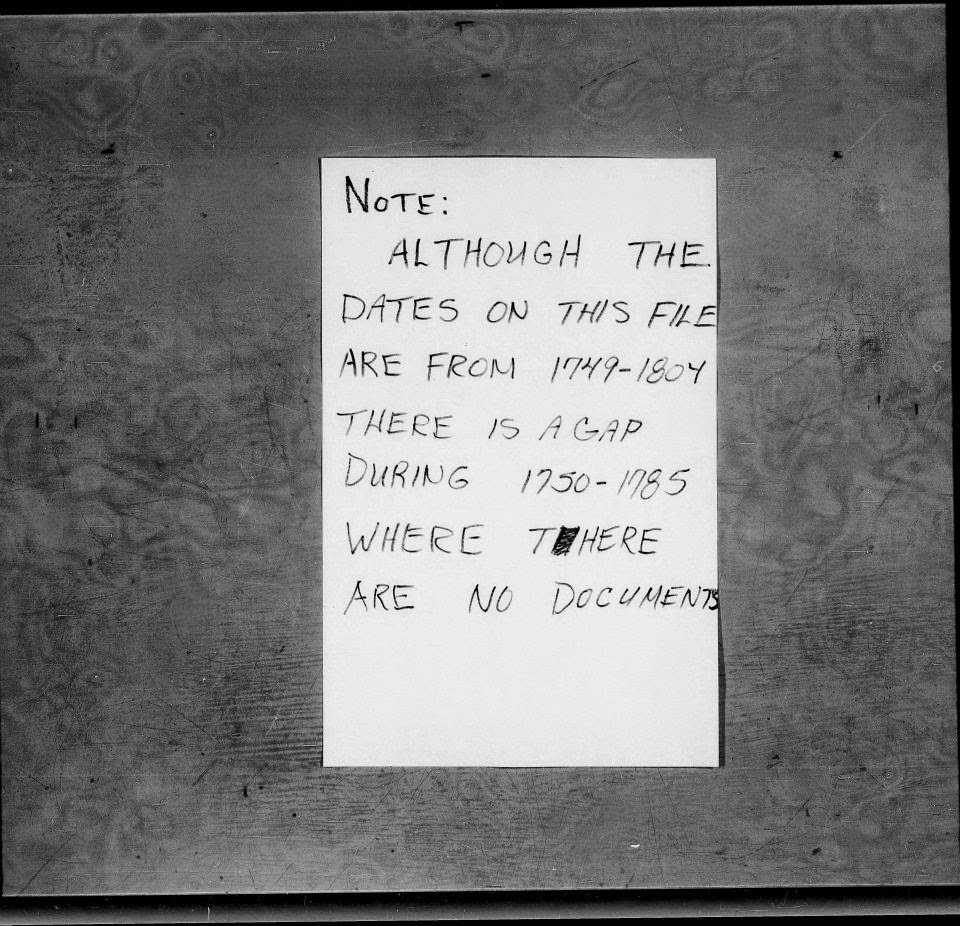
Mind the Gap!

Over the years, I've found a lot of information using FamilySearch.org, especially in their unindexed legal and probate records. But sometimes what I'm looking for just isn't there.


And of course, any records regarding the ancestor I was researching had fallen into the gap.

Source: "New Jersey, Probate Records, 1678-1980," images, FamilySearch (https://familysearch.org/pal:/MM9.3.1/TH-1971-29796-21995-69?cc=2018330&wc=MM1F-8T6%3A1259783228 : accessed 05 Nov 2013), Burlington > Miscellaneous probate records 1749-1804 file no S > images 6 through 9 of 873.

© 2014 Copyright, Christine Manczuk, All Rights Reserved.