A while back Christine posted about our ancestor John Warren Avery and the threats he received from the local Ku Klux Klan, whose members included his brothers and cousins. He received death threats after he testified before a grand jury in Oxford, Mississippi, in 1871 and removed himself and his family from Winston County as a result.
To follow up that story, here's a 1872 newspaper clipping showing how John was regarded by his neighbors in light of his actions, using epithets such as "a simon pure unadulterated scallawag of the meanest type, the double distilled quintessence of all villainy."
[9 May 1872, Page 1 - The Clarion-Ledger at Newspapers.com]
The author of this piece of invective alluded to a statement allegedly made by John's mother Mary (Thornton) Avery who,.having died on December 31, 1871, would not have been available to affirm or deny it.
Even John Warren Avery's military service as a private in the 35th Mississippi Infantry Regiment Volunteers was disparaged and his courage impugned.*
Born on October 16, 1835, in Winston County, Mississippi, John Warren Avery was the next to last child of Samuel L. Avery and his wife Mary Thornton.
John was 17 in 1853 when his father died without having made a will, so he and his younger sister Frances were given a court-appointed guardian during probate. Although Samuel had steadily increased his wealth over the years, his estate wasn't large enough to guarantee an easy life for his 12 surviving children.
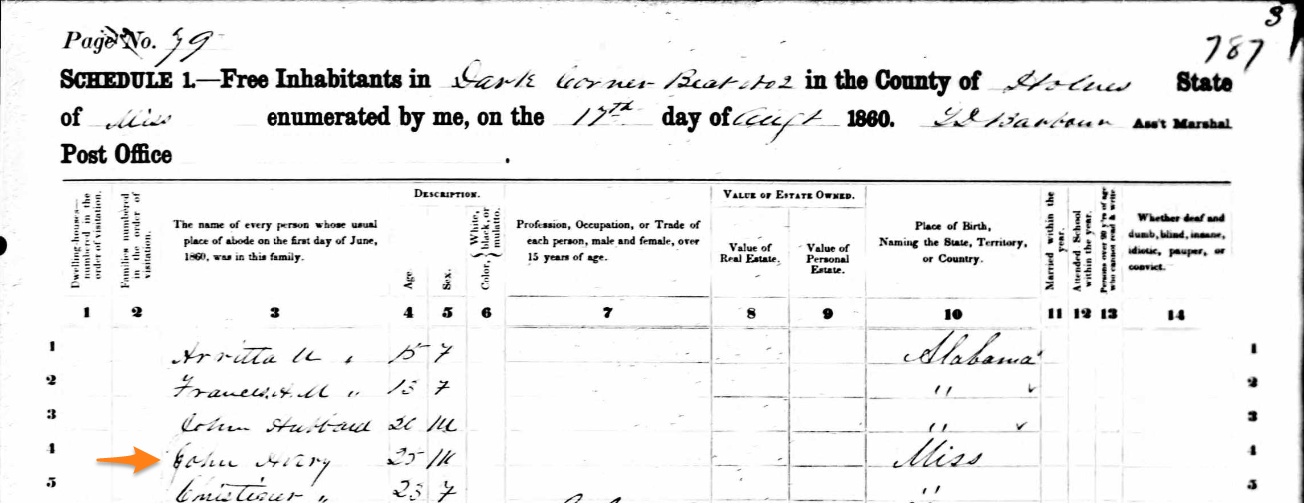
John married Celestine Letitia Herrod in 1857 and in the 1860 U.S. Census the couple were living in the household of a wealthy farmer in Dark Corner Beat in Holmes County, Mississippi, and there's no indication that either of them owned any real or personal property and no children are listed.
[Ancestry.com. 1860 United States Federal Census [database on-line]. Provo, UT, USA: Ancestry.com Operations, Inc., 2009. Images reproduced by FamilySearch. Original data: 1860 U.S. census, population schedule. NARA microfilm publication M653, 1,438 rolls. Washington, D.C.: National Archives and Records Administration, n.d.]
John and several of his cousins enlisted as privates in Company D* of the 35th Mississippi Infantry Regiment Volunteers on March 3, 1862, for a term of three years. The first surviving record we have of him as a soldier has him listed as "Present Sick."
[Source: Fold3]
The 35th Mississippi fought in the Battle of Corinth on October 3-4, 1862. The regiment's losses in this Union victory were 32 killed, 110 wounded, and 347 missing but John wasn't one of them.
[Battle of Corinth--Oct 3 & 4 1862--Union (Gen. Rosecrans). Loss: Gen. Hackleman, Kirby Smith ... Conf. (Gen. Van Dorn). Loss: Col. Rogers ...Contributor Names: Kurz & Allison. Created / Published: c1891. Library of Congress Prints and Photographs Division Washington, D.C. ]
[Ancestry.com. U.S., Civil War Prisoner of War Records, 1861-1865 [database on-line]. Provo, UT, USA: Ancestry.com Operations Inc, 2007. Original data: Records of the Commissary General of Prisoners, Record Group 249; National Archives, Washington, D.C.Selected Records of the War Department Relating to Confederate Prisoners of War, 1861-1865; (National Archives Microfilm Publication M598, 145 rolls).]
Library of Congress Prints and Photographs Division Washington, D.C.]
Although the 35th Mississippi Regiment was part of the Confederate troops defending Vicksburg during Grant's siege of 1863, John's name isn't on the list of paroled soldiers and it appears that he was on leave after his release from Alton.**
[Source: Fold3]
By the end of the year John was back with his regiment (which had been reorganized after the Confederate surrender of Vickburg on July 4th), but in May of 1864 he spent nearly a month in the C.S.A. Hospital in Jackson, Mississippi.
[Source: Fold3]
[Source: Fold3]
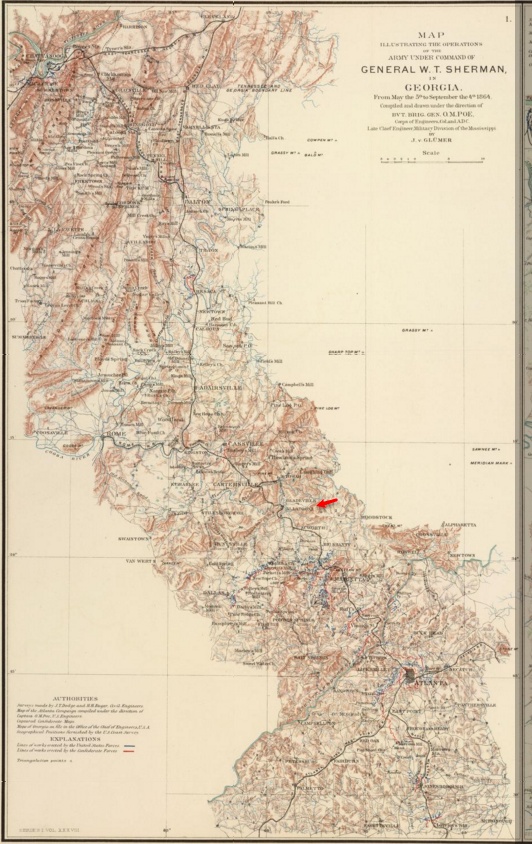
The 35th Mississippi took part in the Atlanta Campaign from May through September, 1864, during which the Confederate Army vainly tried to halt the advance of Union forces commanded by General William T. Sherman. After they were compelled to evacuate Atlanta during the night of September 1-2, Confederate General John Bell Hood ordered his men to destroy tracks along the Western & Atlantic Railroad that was bringing supplies into Atlanta from the north. After some early successes, on October 5th Confederate troops, including the 35th Mississippi, attempted to block Allatoona Pass, capture the large amount of rations stored near there and destroy the bridge at Etowah. In the bloody battle that ensued the Rebels were unable to overpower the Union defenses and according to William T. Lewis, author of The Centennial History of Winston County, MS. (1876), Private John W.Avery was wounded and captured there.
[Atlas to accompany the official records of the Union and Confederate armies. Published under the direction of the Hons. Redfield Proctor, Stephen B. Elkins and Daniel S. Lamont, secretaries of war, by Maj. George B. Davis, U.S. Army, Mr. Leslie J. Perry, civilian expert, Mr. Joseph W. Kirkley, civilian expert, Board of Publication. Compiled by Capt. Calvin D. Cowles, 23d U.S. Infantry. Washington: Government Printing Office, 1891-1895. Source: David Rumsey Historical Map Collection.]
[Detail of another section of the above map showing Allatoona and Etowah]
[Allatoona Pass, looking south (1861-1864 / Barnard, George N., 1819-1902, photographer. Library of Congress Prints and Photographs Division Washington, D.C.]
[Battle of Allatoona Pass / Artist: Thure de Thulstrup (1848-1930). Creator(s): L. Prang & Co., Date Created/Published: Boston : L. Prang, c1887 Dec. 19. Library of Congress Prints and Photographs Division Washington, D.C.]
I have not found any military records for John after Allatoona so we don't know where he was held as a P.O.W. but we have an overview of his wartime service from his indigent 80-year-old widow Celestine's pension application in 1916 which stated his regiment was paroled at Citronelle, Alabama, on May 4, 1865, the date of the last surrender of the Confederate Army east of the Mississippi.***
Although my great great grandfather John Warren Avery's father Samuel had been a relatively successful planter, John was a poor man going into the war and he remained poor the rest of his life.**** Based on information from post-war census records, he worked as a farm laborer for others. There's no suggestion that he ever owned any land himself.
Further resources:
Overview of Mississipians in the Civil War here.
Company D, (Fort Donelson Avengers), 35th Regiment, Mississippi Infantry here [PDF]
More on the Battle of Alatoona here.
Watch a lecture on Civil War POWs:
[Dan Welch of the Gettysburg Foundation presents his Winter Lecture at Gettysburg National Military Park, 2014]
*They called themselves "The Fort Donelson Avengers" in response to the previous month's unconditional surrender of that Tennessee fort to Union troops commanded by Brigadier General U.S. Grant.
**His second child, daughter Lilla , was born in 1864 so John must have spent time at home recovering his health before returning to the army.
***Prisoner exchanges had been halted in early 1864, it's almost certain he remained in a military prison until after the surrender.
****Historically the Averas/Averys appear to have been a well-to-do family. Samuel's brother Henry William Avery was worth nearly $100,000 in 1860 and he will still wealthy at his death in 1873 when he left his estate to be divided equally among his seven siblings and their heirs. While some of his heirs received substantial amounts of money because Samuel had had so many children, John's share came to $87.50 out of which he had to pay the lawyer he hired to act on his behalf. But we do have his signature from the power of attorney he signed.
["Alabama Estate Files, 1830-1976," database with images, <i>FamilySearch</i> (https://familysearch.org/pal:/MM9.3.1/TH-1942-23164-61290-82?cc=1978117 : accessed 2 March 2016), Bibb > Avery, Henry, Sr. image 36 of 149; county courthouses, Alabama.]
This paternal third great grandfather was born in Cumberland County, North Carolina, but grew up across the border in Chesterfield County, South Carolina, where his family moved when he was very young.
[In 1814 Chesterfield was in the Cheraw District (outlined in blue in this map). The State of South Carolina: from the best Authorities, By Samuel Lewis. W. Barker, sculp. Source: David Rumsey Historical Map Collection.]
And that's where Samuel L. Avery and Mary Thornton were married on June 18, 1808. Two years later he appears at the top of the first of these two pages from the 1810 U.S. Census. (Note that his surname is spelled Avera here; the shift to using Avery appears to have occurred a few years later.)
[Year: 1810; Census Place: Chesterfield, Chesterfield, South Carolina; Roll: 60; Page: 571; Image: 00293; Family History Library Film: 0181419. Ancestry.com. 1810 United States Federal Census [database on-line]. Provo, UT, USA: Ancestry.com Operations, Inc., 2010. Images reproduced by FamilySearch. Original data: Third Census of the United States, 1810. (NARA microfilm publication M252, 71 rolls). Bureau of the Census, Record Group 29. National Archives, Washington, D.C.]
Sources* agree that Samuel, together with two of his younger brothers, Thomas and William, served as privates in the 3rd (Alston's) South Carolina Militia. during the War of 1812. Here's a general description of the role played by South Carolina's troops:
"The troops in the War of 1812 were basically of two kinds - the regular army, known as regulars, and the militia. The regulars were entirely volunteers. All men belonged to the militia, but not all militias were called into service. Those who were actually enrolled were known as the detached militia; they were obtained preferably by volunteers from the total militia or by conscription if not enough volunteered. The militia in the past had been thought of as a body of men only used for home defense, but in the War of 1812 they were not only used at home but were also sent out of the state to aid at other danger points."
Samuel's name is also on the 1814 muster rolls for Craven County, South Carolina, but it appears that he could afford to hire a substitute.
[Section: Muster roll of the detached militia, organized in August, 1814. Ancestry.com. Muster rolls of the soldiers of the War of 1812 : detached from the Militia of North Carolina in 1812 and 1814 [database on-line]. Provo, UT: Ancestry.com Operations Inc, 2005. Original data: Muster rolls of the soldiers of the War of 1812 : detached from the Militia of North Carolina in 1812 and 1814. Raleigh, N.C.: C.C. Raboteau, 1851.]
[Pitt County Genealogical Quarterly, August 1996, page 4. Copyright Pitt County Family Researchers. This item is presented courtesy of Farmville Public Library for research and educational purposes only.]
Department of the Army Pamphlet, Leonard L. Lerwell, 1954. (PDF)]
By 1819 the Avery family had left South Carolina for Alabama and moved on to Winston County, Mississippi, by 1835 where my great great grandfather John Warren Avery was born.
This paternal third great grandmother was born in North Carolina in 1793, probably in Moore County which had been created out of Cumberland County in 1785. Her parents were Sarah* and James Thornton; Mary was their third child and oldest daughter.
[The State of North Carolina, Carey's American Atlas: Containing Twenty Maps And One Chart ... Philadelphia: Engraved For, And Published By, Mathew Carey, No. 118, Market Street. M.DCC.XCV. (Price, Plain, Five Dollars-Coloured, Six Dollars.)
Source: David Rumsey Historical Map Collection.]
By 1807 the Thornton family had moved just south of the state border to Chesterfield County, South Carolina, and that's where Mary and Samuel L. Avery were married on June 18, 1808.
[South Carolina. Drawn by S. Lewis. Engd. by D. Fairman. (Boston: Published by Thomas & Andrews. 1812)
Source: David Rumsey Historical Map Collection]
Samuel served as a private in Alston's 3rd Regiment South Carolina Militia sometime during the War of 1812. (Unfortunately I haven't been able to learn when and where his service took place.)
The young couple stayed in Chesterfield County, where their four oldest children were born, until about 1819 when they moved to Greene County, Alabama, which had just been established on the eastern border of Choctaw lands by the territorial legislature. Their next five children were born there.
By 1830 the family had relocated to Marengo County, just south of Greene (and part of the fertile "Black Belt" of Alabama) where two more children were born.
But their travels weren't over yet--sometime after 1833 the Averys moved to Winston County, Mississippi, where my direct ancestor John Warren Avery was born on October 16, 1835. his younger sister, born two years later was Mary and Samuel's last child.
The 1850 U.S. Census is the first one that named all the (free) members of the household. Samuel and Mary still have four children living at home with them, including John. The family has prospered; Samuel is claiming ownership of $4,000 worth of real estate.
[Year: 1850; Census Place: Winston, Mississippi; Roll: M432_382; Page: 363B; Image: 739. Ancestry.com. 1850 United States Federal Census [database on-line]. Provo, UT, USA: Ancestry.com Operations, Inc., 2009. Images reproduced by FamilySearch. Original data: Seventh Census of the United States, 1850; (National Archives Microfilm Publication M432, 1009 rolls);
Records of the Bureau of the Census, Record Group 29; National Archives, Washington, D.C.]
After Samuel died intestate on Marcy 27, 1853, his widow filed a petition in the Winston County Courthouse to claim her dower rights** which were granted to her.
["Mississippi Probate Records, 1781-1930," images, FamilySearch (https://familysearch.org/pal:/MM9.3.1/TH-1961-31024-8379-38?cc=2036959 : accessed 30 November 2015), Winston > Minutes 1834-1854 vol 1-2 > image 432 of 467; county courthouses and public libraries, Mississippi.]
And in other probate records we find that Samuel owned fourteen slaves who could not be fairly divided so the heirs were being notified that they would be sold by the estate's administrator.
["Mississippi Probate Records, 1781-1930," images, FamilySearch (https://familysearch.org/pal:/MM9.3.1/TH-1971-31024-7375-41?cc=2036959 : accessed 30 November 2015), Winston > Minutes 1834-1854 vol 1-2 > image 439 of 467; county courthouses and public libraries, Mississippi.]
Mary survived Samuel by 18 years. She continued to live in Winston County for the rest of her life.
[Year: 1860; Census Place: Winston, Mississippi; Roll: M653_594; Page: 679; Image: 161; Family History Library Film: 803594. Ancestry.com. 1860 United States Federal Census [database on-line]. Provo, UT, USA: Ancestry.com Operations, Inc., 2009. Images reproduced by FamilySearch. Original data: 1860 U.S. census, population schedule. NARA microfilm publication M653, 1,438 rolls. Washington, D.C.: National Archives and Records Administration, n.d.]
Although the Civil War and Emancipation made a great difference in her fortunes (the $3,000 in personal property in the above census almost certainly represents the value of slaves she owned), in the 1870 U.S. Census when Mary was living with the son Samuel, she owned $500 worth of real estate and $430 in personal property.
[Year: 1870; Census Place: Township 13 Range 12, Winston, Mississippi; Roll: M593_753; Page: 457B; Image: 442; Family History Library Film: 552252. Ancestry.com. 1870 United States Federal Census [database on-line]. Provo, UT, USA: Ancestry.com Operations, Inc., 2009. Images reproduced by FamilySearch. Original data: 1870 U.S. census, population schedules. NARA microfilm publication M593, 1,761 rolls. Washington, D.C.: National Archives and Records Administration, n.d.Minnesota census schedules for 1870. NARA microfilm publication T132, 13 rolls. Washington, D.C.: National Archives and Records Administration, n.d.]
Mary Thornton Avery died on December 23, 1871, and she and Samuel are both buried in the Golden Cemetery in Fearn Springs, Winston County, Mississippi.
*We don't know her mother's maiden name; it could be Davis or Brewer.
**You can read more about dower here.