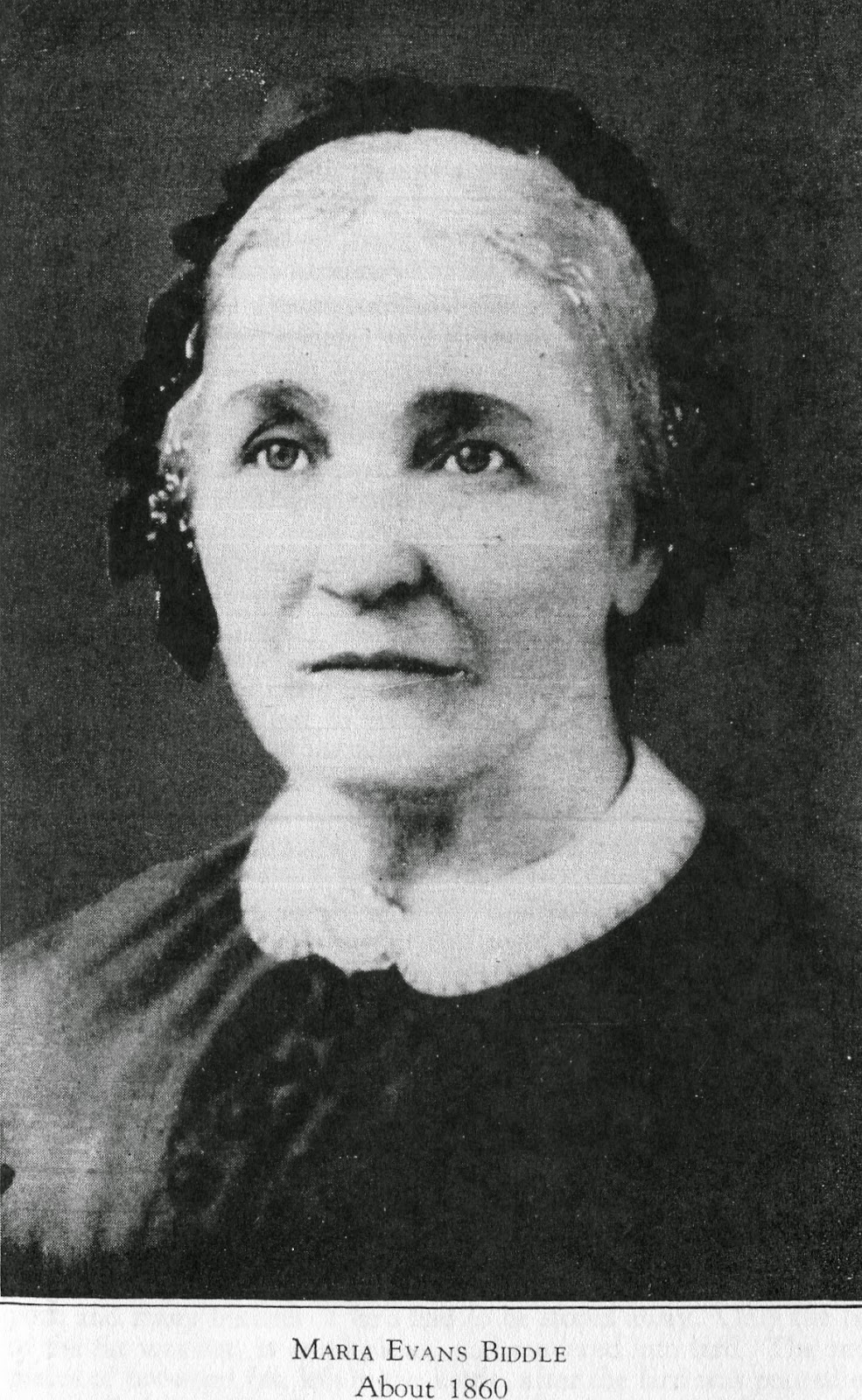
Because her granddaughter Esther Moreland Leithold wrote a book about them based on family stories, we know more about the personal life of my paternal great-great-great grandmother Maria Evans (and her husband
B.R. Biddle).
Courtesy of the Hathi Trust Digital Library (original from University of Wisconsin).]
Maria was born in
Claiborne County in northeast Tennessee in 1814 and was named her for one of her father's sisters, Mary Evans Conway, who had no children of her own. Her parents Elijah and Rutha (Holt) Evans owned an inn on the south bank of the Clinch River on the route from North Carolina to Kentucky, via the Cumberland Gap.
[Map of Kentucky And Tennessee Compiled from the Latest Authorities. Published by S. Augustus Mitchell Philadelphia. 1831. J.H. Young Sc. List No: 3884.010. David Rumsey Historical Map Collection]
Maria met her future husband, Robert Biddle* as a young girl during a visit to relatives in Grainger County where his family lived. The acquaintance was continued years later after Robert apprenticed himself to a tailor in Middlesborough, in what is now Bell County, Kentucky, staying at her father's inn on his way between there and Grainger County and Maria and Robert formed an attachment.
After his apprenticeship was over, Robert opened a tailor shop in Tazewell, the county seat of Claiborne County but the couple faced opposition to an engagement from Maria's family who considered him an undesirable mate because he was a tradesman with what Leithold terms "parents who would always be a financial burden to him."**
In what proved to be a futile attempt to distract her from her attraction to Robert, Maria was sent to
Knoxville Female Academy in 1831-1832. Leithold describes her studies there.***
"Her father thought that the expense was too great for such an unnecessary thing as an advanced education for a girl; but Aunt Mary was determined that Maria should go, and insisted on paying all of the expense herself, which was considered a large amount, at that time. The tuition, alone, was ten dollars for each session. There was no charge for room rent, but the price of board, fire wood, and candles amounted to one dollar and a half each week. Maria also took ornamental needlework, on lace and muslin, which was five dollars extra each session. All students had to recite, once a week, on the Sacred Scriptures; and Maria, who always stood at the head of that class, became so interested in Bible-study, she continued it through the rest of her life.
The first year, at the Academy, she studied Arithmetic, and Geography (with the drawing of maps and "the solution of the problems of the terrestial Globe", Rhetoric, Astronomy, and the History of Natural Philosophy.
The next year she had the same studies with an advanced teacher, and an additional five dollars tuition. The second year Astronomy, included "the solution of the problems of the Celestial Globe." There were also lectures on "Good Manners and Proper Behavior in Polite Society." Maria also took a course in Fancy Weaving and Rug Making.
The school year was divided into two sessions. The winter session of five months, began on November first and continued until March 31st; and the summer session started on the first of May and continued until September 30th; so Maria had vacation during the months of April and October, when she could visit her family and Aunt Mary."
Near the end of her school days in Knoxville Maria promised to marry her sweetheart and the couple were able to carry on a clandestine correspondence with the help of her older married sister Matilda Evans Garrett.
Robert's father Benjamin decided to move to Illinois at about this time and bought some public land in Sangamon County so Robert sold his business in Tazewell and followed his parents there, opening a tailor shop in Springfield in 1833. By the following year his business was doing well enough that he felt he could support a wife and returned to Tennessee with his mother and sister Angeline.
After his prospective son-in-law asked for permission to marry his daughter, Elijah Evans tried to persuade Maria to reconsider.****
That night Elijah Evans asked Maria if she really planned to marry Robert Biddle, and when she told him that she did, he said, "Well, Maria, I reckon Robert is a likely young man, and he has good manners; but you are a little mite of a girl, and should never have to lift and carry, like the Yankee women do. We've always had slaves to do all the hard work, and you've never even had to ready up your own room, lest you felt like it. I've heard tell that the Yankee women out there in Illinois even do their own washin' and ironin', and I don't like to think of you'r goin' there. The Biddles are great spenders too,
and people like them are most always poor. You don't know what it's like to be poor, and I don't want you to have to find out. I only want you to be happy, and the Biddles aren't our kind of folks. So I calculate you'd be better off if you'd stay here amongst your own kin. We all'd like to see you marry Jesse Hirst. He's a fine young man and could give you a good home, near your own folks, but if you won't have him, why can't you take one of the other men who've asked if they could court you? They're our kind of people, and any one of them would make you a good husband."
Maria told him that Jesse Hirst was just like one of her own brothers, and she could never think of marrying him, even though he was really no blood relation, and most of the other men he spoke of were almost as old as he, and she couldn't marry a man as old as her father. Even though most girls married men much older than they were, she was sure she would be happier with some one nearer her own age. At last he said, "Well, Maria, my little one, you are past eighteen and can do as you please. I want to see you happy, and will never give my consent for you to marry Robert Biddle, for I'm sure you'll be sorry if you do."
With her father away from home, on May 3, 1834, Maria and Robert were married by the local preacher in the presence of her mother and sister. Later that day the bride and groom set out for Illinois and their new life together.
To be continued.
*
Benjamin Robert "B.R." Biddle (1808-1882)
**And they were right. His parents, Benjamin and
Polly Capell Biddle had already squandered a considerable estate in Southampton County,Virginia, before moving west to Tennessee. Benjamin's paltry inheritance from his mother is discussed
here.
***
And this is our heritage, page 32.
****And this is our heritage, page 41.
© 2016 Copyright, Christine Manczuk, All Rights Reserved.