Showing posts with label New Orleans. Show all posts

Wednesday, May 9, 2018

Gone for Soldiers: Josiah Haralson Freeman (1897 - 1950), Sailor

He was born in rural Morgan County, Georgia, which is nowhere near the ocean but Josiah chose to enlist in the U.S. Navy in 1917.

[Ancestry.com. Georgia, World War I Service Cards, 1917-1919 [database on-line]. Provo, UT, USA: Ancestry.com Operations, Inc., 2013. Original data: Georgia Adjutant General’s Office. World War I Statements of Service Cards. Georgia State Archives, Morrow, Georgia.]

I found a photograph of his ship, the U.S.S. San Francisco, at the Library of Congress.
[U.S.S. San Francisco. Detroit Publishing Company photograph collection (Library of Congress)]

He must have found life at sea attractive because four months after his discharge from the Navy he applied for his Seaman's Protection Certificate in New Orleans.*

*You can see a picture of Josiah (who is my second cousin, twice removed) in this earlier post.

© 2018 Copyright, Christine Manczuk, All Rights Reserved.

Monday, January 8, 2018

My Connection to the Battle of New Orleans: William T. Slater (About 1794 - 1847)

Today marks the 203rd anniversary of the famous battle won by American forces under the command of Andrew Jackson. That didn't affect the outcome of the War of 1812 because a peace treaty had already been signed although the news hadn't reached either army in the field. The victory made Jackson wildly popular and led to his eventual election as our seventh President in 1828.

[The battle of New Orleans for the piano forte; Composer P. Ricksecker. Published and sold at G. Willig's Music Store, 1816.
Source: Library of Congress]

According to Slater family stories shared by my cousin Sue, William T. Slater, our maternal third great grandfather, was part of the British invasion forces. It's been assumed that he was a sailor because the legend is that he deserted by going over the side of the ship. We know he was from Yorkshire, but Slater is a very common name and I haven't been able to find any convincing records of him in British archives.

He's the most recent of my foreign born ancestors--all the others seem to have gotten here well before the American Revolution.

[Ancestry.com]


© 2018 Copyright, Christine Manczuk, All Rights Reserved.

Sunday, January 8, 2017

Gone for Soldiers? Sailors? Marines? William T. Slater (About 1794 - 1847)

This morning the Library of Congress* reminded me that today is the 202nd anniversary of the Battle of New Orleans. Family history gives this date (or sometime near it)** as the moment when one of my maternal third great grandfathers Yorkshireman William T. Slater*** decided he didn't want to be English any more.

[Battle of New Orleans…the 8th of January 1815. William Edward West, artist; Philadelphia: Published and sold by J. Yeager, engraver, [1817]. Popular Graphic Arts. Prints & Photographs Division]

Three years later he was applying for citizenship in Jefferson County, Indiana.

*Through their Digital Collections' Today in History which is my home page.
**You can find an excellent overview of the War of 1812 leading up to the two-month long campaign now known as the Battle of New Orleans here. I had never considered the terrain my great great great grandfather faced upon leaving his post, but this National Park Service photo of a Louisiana bayou included by the author makes it clear that it must have been daunting--even without taking into account the wildlife that's found there.


[Alligator crossing the road, Jean Lafitte National Park
Both photos courtesy of the National Park Service]

And he wouldn't have had the benefit of the safety information currently distributed by the Park Service--an example:
Think like an alligator. Alligators are surprisingly fast: on land they can move quickly over short distances and in the water they're unstoppable. Remember to keep your distance and stand tall. Alligators judge their prey by its size, and if you are kneeling down to take a picture, you're a much more tempting target than if you're standing up.
***Allegedly part of the British invasion forces, you can read more about William T. Slater in my original post and see what more Christine was able to find out about him here.

© 2016 Copyright, Christine Manczuk, All Rights Reserved.

Wednesday, August 3, 2016

Gone for Soldiers: Willet Orlando "Richard" or "Dick" Worden (1843 - 1912), Soldier, U.S. - Part 7

After the fall of Vicksburg on July 4, 1863, Dick Worden and his comrades of the 24th Iowa Infantry in General Hovey's Division formed part of General Sherman's forces at the Siege of Jackson* which took place from August 9th until the morning of the 17th when it was discovered that Confederate troops had abandoned the city.

[Map of the Siege of Jackson, Miss. Source: Library of Congress]


[From Personal memoirs of U. S. Grant by Grant, Ulysses S. (Ulysses Simpson), 1822-1885. Source: Internet Archive]

After Jackson's second fall, according to its regimental history the 24th Iowa
"was transferred to the Department of the Gulf, and put in much of the fall and early winter in marches in various directions, without apparent aim or result."
The transfer entailed being transported downriver to New Orleans where on August 23, 1863, Dick Worden received a disability discharge from the Army and returned home to Iowa.**

For the moment at least, his war was over.


*Jeff T. Giambrone's blog Mississippians in the Confederate Army has an excellent detailed description of the two battles for Jackson here.
**To date I haven't been able to discover what disability my great great grandfather suffered that led to his discharge.


© 2016 Copyright, Christine Manczuk, All Rights Reserved.

Wednesday, November 25, 2015

Working on Wednesday: William T. Slater (About 1790? - 1847), Deserter, Farmer, Justice of the Peace

Up until 1818 when William Slater applied for naturalization in Jefferson County, Indiana, all the information we have about this maternal 3rd great grandfather comes from family stories that I haven't been able to verify.*

According to Slater family lore, William first arrived in the United States on a ship that was part of the British invasion fleet that attacked New Orleans in 1814-15, and at some point he went over the side of the ship and never looked back.

It's been presumed that William was a sailor in the Royal Navy but I think it's possible that he could have been a marine or a soldier in the British Army.**

[Painting depicting the Naval Battle of Lake Borgne, Louisiana, between U.K. and U.S. forces in the War of 1812, by Thomas L. Hornbrook (active 1836-1844). (Image Courtesy of the U.S. Naval Academy Museum, Annapolis, Maryland.) Found on Naval History Blog. ]

We can't find him in the 1820 U.S. Census but on July 20th of that year he married (Emily) Jane Wilson in Crawford County, Indiana, and the couple's eight oldest children were born in that state. By 1830, they were living in farther west in Pike County.

[1830; Census Place: Jefferson, Pike, Indiana; Series: M19; Roll: 26; Page: 373; Family History Library Film: 0007715. Ancestry.com. 1830 United States Federal Census [database on-line]. Provo, UT, USA: Ancestry.com Operations, Inc., 2010.  Images reproduced by FamilySearch. Original data: Fifth Census of the United States, 1830. (NARA microfilm publication M19, 201 rolls).
Records of the Bureau of the Census, Record Group 29. National Archives, Washington, D.C.]


But their ninth child, my great great grandfather George W. Slater (1832-1899), was born in Illinois, signalling the family's move to Lawrence County*** where they remained through 1840. (Their last two children were born there also.)


[Year: 1840; Census Place: Lawrence, Illinois; Roll: 63; Page: 171; Image: 345; Family History Library Film: 0007643. Ancestry.com. 1840 United States Federal Census [database on-line]. Provo, UT, USA: Ancestry.com Operations, Inc., 2010. Images reproduced by FamilySearch. Original data: Sixth Census of the United States, 1840. (NARA microfilm publication M704, 580 rolls).
Records of the Bureau of the Census, Record Group 29. National Archives, Washington, D.C.]


By 1843 the Slaters had moved again, this time in the northeastern corner of South Audubon Township in Montgomery County, Illinois. Three years later William was elected the first Justice of the Peace so he must have been a respected citizen.

[History of Montgomery County, Illinois, Illustrated Atlas Map Of Montgomery County, Ill. Carefully Compiled from Personal Examinations and Surveys. 1874. Published by Brink, McCormick & Co., of Illinois. Duval & Hunter, Lithographers, Philada, Pa.
Source: David Rumsey Historical Map Collection.]


William T. Slater died in 1847; his place of burial is unknown.

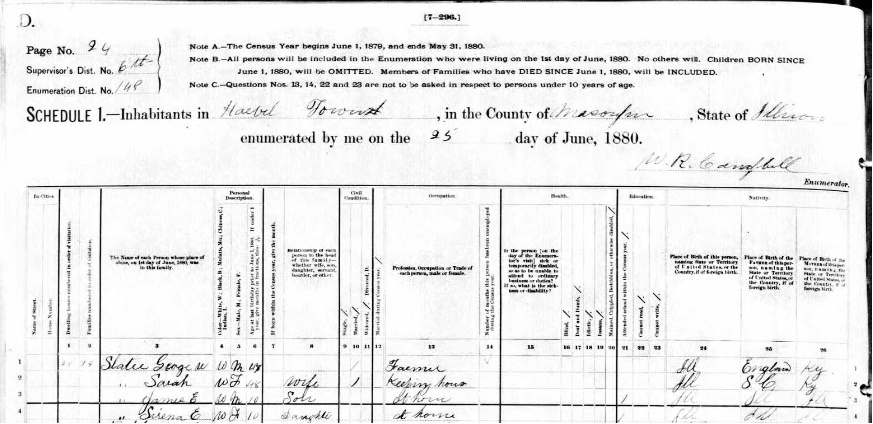
Family tradition has one more bit of information about William, asserting that he was born in Yorkshire. Unfortunately there are a lot of Slaters in Yorkshire so that hasn't helped locate a birth record for him. As this 1880 U.S. Census record shows, his children list his place of birth as "England."

[Year: 1880; Census Place: Harvel, Montgomery, Illinois; Roll: 237; Family History Film: 1254237; Page: 283D; Enumeration District: 149; Image: 0567. Ancestry.com and The Church of Jesus Christ of Latter-day Saints. 1880 United States Federal Census [database on-line]. Provo, UT, USA: Ancestry.com Operations Inc, 2010. 1880 U.S. Census Index provided by The Church of Jesus Christ of Latter-day Saints. Original data: Tenth Census of the United States, 1880. (NARA microfilm publication T9, 1,454 rolls). Records of the Bureau of the Census, Record Group 29. National Archives, Washington, D.C.]


*Yet. (But not for lack of trying.) And we're assuming that he didn't change his name after his unauthorized departure from the Royal Navy.
**I didn't grow up as a Slater and I've only heard this story once, from my cousin Susan. If the belief that William was a sailor is based on his desertion by "going over the side" that doesn't take into account the fact that all Royal Navy ships had marines on board or that the British Army troops had all arrived by ship too.
***Where William's father-in-law John Wilson had bought land in 1825.


© 2015 Copyright, Christine Manczuk, All Rights Reserved.