Showing posts with label Nosler. Show all posts

Wednesday, October 3, 2018

RePost from 2015: Tip: Don't Just Rely on the Search Function When Using Newspaper Databases

"Dehesa Doings," San Diego Union (San Diego, CA), p 5, col 4, 8 Aug 1892; digital image, GenealogyBank.com (http://www.genealogybank.com: accessed 17 Oct 2015).

The info above was found doing a "Hartley" search.  Since newspapers often had recurring columns I thought to search "Dehesa Doings" to possibly find other tidbits in other issues.  But instead I got this:

Oh, come on, I just found Dehesa Doings three minutes ago!
I am assuming the optical character recognition just doesn't read it as Dehesa Doings (and who knows what it thinks it says).  While it may not be an ongoing column like I thought, the term "Dehesa Doings" DOES appear at least once for sure!  So what should I do?

I went page by page through other issues close in time to this one.  This is a bit tedious, but not only can it help you catch information missed by OCR, it also gives you a feel for what the newspaper was like and what kind of information you can realistically expect to glean from it.

Unfortunately I haven't found a graceful way to search newspapers this way on GenealogyBank, as they don't provide an easy way to browse papers--you have to search through them, which is different.  So I narrowed down to the specific paper I wanted, and then typed in a date range (in this case San Diego Union and August 1892--alternately, you could just type in a specific day and year):


Then I ordered by Oldest (you an order by Oldest, Newest, and Best):


Note the varying quality of the scans, even in one issue (in this case, all the results in this screenshot are from the August 1, 1892 issue).
No wonder the OCR doesn't find every word from the scanned images--just look at what it has to contend with!


After looking at a number of issues I realized that "Dehesa Doings" was not a regular heading, but I could depend on page 5 in any given issue in that era for information on local people, with the leading title "Local Intelligence. In General.":

"Dehesa Doings" in the larger context.

Every newspaper database I've used has to deal with the same OCR problems.

Many states now have historic newspapers to browse through, like the Historic Oregon Newspapers.  I use this database to find my Oregon ancestors.  When a search for my 2nd great grandfather William Nosler's death notice or obituary came back with no results, I used his known death date (3 Dec 1914 in Coquille, Oregon) to narrow down and search page-by-page, issue-by-issue, to find his obituary:
No doubt the fuzzy print threw off the OCR.  This example also shows how discrepancies can occur in newspapers--the Oregon death index indicates he died on the 3rd, while this report indicates he died on the 5th.  Mrs. George Hartley is my great grandmother Minnie (Nosler) Hartley"Dies in Coquille," The Coos Bay Times--Evening Edition (Marshfield, Oregon), 7 Dec 1914, p 1; digital image, Historic Oregon Newspapers (http://oregonnews.uoregon.edu/ : accessed 17 Oct 2015).


Here is the obituary in the larger context:
These obituaries are often found later in the issue, but more well-known citizens' obituaries might be featured on the front page.


Oh, so maybe I should have searched for William H. Nosler, then?  Nope (and using capitals or not didn't matter, either):

But I just found his obituary in there!


While using Search is a great way to use newspaper databases like GenealogyBank or Historic Oregon Newspapers, it is really just the tip of the iceberg. You've got to really spend some time looking at newspapers, page by page, to know how to use them.


© 2015 Copyright, Christine Manczuk, All Rights Reserved.


© 2018 Copyright, Christine Manczuk, All Rights Reserved.

Thursday, May 31, 2018

Death of Jane E. Hartley

Jane "Jennie" (Denby) Hartley is likely the dark haired woman on the far left in the back, standing next to husband George Henry Hartley and his family.  I have to get a better quality image of this photo from my Hartley cousin Sarah who sent me this rare glimpse of Jennie.  Jennie died soon after her son, James Denby Hartley (later the Hartley patriarch), was born. Image courtesy of Sarah Bennett.

Before my great grandfather George Henry Hartley married my great grandmother Minnie Nosler, he was married to Jane "Jennie" Denby (born in 1879 in Tunbridge, Kent, England).


San Diego Union Tribune (from GenealogyBank)
8 May 1903
page 8 
Death of Jane E. Hartley 
Mrs. Jane E. Hartley died at her home in Park Villa Wednesday night.  The deceased, who was 24 years of age, leaves a husband and infant.  The deceased was the wife of George Hartley, the brother of Jack Hartley, the well known son-in-law of J. M. Dodge.
...............
Deaths
HARTLEY- At Park Villa, May 6th, 1903, Jane D., wife of George Hartley, a native of England, aged 24  years.
Funeral services will be held at Johnson & Connell's chapel, D and Seventh streets, at 2 o'clock p.m. today, and will be private.


© 2018 Copyright, Christine Manczuk, All Rights Reserved.

Thursday, March 16, 2017

Throwback Thursday: Noslers in the Cemetery

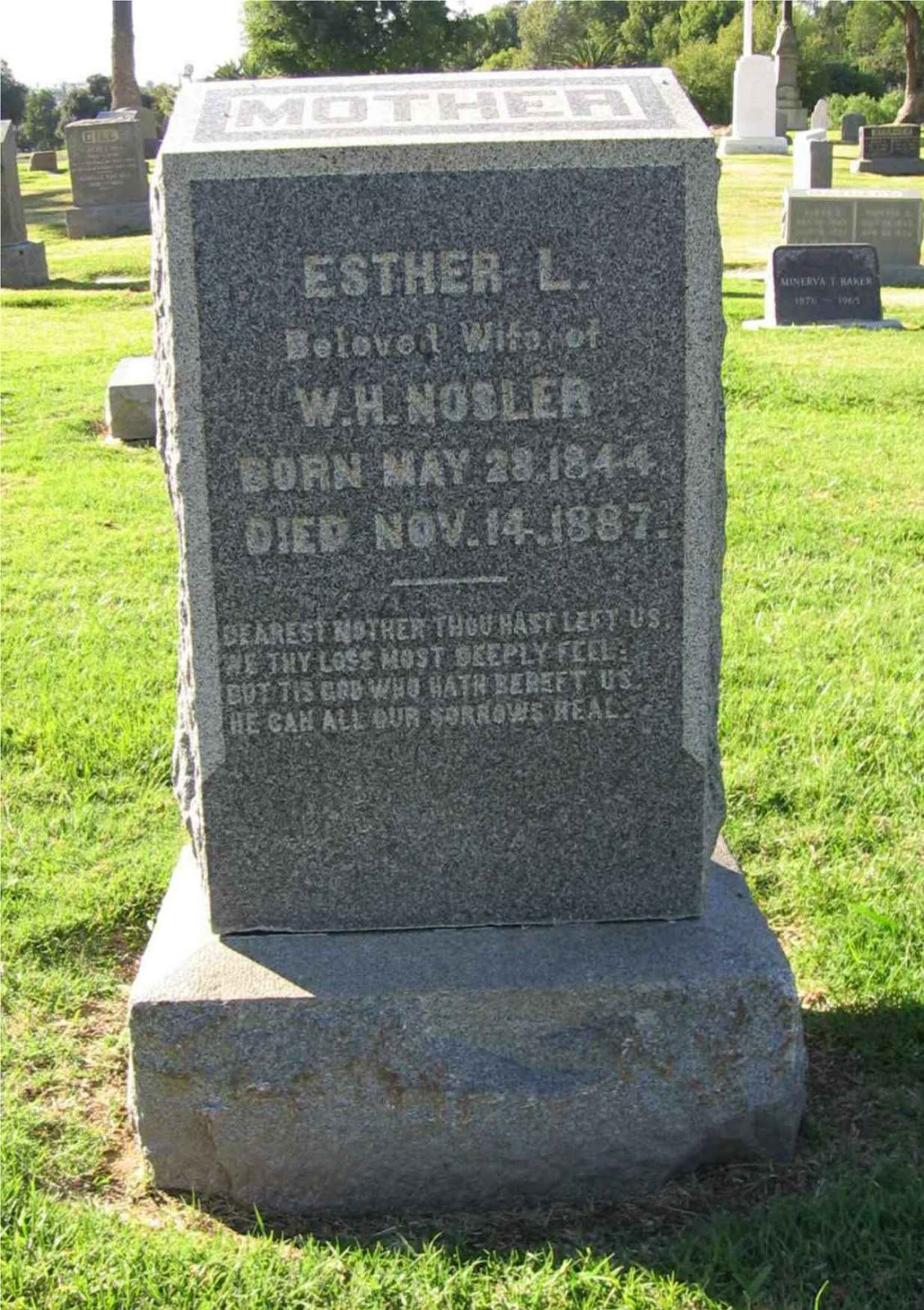
From earlier today at Mt Hope Cemetery in San Diego.  James Milo Nosler and his sister-in-law Esther (Rittgers) Nosler lie side by side in the G. A. R. 1 area.

This picture represents what must have been a horrible time for my 2nd great grandfather, William H Nosler (1840-1914) -- his youngest brother James Milo Nosler died of tuberculosis on May 8, 1886 and then William's wife, my 2nd great grandmother Esther Loretta (Rittgers) Nosler died a year later (of unknown cause) on November 14, 1887, after 23 years marriage and 10 children.

William Nosler later died and is buried in Coquille, Coos, Oregon.


A better picture of Esther's tombstone, by FindaGrave contributor John Burkholder (1/09/2007)
A better picture of James' gravestone, by FindaGrave contributor Michael Harris (5/15/2004)

Red arrow shows approximate location of the graves.


© 2017 Copyright, Christine Manczuk, All Rights Reserved.

Tuesday, October 4, 2016

My Great Grandparents George Hartley and Minnie Nosler Got Their Marriage License in Los Angeles

George and Minnie (highlighted by yellow stars) and their witnesses, George's sister Mary Catherine Hartley (1872-1957) and Minnie's brother Israel Rittgers Nosler (1876-1954).  Image from "California, County Marriages, 1850-1952," database with images, FamilySearch (https://familysearch.org/ark:/61903/1:1:K8DQ-YGB : 28 November 2014), George Hartley and Minnie Nosler, 10 May 1906; citing Los Angeles, California, United States, county courthouses, California; FHL microfilm 2,074,002.

I believe Minnie was a pupil of George Hartley's sister, Delia Hartley (1873-1938), who was a teacher out in Dehesa, San Diego in the 1890s.  I was surprised that they obtained a marriage license in Los Angeles instead of San Diego, but apparently George and Minnie were living there in 1906.

I need to check out the Los Angeles city directory over at Fold3 to see if I can find George or Minnie.

George had been widowed almost exactly 3 years (his first wife, Jane "Jennie" Denby had died May 7, 1903 in San Diego--this license is dated May 9, 1906).  I don't know exactly what Minnie was doing between the 1900 Census and this marriage license, but until now I had only looked at sources in San Diego.

And there she is, working as a milliner and living at 1947 E 2d in the 1906 Los Angeles city directory.  I'm glad I wrote this post, it helped me think more analytically about where she was when she married George.  From Fold3.


And here is George.  Same address as Minnie.  Since they got married in the middle of the year I'm not sure what to make of her going by her maiden name, unless it was a carry-over from the previous city directory?  They did marry in the middle of the year (May).  I don't find her in the 1905 LA city directory, however.  Hmmm.  From Fold3.  


© 2016 Copyright, Christine Manczuk, All Rights Reserved.
Wednesday, September 14, 2016

Hibbs Trajectory I had Not Considered

The yellow arrows show where I know Mahlon Hibbs lived (Anderson County, Tennessee and Putnam County, Indiana), and the heat map points (red with green halo) are where I find Hibbs in DNA matches to Dad and records.  I also find some DNA matches that hint at Hibbs who lived in Kentucky.

Loudoun County (indicated on the above map by the marker right near Washington, DC) is where I suspect Mahlon Hibbs was born about 1747  (I think he ultimately descends from the Quaker Bucks County/Philadelphia Hibbs).

I had thought that he had gone down the Shenandoah River Valley area to Knoxville and Anderson County, Tennessee (sometime in the 1780s/1790s), but I had forgotten that Virginia had also meant West Virginia (until the Civil War).

My dad has numerous DNA matches to Hibbs in Ohio, and many of the Ohio Hibbs went on the Jasper County/Polk County, Iowa, where a quite a few lines of Mahlon Hibbs descendants also ended up (including a grandson James Milo Nosler).

I think Mahlon was possibly up in the western Pennsylvania/eastern Ohio at some point.  I find it quite interesting that many of his children named one of their daughters Sciota/Syotha/Sciotha, which I can only surmise is in honor of the Scioto River in Ohio??  Why else would people in Tennessee name girls after an Ohio river?

I think I need to reevaluate where I'm researching my Hibbs, and focus more on western Pennsylvania and West Virginia.


© 2016 Copyright, Christine Manczuk, All Rights Reserved.

Thursday, September 1, 2016

Minnie Nosler Enjoyed Watching Professional Wrestling

Minnie's obituary, and they didn't even mention that she was a professional wrestling fan? San Diego Union (San Diego, CA), Saturday, 11 January 1969, page 34 (GenealogyBank).

I didn't know much about him until I looked it up, but I did recognize the name Gorgeous George.  I assume my great grandmother found this stuff hilarious.  I don't think that she attended the events but watched on TV as it was very popular, but who knows?

According to my father, his grandmother Minnie Nosler (Hartley) (Fuhrman) (1883-1969), daughter of Civil War veteran William Henry Nosler and Esther Loretta Rittgers, really enjoyed professional wrestling.

I don't know who she liked best, but fortunately fans on Youtube have put up quite a few videos of the time, including interviews, to get an idea of the types of antics these guys were up to:


Vintage L.A. Wrestling: Dick Lane, Gorgeous George, and Freddy Blassie.  This is pretty entertaining stuff.  I especially enjoyed the David Letterman, Andy Kaufman, and Freddie Blassie segment at the end (which was way past Minnie's time), So ridiculous LOL


© 2016 Copyright, Christine Manczuk, All Rights Reserved.

Saturday, August 13, 2016

Diary of James Milo Nosler: 1860--Girls, Self-Inflicted Hardships, and the Coming Civil War

James Milo Nosler (1843-1886), my 3rd great uncle who kept a diary for many years.  He was the youngest brother of my 2nd great grandfather, William "Will" Nosler (1840-1914).  The following is continued from my post "Diary of James Milo Nosler: Tired of Nebraska and Distracted by "Kissing Bees".


I prided myself, although stripling that I was, on the number of girls I had kept company with during the winter, which amounted to 14 or 15, but this a poor recompense for the schooling I missed, and the only blame I can not attach to my father is that he did not serve objection and cause me to attend school and obey him [I am assuming he meant "the only blame I CAN attach to my father"?].  Of course, I would have disliked it then, but I could now have cause to rejoice.

Atchison, Kansas City and Mirabile. Closeup from Colton's Kansas and Nebraska (1855).

During the winter I attended debating society some and made my first attempt at public speaking.  In the spring I commenced farming for father [John Nosler].  He promised everything, boarded me and give me half.  Will [James' brother William Nosler] went back to Indiana on a wild goose chase.  He soon came back and I sold him my prospect for a crop and started to Kansas, but was only gone two or three days when I came back, stayed a little while, and Will and I another fellow started to Kansas, intending to drive a government team across the plains.  We had but little money, but got to Kansas City--by laying out every night--here we soon hired to a train, but instead of lending us on out, they put us to work quarrying rock until their freight could arrive by steamer.  We soon got tired of this and quit them.  We went out of town in the woods and camped out.  Morning we were hungry and no money.  Finally we killed Jay (nock it down) and roasted it, then went back to town and hired to another train that was going to start from Atchison soon.  They put us on a boat and sent us up.  We spent that 4th of July, yoking and breaking wild Texas cattle, finally, we got started and was three days getting fifteen miles.  The wagon master was so mean to us and so overbearing that Will and I concluded we would quit him and go home.  We then was[sic] about seventy miles from home.
Accordingly we started just after dark one night as we knew the wagon boss would not let us go if he knew it; we secured a lot of bread and meat before we left.  We got to Atchison, but it took hard coaxing to get the capt. of the boat to take us over the river as we had no money, but at last we got over and then come, I think, the hardest trip I ever made.  We stretched out our grub as far as it would go, but before we got home, we were entirely out and too proud to beg.  The last night we ??? until four o'clock in the morning, and oh how hungry and tired, and sleepy.  I think I stood it better than Will, for every time we would set down he would go to sleep and oftimes it required great effort to rally him, but at four in the morning we got to Johns.  Fool must learn in the school of experience, although she is a dear teacher.  Well, I think this was a good lesson and I have not forgotten it yet.
When we got home [I am assuming Mirabile, Missouri, where his father John Nosler was] we found that a new difficulty had arose some time before.  Will and I were trading with a negro and in the trade we sold him a little one barrel pistol, this was against the laws of the state, but we did not know it and there would perhaps have been nothing said about it, but for the established fact that we were all republicans.  It was now the fall of 1860.  The presidential campaign was coming on and we could all see that by the split in the Democratic at Charleston, Mr. Lincoln would surely be elected.  The South had openly avowed that should such be the case, they would secede from the Union.  Cecession[sp] would inevitably be followed by war.  So have a chance to go to Iowa, I concluded that I would have to do so soon. So I started with Jerry [Jeremiah "Jerry" Lawson who was married to ]ames' sister Caroline Nosler], but I told Caroline then that when I returned to the State it would be in company of armed men.  These words were prophetic.


© 2016 Copyright, Christine Manczuk, All Rights Reserved.

Tuesday, June 14, 2016

Mary Esther Hartley in the 1928 San Diego High School Yearbook

My grand aunt, Mary Esther Hartley (1911-2007), sister to my grandfather George Hartley, Jr. who also attended SDHS, and daughter of Minnie Nosler and George Henry Hartley,  in the 1928 yearbook.  She was on the Glee club!


© 2016 Copyright, Christine Manczuk, All Rights Reserved.

Saturday, May 7, 2016

Diary of James Milo Nosler: Tired of Nebraska and Distracted by "Kissing Bees"

James Milo Nosler (1843-1886), my 3rd great uncle who kept a diary for many years.  He was the youngest brother of my 2nd great grandfather, William "Will" Nosler (1840-1914).  The following is continued from my post "Diary of James Milo Nosler: Time in Nebraska and "Total Defeat".  The following passage is likely in 1859.

James Milo Nosler boarded a riverboat somewhere in Nebraska (I'm assuming Nemaha County) and arrived in St Joseph about 3 am on July 9.  Closeup from Colton's Kansas and Nebraska (1855).


On the 8th of July, having become tired of Nebraska, I boarded a boat and started for Mo., having worked out and got a couple of dollars or so.  This was the last time I saw Wieth [James' brother Wyatt or Wieth Nosler].  I took deck passage to St. Joe, got there about three in the morning with fifty cents in money and about sixty miles from home, but I got me a little something to eat and bravely set out on my journey.  That night I layed on the Jaraini [maybe this meant "train"?] and I reckon dreamed of the Prodigal Son.  The next day resumed my journey, got lost and oh what a time finally got to Mirable but the next four miles was a big thing, however made the [unintelligible], but I had to stop every hundred yards or so and rest my weary legs.  Well here I was, black, ragged, and dirty.  My five acres of corn in Nebraska.  So much for experience.


From St Joseph to Mirabile proved to be a harrowing trip for him.  Closeup from Colton's Kansas and Nebraska (1855).


My father [John Nosler, ] never in his life refused me a good chance to make money when I asked it--but on the other hand often solicited me to tend his farm.  Well, I worked around during the summer and toward fall father wanted me to come home and stay and go to school.  At this I consented.  He got me a good suit of clothes and fixed me up and after we had the corn gathered, I started to school to a splendid teacher by the name of Slocum (?) [the transcriber wasn't sure of the name.  I find a Geo Latimer, a 26-year-old school teacher from Ohio in the 1860 Census in Rockford, Caldwell, Missouri--is this him?] who thought a great deal of me.
Will [James' brother] had in the mean time gone to Neb. and returned, having sold my corn for $25.  Well, I went two or three weeks and was getting along fine when came to be the day they began having those sissy infernal play parties or "kissing bees" in the neighborhood, which soon so completely drew my mind from my studies that I give up the school entirely.  I shall always be a bitter opposer to all such amusements.  Soon after on some frivolous account, I left home and staid at Johns [James' brother John Nosler] the rest of the winter, who by the way had moved to Mo. during the summer previous.

I find a description of these hated "kissing bees" from "Stories of Missouri" by John Roy Musick:  
"A substitute for this sort of amusement [dancing] which was tolerated by the church members was the "social party," "play party," or, as they were sometimes called, "kissing bees."  At these, such games as "Weevilly Wheat," "Sister Phoeby," "We're Marching down to Old Quebec," and "King William," are played for the amusement of the young people. If it was announced that there was to be a dance, "frolic," or "kissing bee" at a house on a certain night, soon after dark the young people would begin to arrive.  They came from all parts of the country, some on foot, some on horseback, and a few, who came from a distance, in wagons. 
The dancing was usually of the rudest sort.  The fiddler sawed away on his cracked instrument all night long on such airs as "Old Dan Tucker," "Zip Coon [now known as Turkey in the Straw"]," "Natches under the Hill," "Rickets," Fisher's Hornpipe," "Sailor's Hornpipe,[the tune is probably most associated with Popeye today]" "Run, Nigger, Run[from the film "12 Years A Slave"]" "Soap Suds," "Great Big Taters in the Sandy Land," and others of like character.  When not engaged in dancing or talking with the girls, the young men usually discussed farming, logging, or clearing off the forest and plowing the land.


© 2016 Copyright, Christine Manczuk, All Rights Reserved.

Saturday, April 30, 2016

Diary of James Milo Nosler: Time in Nebraska and "Total Defeat"

James Milo Nosler (1843-1886), my 3rd great uncle who kept a diary for many years.  He was the youngest brother of my 2nd great grandfather, William "Will" Nosler (1840-1914).  The following is continued from my post "Diary of James Milo Nosler: Moving to Missouri".

These are a few bits from an obviously tumultuous time in James Milo's life, bouncing back and forth between older brothers and brothers-in-law:
When Docks ["Doctor Benjamin Franklin Hunt, 1832-1910, James's brother-in-law through sister Ellin] went back to town, Will went with.  I was fifteen years old when we lived on the Perkins farm [probably the Christopher Perkins in Ray and Clinton County, Missouri] and from that time have fended for myself.  During this winter I went to school awhile [presumably in Missouri] until Will [his brother William Nosler, 1840-1914, and my 2nd great grandfather] came back from Iowa when I quit and soon after went with Jerries to Nebraska [likely Nemaha County, Nebraska].  They soon returned but I staid and farmed with Bird [another brother-in-law, Bird Vowell, 1826-1902, who was in Nemaha in the 1860 Census].  I got five acres of corn for my summers work.  


The general area where James would be about 1860 (Nemaha).
From the "1856 Nebraska And Kanzas Atlas Map". Published by J. H. Colton & Co.

I went to church one night with Francis Cook [not sure which church, presumably in Nemaha County or Johnson county,  Nebraska there appeared to be an English Cook family, maybe this Francis was a member?  I don't know if this Francis was a boy or girl].  This was my first adventure on that time.  I was soon after "outwitted (or outmitted)" by Rachel Bents [probably the Rachel Bentz (1843-1924), daughter of John and Rachel Bentz, who lived in the next county over, in Johnson County, Nebraska by the 1860 Census, and later married Robert Shelly Brown.]], and that was my only total defeat in that time.  It dampened my powder completely and I made no more advances in Neb.  

Did he have a crush on Rachel, or did she beat him up?  Or both?  Not sure what is going on in that passage.


© 2016 Copyright, Christine Manczuk, All Rights Reserved.

Saturday, April 16, 2016

Diary of James Milo Nosler: Moving to Missouri

James Milo Nosler (1843-1886), my 3rd great uncle who kept a diary for many years.  He was the youngest brother of my 2nd great grandfather, William "Will" Nosler (1840-1914).  The following is continued from my post "Diary of James Milo Nosler: Moving Around Iowa and Checking Out Nebraska, Kansas, and Missouri".


In April (1859) I think, we started to Mo. with those two horse teams, we had a dreadful wet spring and summer, and consequently, a bad time for moving. We got to Maye Ville (?) Mo. [I think Maysville Court House, De Kalb, Missouri] and there waited a few days for Jerry Dawsons (?) [Jerry Lawson, his brother-in-law] who intended to meet us there.  Just when we were ready to start they came and we all moved out together.  Went down toward Haynes Ville [probably Haynesville, Clinton County] and there layed over while the men looked around a few days, but they soon rented a farm of old Kit Perkins [possibly Christopher Perkins who bought land Ray and Clinton Counties in 1843] in Ray county and we all moved with the one horse with but one move.  It was here that father virtually gave Will and Souns (?) [likely Sons] freedom by giving us a part of the crop and boarding us with James.  This was caused mostly by family discords, as we never could regard our stepmother [Valeria Young] in any other light than that reflected by her own mercenary self, and she as wearily reciprocated our dislike for her.

The move in 1859 from Madison County, Iowa to Clinton/Ray counties in Missouri.  There was a stop in Maysville C.H.  Circled unlabeled area is the Clinton/Ray county region where I think they stayed a while. Brother-in-law Jerry Lawson was in the Knoxville, Ray, Missouri area in the 1860 Census (right next to the unlabeled circled area).  Closeup from Colton's Kansas and Nebraska (1858).  
Representing the unlabeled  area circled in the map above.  There was a Christopher Perkins who bought land in Clinton and Ray counties in Missouri that I think might be the "old Kit Perkins" that James Milo refers to.  Snapshot from HistoryGeo's First Landowners Project (which uses BLM data).


During the summer the old folks and Will went up to Iowa on business and brought back another team.  At this time Father could command perhaps as much as he ever could; he was worth about $10,000.  Soon after they returned, Jerries and I went with a load of apples.  Docks came back with us to see the country.  Father had bought a nice farm four miles south of Ninabile (?) [Mirabile, Caldwell, Missouri].

As James Milo indicated, his father had bought a farm in Mirabile (Rockford Township) in Caldwell County, Missouri (north from Ray County).
There he is, with his father John Nosler, stepmother (Valeria Young, labeled as C?), stepsister Elizabeth Dewey "Nosler", stepbrother James H Dewey "Nosler",  younger half-sibling Peru Nosler, and full-brother William H Nosler (my direct ancestor!).  Also note the next-door neighbors brother-in-law Jerry Lawson and sister Caroline (Nosler) Lawson with their young son John W Lawson.  1860 U.S. census, Caldwell County, Missouri, population schedule, Rockford township, p. 43 (penned), dwelling 284, family 284, J. Nosler; digital image, Ancestry.com (http://www.ancestry.com: accessed 16 Apr 2016); citing NARA microfilm publication M653, roll 610.


This census year turns out to be an interesting case of how one person can be recorded in two different places, as James Milo also appears with his brother-in-law "Jas H. Lawson" (Jerry Lawson) and sister Caroline in Ray County.  Given how much moving around he described in his diary it is not surprising.

James Milo Nosler was also counted as living in Ray County in his brother-in-law's household. 1860 U.S. census, Ray County, Missouri, population schedule, Knoxville township, p. 187 (penned), dwelling 1301, family 1301, Jas H. Lawson; digital image, Ancestry.com (http://www.ancestry.com: accessed 16); citing NARA microfilm publication M653, roll 643.


I'll admit it, I was a little disappointed that James didn't mention anything about the census taking in his diary. I keep hoping to find an example of a direct ancestor or collateral describing interaction with a census taker, but no luck this time.


© 2016 Copyright, Christine Manczuk, All Rights Reserved.

Tuesday, March 29, 2016

Diary of James Milo Nosler: Moving Around Iowa and Checking Out Nebraska, Kansas, and Missouri

James Milo Nosler (1843-1886), my 3rd great uncle who kept a diary for many years.  He was the youngest brother of my 2nd great grandfather, William "Will" Nosler (1840-1914).

In the Autumn of "55" Father married a widow [Valeria Young, 1819-1897, widow of Job Dewey] with three children notwithstanding the remonstrances of all his children who were bitterly opposed to it.  My sisters immediately left him and soon after Emily was married to Dr. Hunt ["Docks" Benjamin Franklin Hunt, 1832-1910]. The subsequent winter we lived in the S.E. corner of the county on a farm father had bought, but in the spring we moved up in the Hunt settlement on another of our farms.

Approximate locations of John Nosler (1800-1864) and Docks, in "55".  Detail from the BLM record for "Benjamin J. Hunt" in Polk County, Iowa.  This is all just north of Des Moines.


Same areas, in the larger context.

This spring Caroline was married to Jerrymire S. Dawson [Jeremiah "Jerry" S Lawson, b 1833] , Bird Vowel and Wieth Nosler moved to Wis. (?) (probably Neb.) [Bird Vowel and Wieth (Riley Wyatt Nosler, 1822-1878, James' oldest brother) moved to Nebraska--I find record of "Wieth" in Nehama, Nebraska in 1860].

"Wieth" Nosler was in Peru, Nemaha, Nebraska by 1860, so this is possibly where both he and Bird Vowel went to in 1856.  Peru is shown relative to Des Moines and Omaha in this modern Google map.

1857
I had my first experience in farming this summer, during the winter went to school [he was 14]; in the fall John [his brother John, 1831-1907] moved to S.W. Iowa and in the coming spring Jerry moved to Nebraska, taking Will [William Nosler, my 2nd great grandfather, 1840-1914] with them; in May the old folks, Docks, and myself went on down to look at the country in Nebraska.  We left Docks and went on down (taking Will) to look at Kansas; from thence up through Mo. and back to Iowa.  Docks got back sometime after.  

A close up of Colton's Kansas and Nebraska (1858), in areas where the Noslers were likely looking around, trying to find a place to settle.  Nebraska and Kansas are in colors on the left of the Missouri River, Iowa and Missouri on the right.  "Wieth" was in Nemaha (arrow) by 1860, and the counties in Missouri where Noslers went are circled.


From "Annals of Polk County, Iowa: and city of Des Moines" on Ancestry.  This may explain all the moving around in this year, even though James didn't mention it by name (the Panic of 1857).


That winter I went to school some [I need to look at what record there would be for schools in Polk County in that time]; attended the first revival I ever was at.  Docks and Will experience religion, at last, seeing everybody else go I went forward, and just done what they required of me, but all in vain.  I think now I wasn't sufficiently charged with electricity, or I might have showed to advantage too. 

This must be a reference to the beginnings of the religious phenomenon now referred to as the Third Great Awakening in America.  It doesn't seem James was that into it.

Father had bought a house and lots in Winterset [in Madison County, Iowa, same place where the later novel "Bridges of Madison County" took place]--lived there during the winter while Will and I stayed with Docks; in the spring he intended moving to Mo., taking Will and I with him. A step sister [Angeline Dewey, 1842-1918] had in the fall married Austin McLain [William Austin McLain, 1837-1863].


Winterset, Madison, Iowa in relation to Des Moines.  James' father John Nosler would die almost 7 years later in Winterset in 1864.  Although John's mother Martha Snavely is not mentioned in James' diary as far as I can tell, she was still living and would die in Madison County in 1871 at age 95.  From "Parker's sectional & geological map of Iowa" (1856).


© 2016 Copyright, Christine Manczuk, All Rights Reserved.

Saturday, March 26, 2016

His Mother Nancy (Hibbs) Nosler Dies: The Diary of James Milo Nosler

James Milo Nosler (1843-1886), my 3rd great uncle who kept a diary for many years, was born in Putnam County, Indiana.  When he was six his parents took him out to Iowa to visit an older brother, and soon after the family moved out to Iowa by 1850.  A few weeks before his 11th birthday his mother, Nancy Hibbs (1800-1854) died of illness on a trip back from an extended visit to family and friends in Putnam County, Indiana.


In the fall of 1853 my parents (M) sisters [Syotha Caroline, Mary, and Emily], Will [William Nosler, my 2nd great grandfather], and myself made an overland trip to Indiana where we remained during the winter visiting our old neighbors and relatives.  Early in the spring we started back  and just in the edge of Ill. mother and Emily were both taken sick, and we stopped with a man by the name of Landreth in the middle of an 18 mile prairie.

I am still struggling to discover where this was exactly.  I'm assuming somewhere on the road in eastern Illinois along a route to Springfield, as he mentions that after his mother died they buried her on the "Springfield road" in Smigton(?), but I don't find a Smigton. It is not clear to me what route they were taking, as I would have expected Edgar or Coles counties to be where they would have gone through if they were going toward Springfield, that is), but maybe they took a more southern route, as the only men with last name Landreth that I could find in the 1855 Illinois Census were in Clay County (toward the bottom of the map).  Also, in the BLM records I find a Wells Landreth in neighboring Effingham County who bought land in 1853, just the year before.  Maybe the family went from Green Castle to Terre Haute, and then due south to Vincennes and across into Illinois?

On the other hand, even though I don't find Landreth men in the Clark County area in that time period, it did run along a route from Green Castle to Terre Haute to Vandalia, there is a *Livingston*  east of Marshall, Clark, Illinois, on a modern map along that route (maybe the person transcribing the diary mistook the L for an S?--that might make sense).  And it is just inside Illinois, as James said. But it doesn't satisfy the "middle of an 18 miles prairie" description.

For a while I had her dying possibly near Gordon, Crawford County, Illinois, as that is also on the border of Illinois and Indiana, and has a Landreth man there by 1860, but it doesn't seem like a logical place they would have traveled through.

It is also possible that James didn't give an entirely accurate location, since I don't think he was overly familiar with Illinois at any point in his life.

If anyone else can figure this out, that would be great!  I'd love to know where my ancestress is buried.

I am assuming somewhere between Greencastle, Putnam, Indiana (right) and Springfield (circled left) is where they stopped and where Nancy is buried.  I have looked up Landreth (and other spelling variations) in the 1855 Illinois Census and found men of that name only in Clay county (toward the bottom) and also land records indicate a man in neighboring Effingham.  From the 1856 Map of Illinois.


After an illness of about two weeks, I was left motherless on the 12 day of April 1854.  Two or three days before she died, (her mind had been wandering for some time), when she was noticed looking very attentive at me.  Caroline [Syotha Caroline Nosler, b 1829] asked her if she knew who it was.  She said, "Is it Jimmy?" Answer, "Yes," "Well then Jimmy bring me a drink," and these were the last words she ever spoke to me.  I can remember how these words filled my young heart with joy, for I thought it an indication of my mother's recovery.  
She was buried near a little town by the name of Smigton (?) [possibly Livingston, Clark County, Illinois], seven miles west of Landrettis (?) on the Springfield road. 
After a few days travel, Emily [Emily Ellin Nosler, 1833-1888] was taken worse, and had to lay over another week, but at last we got back to the old mill [in Jefferson Township, Polk County, Iowa, on Beaver Creek, just northwest of Des Moines, for an image of the general area see this post], father had disposed of all his land and sold the mill to Jno. Nosler [likely son John Houston Nosler, 1831-1907] and Samle Kent, but during the summer he bought one third of the mill back and Bird Voweland [Bird Vowell, who was daughter Mary Nosler's husband, not sure why James sometimes puts Voweland instead of Vowell??] bought Hunt's share [Hunt was the last name of James' soon-to-be brother-in-law, Benjamin Hunt, so likely either him or a near relative], rented his farm in Jasper county and moved up.  Bird did not buy though until the summer of "55".  


© 2016 Copyright, Christine Manczuk, All Rights Reserved.

Thursday, March 24, 2016

Diary of James Milo Nosler: Introduction, part 2

Continued from Part 1.

James Milo Nosler (1843-1886), my 3rd great uncle who kept a diary for many years, was born in Putnam County, Indiana.  When he was six his parents took him out to Iowa to visit an older brother, and soon after the family moved out to Iowa:

When I was about six years old my parents took me and Will on a visit to Wapello to Iowa to see Wieth and Mary who had married and gone out before and also to look at the country.  
Since James was born in 1843 then the year he is discussing is probably 1849, and likely in the the spring, as the next passage indicates they got back by summer.  William "Will" Nosler (1840-1914) is his brother, my 2nd great grandfather.  Wieth is their oldest brother, Riley Wyatt Nosler (1822-1878), and his first wife Mary? Jane Turner (1822-abt 1850).

James doesn't explain how they traveled from Indiana to Iowa.  It doesn't appear to be by train, at least in Iowa itself, which didn't have railroad until a few years after this trip.  The National Road ran right across Putnam County (between Indianapolis and Terre Haute), so my theory is that the family may have taken that all the way to Vandalia, Illinois, and then from there to the Mississippi on the same road  to St Louis possibly (but not part of the National Road officially which stopped in Vandalia because of lack of funding after the 1837 financial panic).  


Conner Prairie has an overview of transportation in Indiana from 1800 to 1860.


The Historic National Road from Wikipedia, courtesy of Citynoise.  Putnam County is between Terre Haute and Indianapolis.


Or, they could have taken the National Road to Terre Haute, and then taken the Wabash and Erie Canal, and then to the Ohio and then Mississippi?:


From Wikipedia, the Wabash and Erie Canal, courtesy of Charles Edward.


I suspect that Wapello was Ottumwa (which is in Wapello County), and that James and his family may have taken a steamboat from the Mississippi up the Des Moines River.  


From Enchanted Learning.  Jasper County, just east of Des Moines, is where James'  sister Mary Vowell lived with her husband Bird Vowell.


As you can see in the right image, Iowa was only just beginning to be settled, and much of it along the watershed area of the Des Moines River.  From "Atlas of the Historical Geography of the United States."


We got back during the summer and the next spring father sold out "root and branch" bound for the West; got through safe enough to Bird Virott [Bird Vowell, 1826-1902] in Jasper Co.  (He is Mary's man [James' sister Mary Ann Nosler, 1829-1904]); stayed there a short time and moved on into about Des Moines thru a little village, Jushapse***, 300 or 400 inhabitants on the Des Moines river.  
I haven't a clue what "Jushapse" was actually called, since the French were in the area it might be a French sounding name, or even a mishearing of a Native American name.  ***EDITED TO ADD: A view of the original writing provided by one of James Milo's direct descendants made me realize that "Jushapse" is just the word "perhaps".  This is yet another lesson to me that it is always important to get as close to the original writing as possible.
After perhaps perambulating around in this country a few days, he [I'm assuming James' father John?] struck a trade. (John [this is likely James' brother John Houston Nosler, 1831-1907, whose descendant John Amos Nosler started the Nosler ammunitions company] was married [to Matilda Farmer, 1832-1897] just before we left Indiana, but had not gone to house keeping yet). 
Father [John Nosler, 1800-1864] bought a good tract of land 5 1/2 miles north of Des Moines on Beaver Creek on which was situated a good saw mill, good house and well, and thought we was at home, but oh what a home it was!  In a few days we all began to feel kind sick, then cold, then we would begin to shake, and finally our teeth began to rattle.  Oh horror of horrors we had the Iowa ague [Ague: Usually malaria but can be any feverish illness with fits of shivering--more on Iowa ague here].  No use now for James Milo to squall; old ague is so miserable.  We were at times all down, but father, but finally we wore it out by the quinine, but it left its mark on me in shape of an ague cake that almost covered one side and did not disappear for weeks.  
In the 1850 John Nosler and family were among the residents in a community in Polk County, and if John was on the same land as he was in the 1852 Iowa census then this was in the area of Jefferson Township, Polk County, Iowa (some history here).  I need to find the land purchase record for this tract of land as I don't have a record of this yet.

Beaver Creek is indicated by the "A", in Jefferson Township, Polk County, Iowa (about 6 miles north from downtown Des Moines).  From city-data.com on Jefferson Township, Polk, Iowa.


It was in the spring of 1850 when we came to this place, and for the three succeeding years I enjoyed myself, I think better than ever before.  I was a boy and had no cares, surrounded by kind and indulgent friends.  Will and I were continually together, and when I now look back on those days they seem only the shadows of a bright, but receding dawn.  The only thing, I think, that marred that happiness was occasionally spills of the croup, of which I had a mortal fear. 
It was during the winter of '53 that father had a tremendous spell of sickness, and nothing I guess but his strong constitution ever brought him through it.  He had been away busily engaged running the mill ever since he bought it with the exceptions of two or three summers as they came far and near for lumber and ghrists (he had built a ghristmill) and had been working on the water from which he took cold and disease set in.


© 2016 Copyright, Christine Manczuk, All Rights Reserved.

Saturday, March 19, 2016

The Famous Nosler

Growing up, the only thing I knew about the Nosler name is that is was my paternal great grandmother's maiden name (Minnie Nosler, my father's father's mother).

I guess most people know the Nosler name from the Nosler ammunition company, begun by my 2nd cousin 2x's removed John Amos Nosler (1913 - 1910).

Here is how I am related, starting with my grandfather George Hartley Jr (1907 - 1977), who was about the same vintage as John Amos Nosler:

Grandfather's Nosler connection (through his mother).


John Nosler's Nosler lineage.


© 2016 Copyright, Christine Manczuk, All Rights Reserved.

Saturday, October 17, 2015

Tip: Don't Just Rely on the Search Function When Using Newspaper Databases

"Dehesa Doings," San Diego Union (San Diego, CA), p 5, col 4, 8 Aug 1892; digital image, GenealogyBank.com (http://www.genealogybank.com: accessed 17 Oct 2015).

The info above was found doing a "Hartley" search.  Since newspapers often had recurring columns I thought to search "Dehesa Doings" to possibly find other tidbits in other issues.  But instead I got this:

Oh, come on, I just found Dehesa Doings three minutes ago!
I am assuming the optical character recognition just doesn't read it as Dehesa Doings (and who knows what it thinks it says).  While it may not be an ongoing column like I thought, the term "Dehesa Doings" DOES appear at least once for sure!  So what should I do?

I went page by page through other issues close in time to this one.  This is a bit tedious, but not only can it help you catch information missed by OCR, it also gives you a feel for what the newspaper was like and what kind of information you can realistically expect to glean from it.

Unfortunately I haven't found a graceful way to search newspapers this way on GenealogyBank, as they don't provide an easy way to browse papers--you have to search through them, which is different.  So I narrowed down to the specific paper I wanted, and then typed in a date range (in this case San Diego Union and August 1892--alternately, you could just type in a specific day and year):


Then I ordered by Oldest (you an order by Oldest, Newest, and Best):


Note the varying quality of the scans, even in one issue (in this case, all the results in this screenshot are from the August 1, 1892 issue).
No wonder the OCR doesn't find every word from the scanned images--just look at what it has to contend with!


After looking at a number of issues I realized that "Dehesa Doings" was not a regular heading, but I could depend on page 5 in any given issue in that era for information on local people, with the leading title "Local Intelligence. In General.":

"Dehesa Doings" in the larger context.

Every newspaper database I've used has to deal with the same OCR problems.

Many states now have historic newspapers to browse through, like the Historic Oregon Newspapers.  I use this database to find my Oregon ancestors.  When a search for my 2nd great grandfather William Nosler's death notice or obituary came back with no results, I used his known death date (3 Dec 1914 in Coquille, Oregon) to narrow down and search page-by-page, issue-by-issue, to find his obituary:
No doubt the fuzzy print threw off the OCR.  This example also shows how discrepancies can occur in newspapers--the Oregon death index indicates he died on the 3rd, while this report indicates he died on the 5th.  Mrs. George Hartley is my great grandmother Minnie (Nosler) Hartley"Dies in Coquille," The Coos Bay Times--Evening Edition (Marshfield, Oregon), 7 Dec 1914, p 1; digital image, Historic Oregon Newspapers (http://oregonnews.uoregon.edu/ : accessed 17 Oct 2015).


Here is the obituary in the larger context:
These obituaries are often found later in the issue, but more well-known citizens' obituaries might be featured on the front page.


Oh, so maybe I should have searched for William H. Nosler, then?  Nope (and using capitals or not didn't matter, either):

But I just found his obituary in there!


While using Search is a great way to use newspaper databases like GenealogyBank or Historic Oregon Newspapers, it is really just the tip of the iceberg. You've got to really spend some time looking at newspapers, page by page, to know how to use them.


© 2015 Copyright, Christine Manczuk, All Rights Reserved.