Showing posts with label Railroad. Show all posts

Wednesday, November 14, 2018

Working on Wednesday: What's a Horse Shunter?

I've been working on the family tree of an Englishman who lives here in France and the occupation of one of his great great grandfather is listed in several censuses as "horse driver" for what I believe is the Great Eastern Railroad. Here's the 1911 England Census:

[Ancestry.com. 1911 England Census [database on-line]. Provo, UT, USA: Ancestry.com Operations, Inc., 2011. Original data: Census Returns of England and Wales, 1911. Kew, Surrey, England: The National Archives of the UK (TNA), 1911.
Data imaged from the National Archives, London, England.]


It wasn't at all clear to me what that meant. Then I found him in a union membership list (via findmypast) where his job was described as H[or]se Shunter:

[National Union Of Railwaymen; Britain, Trade Union Membership Registers, source: findmypast.com]

Fortunately for me, someone on Google knew what horse shunting was and provided more information. Here's a vintage image of a shunter and his horse:

[Jack Wise, Horse Shunter by kind permission of Mrs Prestidge. Source: Woodford Halse Archive.]


 There's even a video of one in action.


© 2018 Copyright, Christine Manczuk, All Rights Reserved.

Wednesday, October 31, 2018

Working on the Railroad: Samuel Louis Martin (1866 - 1943) From Coal Heaver to Locomotive Engineer

Samuel Martin is one of my second cousins, twice removed, through my great grandmother Rufina Tomlinson's lineage. He lived in Iowa his whole life and worked for the Chicago & North Western Railway Company for 51 years, rising from coal heaver to locomotive engineer during his career.


[Ancestry.com. U.S., Chicago and North Western Railroad Employment Records, 1935-1970 [database on-line]. Provo, UT, USA: Ancestry.com Operations, Inc., 2015. This collection was indexed by Ancestry World Archives Project contributors. Original data: Chicago and North Western Railroad Employee Records. Chicago & North Western Historical Society, Berwyn, Illinois. Chicago, St. Paul, Minneapolis & Omaha Railway Employee Records. Chicago & North Western Historical Society, Berwyn, Illinois.]


Here's how we're related:

[Ancestry.com]


© 2018 Copyright, Christine Manczuk, All Rights Reserved.

Thursday, September 6, 2018

Harvey Houses - Early American Fast Food

Richard Watson Tibbetts, 1919, in France. Image courtesy of Patricia Huffman on Ancestry.


Richard Watson Tibbetts (1896-1980), one of my 2nd 3x removed cousins, worked for a number of Harvey Houses in the first half of the 20th century.  He even left his first wife for one of the Harvey Girls!


© 2018 Copyright, Christine Manczuk, All Rights Reserved.

Sunday, September 18, 2016

Sunday Drive: National Railway Museum, York

During our visit to England in May of 2013, Bonnie and I spent hours at the National Railway Museum.

[From my personal collection]

If you're ever in the neighborhood, I strongly recommend you pay this wonderful collection a visit.


© 2016 Copyright, Christine Manczuk, All Rights Reserved.

Sunday, November 22, 2015

Sunday Drive: Train Travel in Victorian England

[England & Wales With its Railroads & Canals, v1855, J. Archer. Found on freepages.genealogy.rootsweb.ancestry.com]


Cousin Randy Seaver has a Saturday Night Genealogy Fun post every week on his Genea-Musings blog and everybody is welcome to join in.* Last night the theme was "Who Is Your Most Recent Immigrant Ancestor?" and Randy's offering was:
"My most recent immigrant ancestor is my great-grandfather, Thomas Richman/Richmond (1848-1917) and his mother, Hannah (Rich) Richman (1824-1911). They immigrated into the United States on 14 November 1856 in New York City, arriving on the ship Osprey out of Bristol in England.  The passenger list included:
*  Hannah Richman - age 32, female, a wife
*  James Richman - age 7, male, a child
*  Thomas Richman - age 6, male, a child
*  Louisa Richman - age 4, female, a child
*  Elizabeth Richman - age 3, female, a child
*  Ann Richman - an infant, female, a child 
James Richman (1821-1912) had come to America on the ship Calhoun from Liverpool in England on 22 October 1855.
The Richmans had lived in Hilperton in Wiltshire, near Trowbridge, until they emigrated.  I don't know how they went from Hilperton to the ports - Liverpool is fairly far away from Wiltshire.  Perhaps they went by wagon or coach.
It was the last paragraph with Randy's speculation of how they may have reached Liverpool and Bristol that caught my attention because I think there's a a strong likelihood that his ancestors traveled by train** instead.

The English were railroad pioneers and by the time the Richman family set out for America in 1855-56 there were thousands of miles of track in Britain and every town of any size had its railway line. As the BBC History Magazine explains:
"At first, train travel was too dear for the average working man but fares gradually came down thanks to competition and William Gladstone’s 1844 Railway Act, which obliged every company to supply at least one train daily at the cost of no more than 1d a mile. Meanwhile, the growth of excursion trains and the Great Exhibition of 1851 stimulated vast numbers to use the railways for the first time. 
By the end of the 1850s, passenger numbers had risen beyond all expectations. In 1854 alone, 92 million journeys were made in England and Wales alone, on a network stretching 6,000 miles. The magic of train travel had caught the public imagination and the rapid expansion of the iron road left few aspects of life in Victorian Britain untouched."
According to A History of the County of Wiltshire,***  railway service reached Trowbridge by 1848. 

[Wiltshire Railways and canals, Source: British History Online]

National Museums Liverpool has an Information Sheet (PDF) describing 19th and 20th century emigration. The section titled "Awaiting Departure" gives us an idea of what James Richman's experience there was probably like in 1855.
"Emigrants were not allowed on board their ships until the day before, or the actual day of sailing, so this meant that most emigrants usually spent between one and ten days waiting for their ship in a Liverpool lodging house. In the mid-19th century emigrants passing through Liverpool were liable to harassment and fraud by local confidence tricksters, known as 'runners'. Runners frequently snatched the emigrants' luggage and would only return it if the emigrant paid a large fee. In the late 1840s and 1850s, lodging houses were often inhospitable, dirty and overcrowded."
For general information about British trains, I suggest you check out the National Railway Museum. We visited it when we were in York last year and it is amazing!


*I added my 3rd great grandfather William T. Slater, the English deserter from the War of 1812 in the comment section of Randy's blog last night.
**And of course, the trains would have been pulled by steam locomotives. If you want to hear and see what they sounded like the obsessive trainspotters of England have puts lots of videos on YouTube. (Unfortunately none of them are short.)
***'Railways', in A History of the County of Wiltshire: Volume 4, ed. Elizabeth Crittall (London, 1959), pp. 280-293 http://www.british-history.ac.uk/vch/wilts/vol4/pp280-293 [accessed 21 November 2015].


© 2015 Copyright, Christine Manczuk, All Rights Reserved.

Tuesday, September 1, 2015

Soon to be Sherman's Neckties: The Montgomery and West Point Railroad

The Montgomery and West Point Railroad (M and W P RR).  My ancestors Timney (Watts) Warren Phillips, Henry Hill Freeman, his wife Elizabeth (Turner) Freeman, and their daughter Nannie Freeman, among other relations, were in Cotton Valley at this time.  Closeup from "Colton's Alabama" by Joseph Hutchins Colton, published in New York by Colton and Co. c. 1861, from the W. S. Hoole Special Collections Library, available through Alabama Maps
If you don't know where Cotton Valley, Macon County, Alabama is, just think Tuskegee (now famous for its university, George Washington Carter, and courageous airmen), which is about 10 miles directly up the road.  Macon county had two railroads crossing through about 1861, the Mobile and Girard Railroad, and the Montgomery and West Point Railroad.  Not surprisingly, the main crop in this county was cotton.


The railway (found between Montgomery and La Grange) in context with other Confederate railroads.  Railroads of the Confederacy, from The West Point atlas of the Civil War / compiled by the Department of Military Art and Engineering, the United States Military Academy; chief editor, Vincent J. Esposito. Image from wikipedia.
"Local News Items: Company D," Columbus Daily Enquirer (Columbus, Georgia), 9 Apr 1861, issue 165, vol III, page 3; digital images, GenealogyBank (http://www.genealogybank.com/ : accessed 1 Sep 2015).

Since it could transport soldiers and supplies, the M and W P R.R. was targeted for destruction by the Union during the Civil War.  According to the Wikipedia article:
During the Civil War, the railroad was raided in July 1864 by 2,500 Union cavalry troops under the command of Lovell Rousseau. Staged out of Decatur, Alabama, Rousseau's force managed to take or burn a large quantity of supplies at Opelika, to destroy 30 miles of track, and to burn railroad stations and warehouses at Montgomery and West Point, by July 17.[2]
In April 1865 a far more destructive raid, Wilson's Raid, wrecked all of the remaining rolling stock of the railroad.[3] After the war, the railroad was repaired and reopened for traffic. The M&WP was merged into the Western Railway of Alabama in 1870.
Destroying the railroad tracks included tying the metal into what became known as Sherman's neckties, which ideally left the material unrepairable.

"Atlanta, Georgia. Sherman's men destroying railroad," photographer George N. Barnard, from negatives : glass, stereograph, wet collodion, Library of Congress (http://www.loc.gov/item/cwp2003005432/PP/ : accessed 1 Sep 2015).

A much more exciting depiction of Sherman's men destroying a railroad.
Felix Darley and Slexander Ritchie, "Sherman's March to the Sea," digital image from engraving, 1868, Library of Congress (http://www.loc.gov/item/2003679761/ : accessed 1 Sep 2015).

Since we didn't grow up knowing this side of the family (my mom was adopted), I unfortunately have no family stories that were passed down to me about my ancestors' experience with this part of the Civil War.  Timney died in December 1863.  Henry Hill Freeman was on the Macon County census list in 1866, so I think he and his family were likely in the area during the destruction of the railway.

I couldn't find Alabama newspaper articles covering these events, but Georgia still had functioning newspapers:
"Raid on the Montgomery and West Point Railroad," 29 Jul 1864, Macon Telegraph (Macon, Georgia), issue 1360, page 2; digital images, GenealogyBank (http://www.genealogybank.com/ : accessed 1 Sep 2015).
cont'd from above

By 1865, the Boston Evening Transcript reported the following:
"Gen. Wilson's Raid in Georgia," 1 May 1865, Boston Evening Transcript (Boston, Massachusetts), page 4, col. 2; digital images, GenealogyBank (http://www.genealogybank.com/ : accessed 1 Sep 2015). 

© 2015 Copyright, Christine Manczuk, All Rights Reserved.

Thursday, August 13, 2015

Jasper R Nosler: Working on the Railroad


P&SR railway line crew in February, 1937 at work on the tracks. The six workers are L-R: Jess Behere, Jim Phillips, Joe Miller, Jasper Nosler, Everett Doughty and Ron Garloff.  


I was fooling around with search terms in National Union Catalog of Manuscript Collections (NUCMC) and found my 3rd cousin 1x removed Jasper R Nosler (1911-2003) posing with fellow Petaluma and Santa Rosa Railway crew members.  You never know what you will find in these collections.

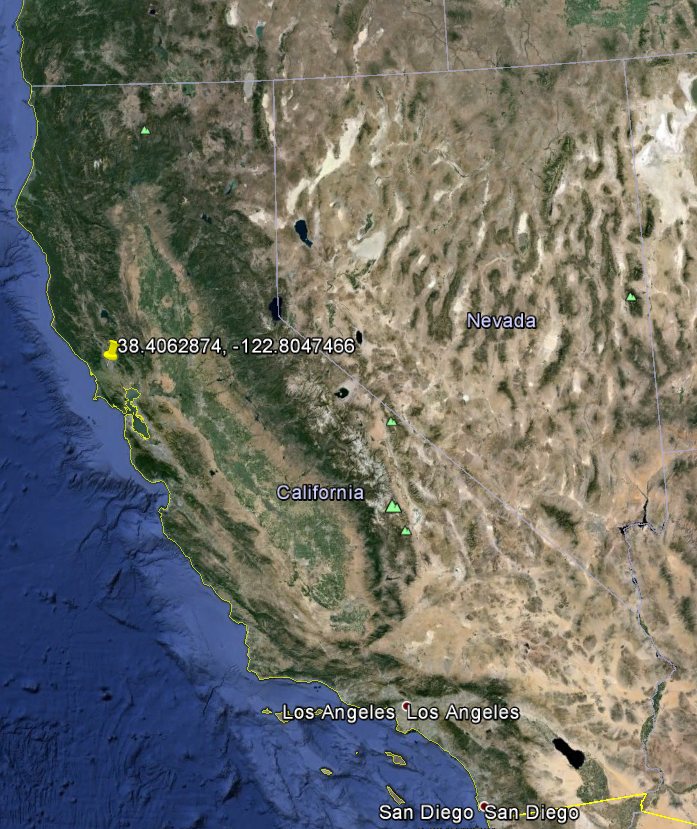
The cataloging metadata had some cool features, including geocoding for the location (in this case for Joe Rodota Trail, where they apparently were).


I guess they figured the group shot was over.  L-R background Joe Miller, Jess Behere, foreground in overalls- E. Yeager, Ron Garloff, Jim Phillips and Jasper Nosler behind pole.

Pictured L-R: Joe Miller, Ron Garloff, Jasper Nosler, Jim Phillips and E. Yeager.  

Not much has changed in that stretch of railway, as this Google Earth snapshot shows:
Now called the Joe Rodota Trail in Sebastopol, California, it is a bike path.


Sebastopol California Social Media Community Videos made a short video about the trail/path:


I always have to compare where these places are relative to me:

Sebastopol location, from Google Earth Pro.


© 2015 Copyright, Christine Manczuk, All Rights Reserved.