Showing posts with label Indiana. Show all posts

Saturday, February 28, 2026

Brick Walls: Now and Forever? (Maybe not)

Every genealogist has them; those ancestors whose lives are not an open book, whose records (and sometimes even names) we haven't found anywhere we've looked.

Now I've just started using AI to help with my research and here is the result of my first trial.

My maternal third great-grandfather William T. Slater from "York County, England" made his first known appearance applying for citizenship in Jefferson County, Indiana, in 1818. All we have of this record is a transcription so I thought it might be interesting to contact the courthouse to see what else might be available. Alas! 


At the time, it was feared that all the court records had been lost but according to the link above, it seems that because the fire was confined to the cupola, roof and top floor, they survived. So I asked Perplexity and Claude "What court records are survive in the Jefferson County Courthouse, in Madison, Indiana?"

Both agree that since before 1906, naturalization was handled by local courts, my ancestor's application could possibly be there (unless destroyed in earlier disasters, including two other fires in1853 and 1859). Both also give information about contracting the court clerk both by phone and email.

Now the rest is up to me!

Note: We've written quite a bit about William here on the blog, including what could possibly be his family in the Yorkshire West Riding--although Christine, who is the DNA expert around here, hasn't found a connection. A search of the blog will find the other posts about him.  

© 2026 Copyright, Christine Manczuk, All Rights Reserved.

Friday, September 21, 2018

Family Friday: Pauline, Bernice & Kenneth Brown - About 1909

I love this studio portrait of Hattie Pauline (1903-1981), Lillian Bernice (1905-2004) and William Kenneth Brown (1907-1979) who are some of my maternal third cousins, three times removed.* They were born in LaGrange County, Indiana and appear to have lived in that state their whole lives.

["Top to Bottom: Pauline, Bernice, Kenneth Brown about 1908-1910." 
Added to her Ancestry.com family tree by elynn7.]


*As you can see we're related through the Worden line.

[Ancestry.com]


© 2018 Copyright, Christine Manczuk, All Rights Reserved.

Monday, August 27, 2018

Further Speculation about William T. Slater's Yorkshire Roots

When William T. Slater, one of my maternal third great grandfathers, applied for citizenship in Jefferson County, Indiana, he stated he was 27 years old and a native of  "York County, England."* We've never been able to definitively trace William's antecedents to a specific location in Yorkshire so when this book came to my attention** I decided it might be worth a try:


I first looked on worldcat.org hoping to find it in a local library but the nearest copy is 629 miles away in Salt Lake City and Amazon's vendor's asking price is $135. Fortunately I was able to find a bookseller in England for a fraction of that, although it turned out I had to pay extra because it's a brick of a book.

When my copy arrived I couldn't wait to see if Slater rates an entry. And it does! (However, Tiller which we believe to be his middle name, doesn't appear.)

According to Mr Redmonds this although this surname can be found thinly spread in many other English counties, it's in "the Pennine area where the name was exceptionally common: Lancashire, West Riding [Yorkshire], Staffordshire, and Derbyshire."

Concentrating on the West Riding this list of Slaters in Yorkshire that Christine found via FindMyPast several years ago hasn't changed materially.***

[findmypast.org]

Christine notes that the Wakefield individual died the in 1815 and I found that the Thornton William Slater was enumerated there in the 1851 English Census which leaves the one erroneously listed as born in Morley. Looking at the baptismal record the actual parish of birth was Leeds and the family's abode was Mill Shaw [Millshaw] a hamlet in Beeston which was a center of woolen cloth manufacture and is still considered an industrial area.


[Ancestry.com. West Yorkshire, Non-Conformist Records, 1646-1985 [database on-line]. Lehi, UT, USA: Ancestry.com Operations, Inc., 2011. Original data: West Yorkshire Nonconformist Records. Bradford, Calderdale, Kirklees, Leeds, and Wakefield, England:
West Yorkshire Archive Service.]

No occupation was listed for William Slater [Senior] but the only time that column seems to have been filled was only when the father was identified with a trade like mason, cordwainer, or clothier which is very seldom. Apparently being a mill hand wasn't deemed worthy of note. The initials purported to be the "Signature of Parents" are all in the same handwriting all throughout the register which would seem to indicate that none of the couples were expected to be able to sign their names.

I've found baptism records for four other children of this William and Mary Slater: Joseph (born 1789 in Churwell); Isaac (born 1790 in Millshaw); Betty (born in Beeston 1794) and Benjamin (born in 1806 in Mill Shaw).****

There's no proof that my ancestor was the William Slater born to this family but I think it's a definite possibility. To someone growing up in the bleak atmosphere of an early Industrial Revolution woolen mill town  and facing a future of unrelenting toil might well find "taking the King's shilling" an attractive idea since the bounty offered could equal several months pay.*****

However he found himself on board one of the over fifty ships comprising the British naval fleet invading Louisiana in 1815, it's clear that William Slater chose to end his military career then and there.


*Christine posted about her discovery of this record here.
**Sadly I don't remember who/where I saw the reference to this book so I can't give them credit.
***Except for the addition of a William Slater born in Whitby, North Yorkshire, in 1790 whom I'm ignoring for now.
****So far I haven't found other records for any these people.
*****Leeds, located 50-60 miles from the nearest port, wouldn't seem to be a likely place for a naval press gang.


© 2018 Copyright, Christine Manczuk, All Rights Reserved.

Wednesday, June 14, 2017

Finding a Hole in One of Bonnie's Brick Walls

Information Mary Agnes Lynch, one of Bonnie's maternal great great grandmothers, has been in short supply. The family story is that she was born in Castlebar, County Mayo, Ireland, but nothing further was known about her parents.

Fortunately her obituary confirmed the date and place of her death but her name didn't appear on the death index or a death certificate. State-level registration began in 1900, six years before her death so where could the records be?

[The Fort Wayne Journal-Gazette, 1 July 1906, page 6. Source: NewsPapers.com]


Using her date of death I was able to locate her death certificate indexed as Mrs. Mary E. O. Conner.
Now that we know her parents' names maybe we can find out more about her heritage.

[Ancestry.com. Indiana, Death Certificates, 1899-2011 [database on-line]. Lehi, UT, USA: Ancestry.com Operations, Inc., 2015.
Original data: Indiana State Board of Health. Death Certificates, 1900–2011.
Microfilm. Indiana Archives and Records Administration, Indianapolis, Indiana.]


This branch of Bonnie's family was Protestant which may make it harder to find out more about them.


© 2017 Copyright, Christine Manczuk, All Rights Reserved.

Monday, June 12, 2017

Wedding Day: Jane J. O'Brien (1876 - 1974) and Roy O'Connor Trainer (1873 - 1948)

While I'm visiting her here in France I've been looking at what can be learned about my best friend Bonnie's ancestors using Newspapers.com. Since several generations of her mother's lineage lived in Fort Worth, Indiana, there's quite a bit, starting with this report of the marriage of her grandparents which took place on August 19, 1902.

[20 Aug 1902, Page 5 - Fort Wayne Weekly Sentinel at Newspapers.com]


Although her mother's family passed down lots of photos, stories, mementos and even a genealogical scrapbook created by her Aunt Janette, this clipping had quite a few details about that long-ago day that were new to Bonnie

Here's a photo of Fort Wayne's Catholic Cathedral of the Immaculate Conception where the ceremony took place. The priest who married the couple was Father William D. Sullivan who had just been ordained the previous May.

[Fort Wayne Indiana~Cathedral of the Immaculate Conception~Catholic Church~1907.
Source: HipPostcard.com]


There must have been pictures of the wedding party in the family's collection, but none seem to have made their way to France. In their place here's a portrait of Jennie taken about 1900 followed by the 1902 city directory entry for the law firm she had worked for.

[Courtesy of Bonnie Groves Poppy]

[Fort Wayne, Indiana, city directory by R.L. Polk & Co.1902. Source: Archive.org.]


There doesn't appear to be an available picture of Roy as a young man however I did find an earlier photo of the factory where he worked.

[From c.1890 Fort Wayne (Packard) Organ Factory catalog.


From the description of her attire as "a costume of tan silk mull, over turquoise silk taffeta" it's clear that Jennie didn't wear a typical white wedding dress. And the description of her hat as "a large white beaver, with ostrich plumes and turquoise velvet trimmings" makes me hope that a wedding photo is forthcoming!

I imagine Jennie's dress would have had the same general lines as this 1902 wedding dress worn by a bride in Montana.


[The Montana Historical Society Collection Wedding Dresses Pinterest Board]


As for the fashionable hat shapes in 1902 here are some Easter bonnets.

[The Delineator "Pretty Hats for Easter" 1902 from Pinterest]


However we should keep in mind that Jennie's large hat was described as white beaver which means it was furry (whether real or artificial material is unclear) This black beaver hat (from the Philadelphia Museum of Art and described as early 20th century and probably later than 1902) shows the texture of the fur contrasted with ostrich feathers.

[Woman's Hat, Label Strawbridge & Clothier, Philadelphia.
Philadelphia Museum of Art, Gift of Emily W. Cunningham]


© 2017 Copyright, Christine Manczuk, All Rights Reserved.

Sunday, January 8, 2017

Gone for Soldiers? Sailors? Marines? William T. Slater (About 1794 - 1847)

This morning the Library of Congress* reminded me that today is the 202nd anniversary of the Battle of New Orleans. Family history gives this date (or sometime near it)** as the moment when one of my maternal third great grandfathers Yorkshireman William T. Slater*** decided he didn't want to be English any more.

[Battle of New Orleans…the 8th of January 1815. William Edward West, artist; Philadelphia: Published and sold by J. Yeager, engraver, [1817]. Popular Graphic Arts. Prints & Photographs Division]

Three years later he was applying for citizenship in Jefferson County, Indiana.

*Through their Digital Collections' Today in History which is my home page.
**You can find an excellent overview of the War of 1812 leading up to the two-month long campaign now known as the Battle of New Orleans here. I had never considered the terrain my great great great grandfather faced upon leaving his post, but this National Park Service photo of a Louisiana bayou included by the author makes it clear that it must have been daunting--even without taking into account the wildlife that's found there.


[Alligator crossing the road, Jean Lafitte National Park
Both photos courtesy of the National Park Service]

And he wouldn't have had the benefit of the safety information currently distributed by the Park Service--an example:
Think like an alligator. Alligators are surprisingly fast: on land they can move quickly over short distances and in the water they're unstoppable. Remember to keep your distance and stand tall. Alligators judge their prey by its size, and if you are kneeling down to take a picture, you're a much more tempting target than if you're standing up.
***Allegedly part of the British invasion forces, you can read more about William T. Slater in my original post and see what more Christine was able to find out about him here.

© 2016 Copyright, Christine Manczuk, All Rights Reserved.

Tuesday, December 15, 2015

John Hill Messinger Was a Democrat in 1840

This were going to be disappointed soon enough.  Van Buren was about to lose.  "Franklin Township," Indiana Democrat (Indianapolis, Indiana), 4 Jul 1840, p. 3, col. 2; digital image, GenealogyBank (http://www.genealogybank.com: accessed 15 Dec 2015).

John Hill Messinger Was a Democrat in 1840.  Well, that is what I am assuming from a notice* in the Indiana Democrat on July 4, 1840, where John Hill Messinger is listed among the "Commitles[Committees?] of Vigilance" for the Franklin Township Van Buren Club. Franklin Township is in the southeastern part of the greater Indianapolis area. The notice was for a committee to draft a constitution for a "Democratic Association" in Franklin Township, Marion County, Indiana, to be call "The Franklin Township Van Buren Club."

Martin Van Buren, former New York governor and previous Secretary of State and Vice President to Andrew Jackson, was the incumbent President, and was about to be voted out by Whig William Henry Harrison.

A nice summary about that election comes from the Virginia Historical Society:
In a national convention, the Whig Party united to nominate William Henry Harrison, who had been its most popular candidate in the 1836 election. Despite a severe and prolonged economic depression that had plagued his first term in office, President Martin Van Buren continued to have the support of the Democratic Party. The antislavery Liberty Party nominated James Birney as its candidate. Harrison’s nickname, “Old Tippecanoe,” came from his victory over the Creek Indians at the battle of Tippecanoe in 1811. The result of the nomination of John Tyler for vice president was a rhyming campaign slogan: “Tippecanoe and Tyler Too."
The opposing Democratic Party made a huge tactical blunder when it attacked Harrison’s character. A Democratic newspaper article joked that he would be content to quit the race and retire to his log cabin for a pension and a barrel of hard cider. Even though the Harrison came from an aristocratic Virginia family and currently lived in a mansion in Ohio, the Whigs turned this comment into a campaign symbol and began to promote its candidate as a common “man of the people” who lived in a log cabin and was always ready to greet visitors who ventured by with a cup of refreshment. Harrison became the first candidate to give speeches on his own behalf, but he confined himself to talking about his military career. As opposed to its candidate’s rustic image, the Whigs mocked Van Buren as an effete dandy who drank from gold goblets in the White House while the people suffered from hard times. Because Van Buren was too well known, the Democrats could not project the same “common man” persona for their candidate and were unable to compete with this new type of campaign strategy.
More people voted in this election than in any previous one (80 percent of eligible voters). Harrison received 234 electoral votes to 60 for Van Buren. After only a month in office, however, Harrison caught pneumonia and died. There were no constitutional guidelines for succession after the death of a sitting president, so John Tyler merely assumed the full powers of the president, thus establishing the precedent that the vice president would actually serve as president rather than as acting temporary chief executive until the next election. Virginia cast its 23 electoral votes for Martin Van Buren.
John Hill Messinger and his friends probably wore ribbons similar to this during the election.
Image from the Virginia Historical Society.


Here's more on the 1840 US Presidential election.


* "Franklin Township," Indiana Democrat (Indianapolis, Indiana), 4 Jul 1840, p. 3, col. 2; digital image, GenealogyBank (http://www.genealogybank.com: accessed 15 Dec 2015).


© 2015 Copyright, Christine Manczuk, All Rights Reserved.

Wednesday, November 25, 2015

Working on Wednesday: William T. Slater (About 1790? - 1847), Deserter, Farmer, Justice of the Peace

Up until 1818 when William Slater applied for naturalization in Jefferson County, Indiana, all the information we have about this maternal 3rd great grandfather comes from family stories that I haven't been able to verify.*

According to Slater family lore, William first arrived in the United States on a ship that was part of the British invasion fleet that attacked New Orleans in 1814-15, and at some point he went over the side of the ship and never looked back.

It's been presumed that William was a sailor in the Royal Navy but I think it's possible that he could have been a marine or a soldier in the British Army.**

[Painting depicting the Naval Battle of Lake Borgne, Louisiana, between U.K. and U.S. forces in the War of 1812, by Thomas L. Hornbrook (active 1836-1844). (Image Courtesy of the U.S. Naval Academy Museum, Annapolis, Maryland.) Found on Naval History Blog. ]

We can't find him in the 1820 U.S. Census but on July 20th of that year he married (Emily) Jane Wilson in Crawford County, Indiana, and the couple's eight oldest children were born in that state. By 1830, they were living in farther west in Pike County.

[1830; Census Place: Jefferson, Pike, Indiana; Series: M19; Roll: 26; Page: 373; Family History Library Film: 0007715. Ancestry.com. 1830 United States Federal Census [database on-line]. Provo, UT, USA: Ancestry.com Operations, Inc., 2010.  Images reproduced by FamilySearch. Original data: Fifth Census of the United States, 1830. (NARA microfilm publication M19, 201 rolls).
Records of the Bureau of the Census, Record Group 29. National Archives, Washington, D.C.]


But their ninth child, my great great grandfather George W. Slater (1832-1899), was born in Illinois, signalling the family's move to Lawrence County*** where they remained through 1840. (Their last two children were born there also.)


[Year: 1840; Census Place: Lawrence, Illinois; Roll: 63; Page: 171; Image: 345; Family History Library Film: 0007643. Ancestry.com. 1840 United States Federal Census [database on-line]. Provo, UT, USA: Ancestry.com Operations, Inc., 2010. Images reproduced by FamilySearch. Original data: Sixth Census of the United States, 1840. (NARA microfilm publication M704, 580 rolls).
Records of the Bureau of the Census, Record Group 29. National Archives, Washington, D.C.]


By 1843 the Slaters had moved again, this time in the northeastern corner of South Audubon Township in Montgomery County, Illinois. Three years later William was elected the first Justice of the Peace so he must have been a respected citizen.

[History of Montgomery County, Illinois, Illustrated Atlas Map Of Montgomery County, Ill. Carefully Compiled from Personal Examinations and Surveys. 1874. Published by Brink, McCormick & Co., of Illinois. Duval & Hunter, Lithographers, Philada, Pa.
Source: David Rumsey Historical Map Collection.]


William T. Slater died in 1847; his place of burial is unknown.

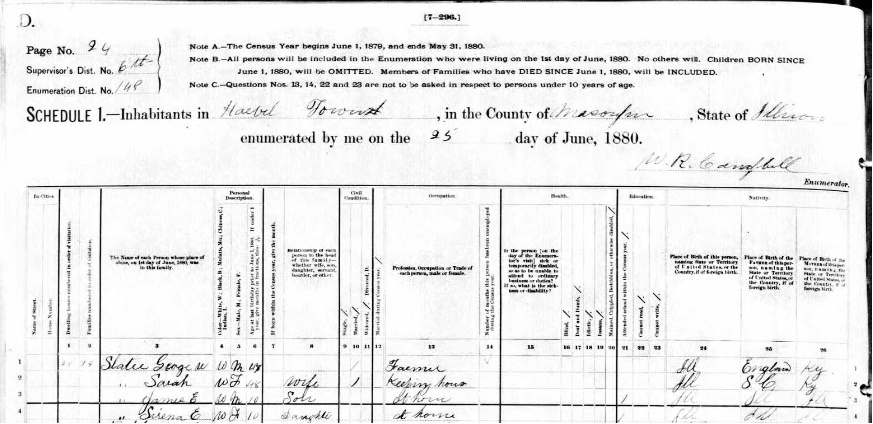
Family tradition has one more bit of information about William, asserting that he was born in Yorkshire. Unfortunately there are a lot of Slaters in Yorkshire so that hasn't helped locate a birth record for him. As this 1880 U.S. Census record shows, his children list his place of birth as "England."

[Year: 1880; Census Place: Harvel, Montgomery, Illinois; Roll: 237; Family History Film: 1254237; Page: 283D; Enumeration District: 149; Image: 0567. Ancestry.com and The Church of Jesus Christ of Latter-day Saints. 1880 United States Federal Census [database on-line]. Provo, UT, USA: Ancestry.com Operations Inc, 2010. 1880 U.S. Census Index provided by The Church of Jesus Christ of Latter-day Saints. Original data: Tenth Census of the United States, 1880. (NARA microfilm publication T9, 1,454 rolls). Records of the Bureau of the Census, Record Group 29. National Archives, Washington, D.C.]


*Yet. (But not for lack of trying.) And we're assuming that he didn't change his name after his unauthorized departure from the Royal Navy.
**I didn't grow up as a Slater and I've only heard this story once, from my cousin Susan. If the belief that William was a sailor is based on his desertion by "going over the side" that doesn't take into account the fact that all Royal Navy ships had marines on board or that the British Army troops had all arrived by ship too.
***Where William's father-in-law John Wilson had bought land in 1825.


© 2015 Copyright, Christine Manczuk, All Rights Reserved.

Monday, November 23, 2015

Monday Is for Mothers: Emily Jane Wilson (About 1800 - Before 1850)

Another female ancestor who is represented in very few records is Emily Jane Wilson, my maternal 3rd great grandmother, who was born in either Barren or Jefferson County, Kentucky, in about 1800. She was the third child and second daughter of  Ruth (Welborn) and John Wilson who were both natives of Rowan County, North Carolina.

[A Map of The Western Part of the Territories belonging to the United States of America. Drawn from the best Authorities. Engraved for Imlay's Topographical Description of that Country. T. Conder Sculpt. Published June 1st 1795, by J. Debrett, Picadilly, London.
Source: David Rumsey Historical Map Collection]

By 1820 the Wilson family had moved on to Crawford County, in southern Indiana, where Emily Jane married William T. Slater on July 30th of that year.

[Indiana. Drawn and Published by F. Lucas Jr., Baltimore. (1822). Source: David Rumsey Historical Map Collection]


By the 1830 U.S. Census the Slater family were living in Pike County, Indiana, west of Crawford County and two years later they had moved on to Illinois, first to Lawrence County in the eastern part of the state and finally to Montgomery County, to the south of the state capitol in Springfield.

[Illinois By David H. Burr New York. Engd by Illman & Pilbrow. Entered ... 1834 by Illman & Pilbrow ... New York.
Source: David Rumsey Historical Map Collection]

William and Emily Jane had eleven children and my descent is from their youngest boy, George W. Slater (1832-1899).

William died in 1847 in Coffeen, Montgomery County, Illinois. We assume that Emily Jane died before 1850 because there's no census record for her in that enumeration. There's no record of where she's buried.

And we have a presidential connection through Emily Jane's older sister Christina (1798-about 1834) whose great great granddaughter Madelyn Lee Payne (1922-2008) was Barack Hussein Obama's beloved maternal grandmother.


© 2015 Copyright, Christine Manczuk, All Rights Reserved.

Saturday, November 7, 2015

Benjamin Tibbetts Kills a 7-Foot Rattler in Dearborn County, Indiana about 1818

This comes at the end of Cotton's chapter on Manchester Township, Dearborn, Indiana.  From A. J. Cotton, "Cotton's Keepsake. Poems on Various Subjects," 1858, Applegate & Co (Cincinnati, OH), p 482; digital images, Internet Archive (https://archive.org/stream/cottonskeepsakep00cott#page/n7/mode/2up : accessed 7 Nov 2015).


That's a big snake.  Cotton's book was published in 1858, so I have extrapolated the snake incident to being about 1818, when the Tibbetts family had newly arrived.  I don't think they had these kinds of snakes in Maine, where they came from!

Cotton's book is mostly about Dearborn County, Indiana, and covers townships, villages, towns, and even schoolhouses.  Worth a look if you have ancestors from this area.


Benjamin Tibbets in the 1820 Census.


How I'm related to Benjamin Tibbetts (1769-1853).


© 2015 Copyright, Christine Manczuk, All Rights Reserved.