Friday, February 13, 2015

Family Friday: Currey

In this color slide taken in San Diego about 1948, I am posed with Delbert Artemus Currey (1869 - 1954) and his wife Ethel Viola (von) Plank (1882 - 1961), the parents of the father* who raised me. We are standing in the walled backyard of the house Dad built for them next door to our home. The dog's name was Lulu.

[Photo from my collection]
*Harold Delbert Currey (1902 - 1981)

© 2015 Copyright, Christine Manczuk, All Rights Reserved.

Wednesday, February 11, 2015

Fantastic Find: Magna Carta

© National Portrait Gallery, London]

As the 800th anniversary of the signing of the original charter by King John on June 15, 1215 approaches later this year, the Magna Carta has been getting even more attention than usual, including a U.S.visit by one of the earliest versions of an original document last year.

[Image source: Linklaters.com]

The recent discovery in Sandwich of a damaged original of the 1300 version issued by King Edward I* has been in the news lately, delighting scholars and opening the possibility that there are more of these documents still to be found. The History Blog has an excellent post about it here.

In case your medieval Latin is a bit rusty, the legal firm of Linklaters has provided us with a Magna Carta Viewer that allows you to examine the document in detail and in translation.

*Succeeding English kings typically issued their own verions of the Charter.

© 2015 Copyright, Christine Manczuk, All Rights Reserved.

Working on Wednesday: Samuel Worden (1646 - 1716), Doctor and Landowner

My maternal ninth great grandfather Samuel Worden was born in Yarmouth in Plymouth Colony in about 1646, the first male of his family to be born in the New World. He was the grandson of Old Peter Worden, the hatter from Lancashire who died shortly after he and his only son, another Peter, arrived in Yarmouth in about 1638.

[Novi Belgii Novæque Angliæ : nec non partis Virginiæ tabula multis in locis emendata 
Visscher, Nicolaes, 1649-1702. Amsterdam?, 1685
Library of Congress Geography and Map Division Washington, D.C. 20540-4650 ]

Samuel was still living in Yarmouth when he and Hopestill Holway were married sometime before May of 1665* and the first two of their ten children had already been born when he was proposed for a freeman.

In 1668 there was a court case in which two men were accused and convicted of forcing their way into Samuel's house while he was gone and trying to rape his wife and her sister who was staying with her. From the Plymouth Colony Court Record of October 20th of that year we learn:
"In reference vnto the complaint of Samuell Worden against Edward Crowell and James Maker, for goeing in his absense into his house in the dead time of the night, and for threatening to break vp the dore and come in att the window, if not lett in, and goeing to his bed and attempting the chastity of his wife and sister, by many lacinous carriages, and affrighting of his children, the Court haue centanced them, the said Edward Crowell and James Maker, to find surties for theire good behauior, and pay each of them a fine of ten pounds to the vse of the collonie, and alsoe to defray all the charge the said samuell Worden hath been att in the vindecation of his wifes innosensy, or be seuerally whipt. 
And the said Crowell and Maker chose rather to pay the fine and giue bonds for theire good behauior vntill the Court of his ma[jestie] to be holden att Plymouth in March next. 
Vpon theire humble petition to the Court, they remitted vnto each of them the sume of foure pounds of the said fines."
Samuel was named as sole executor and main beneficiary of his father's will, with codicil, which was probated and his estate inventoried in March of 1680/1. His mother Mary** received a life-interest in land, houses, household goods and livestock "for her support" and Samuel was to provide her with firewood and hay. After his widow's death Peter directed that his real estate was to go to Samuel while the goods and livestock were to be divided among their three daughters. Samuel, as the only surviving son, received nearly all the land his father owned including those in "Old England" some of which came to his father "through my wife"and the rest probably being those mentioned in his grandfather's will as "all my lands, leases, tenements with goods moveable and unmoveable in the town of Clayton in the county of Lankester."

["Massachusetts, Plymouth County, Probate Records, 1633-1967," images, FamilySearch (https://familysearch.org/pal:/MM9.3.1/TH-1942-31878-3082-51?cc=2018320&wc=M6BX-F29:338083801 : accessed 11 February 2015), Wills 1633-1686 vol 1-4 > image 514 of 616;
State Archives, Boston.]

By then, more than 40 years after the Wordens first immigrated to Massachusetts, neither Samuel nor his mother knew much about the property in England and the inventory describes this item as "an interest in house and land and mony in Old England not knowing what it may be worth." I can't tell if any value was put on this item as it's unreadable.

["Massachusetts, Plymouth County, Probate Records, 1633-1967," images, FamilySearch (https://familysearch.org/pal:/MM9.3.1/TH-1951-31878-3089-89?cc=2018320&wc=M6BX-F29:338083801 : accessed 11 February 2015), Wills 1633-1686 vol 1-4 > image 516 of 616; 
State Archives, Boston.]

Although he remained in Yarmouth until about 1697, as early as 1682 Samuel was probably looking to move as he's one of the men who petitioned the Plymouth Colony Court for permission to leave their present town. But it wasn't until 1693 he that bought 250 acres in what is now Kingstown, Rhode Island, from the estate of the late governor Benedict Arnold. Seven month later he sold his property in Yarmouth, retaining only one-half an acre that was the burial ground of his grandfather Peter, parents Peter and Mary, and several other relatives.

Samuel was active in establishing Kingstown and Worden Pond, the state's largest natural pond covering 1,051 acres, takes its name from him.

[Roger Williams Park Museum of Natural History and Planetarium, "Worden Pond, Block Island," in Virtual Exhibits, Item #453, http://sos.ri.gov/virtualarchives/items/show/453 (accessed February 11, 2015).]

In 1702 Samuel deeded some of his land to his son Isaac and they both joined together to sell approximately 250 acres to Edward Greenman in 1708, the deed being signed by Samuel, Isaac, Hopestill and Rebekah, Isaac's wife.

The next year Samuel bought a total of 150 acres in Stonington, Connecticut, about 35 miles west of Kingstown, and he and Hopestill lived there until her death on September 13, 1715, at the age of 70 and was buried in Wequetequock Burial Ground. The Norwich Connecticut Town Clerk's office records has this quote from Samuel:
"It was to me that woeful day in which my dear and tender and loving wife departed this life and was buried on ye 15th."
We know that Samuel married again because he made provision for his widow Frances (West) through a deed granting the reversion of all his land to his son Isaac "excepting if I should marry again, the widow shall have benefit of biggest room in my house half of cellar, and also my son Isaac to keep 2 cows and 1 horse both winter and summer for her use and provide firewood for her." Samuel died intestate two weeks later on August 26, 1716, and the deed was recorded two days later.

He's buried in the same cemetery in Stonington as Hopestill.****

[photo by John Beckstein, 5/25/2008, on www.findagrave.com;
retouched, Clinton Macomber, Oct 2010]

Frances refused to administer Samuel's estate, requesting that Isaac should be named administrator instead, which he was. Unfortunately Isaac only survived his father by two years and the estate was finally settled by his widow Rebekah in 1718.

It's clear from records that he owned property but why do we think Samuel Worden was a doctor? In several of the land records he is referred to as Dr. Samuel Worden and his death record in Stonington also names him as a doctor. There is no evidence pointing to what medical training he had, if any. For an 1893 look back at Colonial medicine, look here.

A lot of my information was gathered by Waite W. Worden in his book "Worden: A Weir in the Valley" privately printed in 1992 and available here.

*When Hopestill is described as the "wife of Samuel Worden" in the record of the inheritance paid to the children of Joseph Holway, Sr.
**Her maiden name is unknown. She outlived her husband by seven years.
***majestie *i.e., the King
****I haven't located where Frances Worden is buried. It's possible that she's the Frances Werden who married Captain Manassas Minor in 1721.


© 2015 Copyright, Christine Manczuk, All Rights Reserved.

Tuesday, February 10, 2015

Google Pro is Now Free!

https://lh4.googleusercontent.com/-z1MZG-qJOcU/AAAAAAAAAAI/AAAAAAAAaRY/FmyqM4wBZnQ/s120-c/photo.jpg

I have used the free, basic Google Earth for years.  Now Google Earth Pro, which used to be about $400, is now free to download!  More toys to play with!

Instructions at Google Maps blog.


© 2015 Copyright, Christine Manczuk, All Rights Reserved.

What's in a Name: Jesse

I don't recall ever having met a man named Jesse but in my direct line there are seven: three in the paternal line, all Warrens (Virginia and Georgia); four maternal ancestors including two Tomlinsons (Maryland), a Webb (born in Texas but with a father from Pennsylvania) and a Sill (Pennsylvania).

In the late 18th and early 19th centuries every branch of the Warren family in and around Hancock County, Georgia, seems to have a Jesse in each generation which makes sorting them out a challenge. Fortunately the three in my line are a father, son and grandson, all of whom are clearly identified through probate records from the mid-1820s. (As for exactly who was the father of the oldest Jesse, that requires more research which we hope to accomplish with a visit to Georgia later this year.)

Behind the Name gives us this etymology:
"From the Hebrew name יִשַׁי (Yishay) which possibly means 'gift'. Jesse is the father of King David in the Old Testament. It began to be used as an English given name after the Protestant Reformation."
In Christian art the Jesse Tree is a depiction of the ancestry of Jesus as a descendant of the House of David.
[Detail of a miniature of the Tree of Jesse. Origin: France, N. E. (Burgundy) 
Attribution: later addition under Louise de Savoie and Master of the Burgundian Prelates

© 2015 Copyright, Christine Manczuk, All Rights Reserved.

Monday, February 9, 2015

Monday Is for Mothers: Celestine Letitia Herrod (1836 - 1921)

When my paternal great great grandmother Celestine, also known as Celeta, married John Warren Avery in April of 1857, I don't know what hopes the young couple had for their future but their lives together would prove to be much harder than they could have imagined.

By 1860 Celestine* and John were part of the household of a wealthy farmer in Holmes County, Mississippi. There's no clue in the U.S. Census records what they were doing there and they aren't listed as owning any real or personal property.
[Ancestry.com. 1860 United States Federal Census [database on-line]. Provo, UT, USA: Ancestry.com Operations, Inc., 2009. Images reproduced by FamilySearch. Original data: 1860 U.S. census, population schedule. NARA microfilm publication M653, 1,438 rolls. Washington, D.C.: National Archives and Records Administration, n.d.]

By the time their first child was born the American Civil War had begun and in 1862 John enlisted in Company D of the 35th Mississippi Infantry along with several of his cousins. During his service he was captured by Union forces twice and wounded at least once. There are no records that tell us where Celestine and her babies were during this time.

In the 1870 U.S. Census the Averys had moved to rural Winston County, Mississippi, and still apparently owned nothing.* The youngest child is a 9-month old boy "not named" who never appears in any other records we know of and undoubtedly died very young.

[Ancestry.com. 1870 United States Federal Census [database on-line]. Provo, UT, USA: Ancestry.com Operations, Inc., 2009. Images reproduced by FamilySearch. Original data: 1870 U.S. census, population schedules. NARA microfilm publication M593, 1,761 rolls. Washington, D.C.: National Archives and Records Administration, n.d.Minnesota census schedules for 1870. NARA microfilm publication T132, 13 rolls. Washington, D.C.: National Archives and Records Administration, n.d.]

My great grandmother Caroline Celestine Avery was eight at the time of the 1880 U.S. Census which finds the Averys in LaFayette County, Mississippi, where John's occupation is listed as farm laborer. Two little boys, Henry and Herbert, have also be added to the family.


[Ancestry.com and The Church of Jesus Christ of Latter-day Saints. 1880 United States Federal Census [database on-line]. Provo, UT, USA: Ancestry.com Operations Inc, 2010. 1880 U.S. Census Index provided by The Church of Jesus Christ of Latter-day Saints © Copyright 1999 Intellectual Reserve, Inc. All rights reserved. All use is subject to the limited use license and other terms and conditions applicable to this site. Original data: Tenth Census of the United States, 1880. (NARA microfilm publication T9, 1,454 rolls). Records of the Bureau of the Census, Record Group 29. National Archives, Washington, D.C.]

During the 1890s several of the Avery children (including my great grandmother) found spouses and left home, and in 1899 Celestine is listed as the widow of John in the Meridian, Mississippi, city directory. Two of her children were living at the same address.

[Directory Title : Chittenden's Meridian City Directory 1899.
Ancestry.com. U.S. City Directories [database on-line]. Provo, UT, USA: Ancestry.com Operations, Inc., 2010.]

Celestine was still living in Meridian in the 1900 U.S. Census as the head of an extended family that included her daughter Caroline (Carrie) and her husband Tracy D. Porter and their two sons, and her grandson Henry Houst, the orphan of her daughter Susan. Of her eight children, only two are still alive.

[Ancestry.com. 1900 United States Federal Census [database on-line]. Provo, UT, USA: Ancestry.com Operations Inc, 2004. Original data: United States of America, Bureau of the Census. Twelfth Census of the United States, 1900. Washington, D.C.: National Archives and Records Administration, 1900. T623, 1854 rolls.]

The 1910 U.S. Census records Celestine's residence as that of her son Henry and his family in Mississippi City.

[Ancestry.com. 1910 United States Federal Census [database on-line]. Provo, UT, USA: Ancestry.com Operations Inc, 2006. Original data: Thirteenth Census of the United States, 1910 (NARA microfilm publication T624, 1,178 rolls). Records of the Bureau of the Census, Record Group 29. National Archives, Washington, D.C. For details on the contents of the film numbers, visit the following NARA web page: NARA.]

We know that she was living in Gulfport, Mississippi, in 1915 because there's a newspaper item that mentions her as 'the aged mother of Mrs. T. D. Porter" who has been visited by a niece.

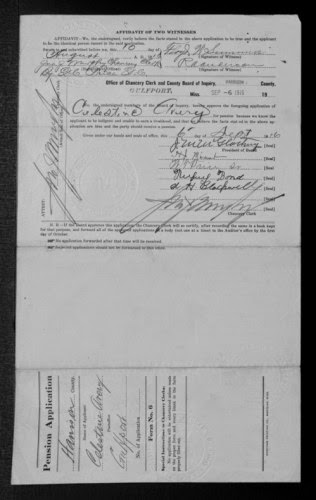
In 1916 Celestine, who states she's living with her daughter, applied for a pension from the state of Mississippi as the widow of a Confederate soldier, something that was only granted to those in extreme need. Her answer to the final question is stark:
Q. Have you any relations or connections whose legal or moral duty it is to support you?
Answer. "No--children unable to support me."
She was granted her pension a month later. I haven't been able to discover what amount she received but  typically it would have been no more than $40 or $50 per year.


[Mississippi Office of the State Auditor Series 1201: Confederate Pension Applications, 1889-1932. http://mdah.state.ms.us/arrec/digital_archives/pensions/print/13961]

By 1920 the extended Porter family, including Celestine, had moved to Shreveport, Louisiana.

[Ancestry.com. 1920 United States Federal Census [database on-line]. Provo, UT, USA: Ancestry.com Operations Inc, 2010. Images reproduced by FamilySearch. Original data: Fourteenth Census of the United States, 1920. (NARA microfilm publication T625, 2076 rolls). Records of the Bureau of the Census, Record Group 29. National Archives, Washington, D.C. For details on the contents of the film numbers, visit the following NARA web page: NARA. Note: Enumeration Districts 819-839 are on roll 323 (Chicago City).]

The final record we have is the Texas death certificate for Mrs Celestine Avery who died in Dallas on April 9, 1921.
[Ancestry.com. Texas, Death Certificates, 1903–1982 [database on-line]. Provo, UT, USA: Ancestry.com Operations, Inc., 2013. Original data: Texas Department of State Health Services. Texas Death Certificates, 1903–1982. iArchives, Orem, Utah.]

 The informant for the information on the death certificate was her daughter (and my great grandmother) Carrie with whom she had lived for at least the final five years of her life. Yet Carrie appears to have known practically nothing about her mother's parents. I suspect that Celestine, like many people who have lived through bad times, chose not to talk about her experiences.

*Her name is written as Christiner here.
**As John is listed as a farmer in this census but not owning anything he must have been renting land.

© 2015 Copyright, Christine Manczuk, All Rights Reserved.

Sunday, February 8, 2015

52 Ancestors in 54 Weeks: Week 15: Peder Faltinson (abt 1804-1864), My 3rd Great Grandfather

Fister kyrkje (this is the 1867 replacement of the original building)
I don't have much information about Peder Faltinson* so far except for what I've received from the family:
Peder Fallentinsen, according to Bjarne Sandvik, was from a family who owned their farm in Fister.  However, he fell in love with a woman who was from a 'hussman'--a sharecropper/tenant farmer--a step lower in the class level of society.  Peder F.'s father refused to allow the marriage, so they lived together anyway, and had two children out of wedlock with a third one on the way when Peder F.'s father finally gave in and allowed the marriage.  As a result, Peder F. lost the right to the farm, and himself became a huusman.  Rasmus was one of the 'uaegte' (out of marriage) children, but the bright note is that the reason Peder F. did it was Randi was the most beautiful girl in the area....
Berdines and Fallentin are Ben and Frank Fister, who changed their names when they came over to America.  martha Ovrebo has several photos of Frank, as a boy and his wedding photo, taken in Chicago.  There is also a photo of Berdines and Per, probably taken about 1896, in Stavanger, when he returned with his wife Mary and two of the boys, Roy and Lyle.


He was born about 1804 in Rogaland, Norway, possibly to Faltin Faltinson and Kari Asgautsdottar.  He married Randi Pedersdotter Folsvig (1804-1871) on December 29, 1834 in Fister kyrkje, Fister, Rogaland, when he was about 30  They had at least 8 children, including Rasmus Pederson (my 2nd great grandfather), who was born before they married, when Peder was about 23:
Rasmus Pederson (1827-1876)
Peder Pedersen (1832-?)
Kari Pedersdottar (1837-?)
Karn Serine Pedersdottar (1838-1839)
Valentin Pederson (1840-?)
Kasper Pederson (1843-?)
Karn Serine Pedersdottar (1846-?)
Jonas Pederson (1849-?)

According to family information, Peder Faltinson died in Rogaland on February 8, 1864.


*I am not sure what the "official" spelling of Faltin would be.  It seems to be a version of Valentine, and I've seen Fallentin, Faltin, and Valentin as variations.


© 2015 Copyright, Christine Manczuk, All Rights Reserved.