Showing posts sorted by relevance for query dna shared. Sort by date Show all posts

Saturday, October 29, 2016

Tip: Add Notes To Your DNA Matches at AncestryDNA

My mom and I share 3,483 centimorgans shared across 42 DNA segments, by Ancestry's calculation.  I found that out by clicking on the dark circle with the white "i" in the Predicted relationship info, and then copied and pasted the values in the comment section (see arrow).


For the past few years I've been using the comment section for each of my parents' DNA matches at Ancestry, noting any details I can figure out about the match, including shared cousins and any special mentions of certain names and places if they have a  tree to consult.  At a glimpse of the main match pages I can see how these people are related.

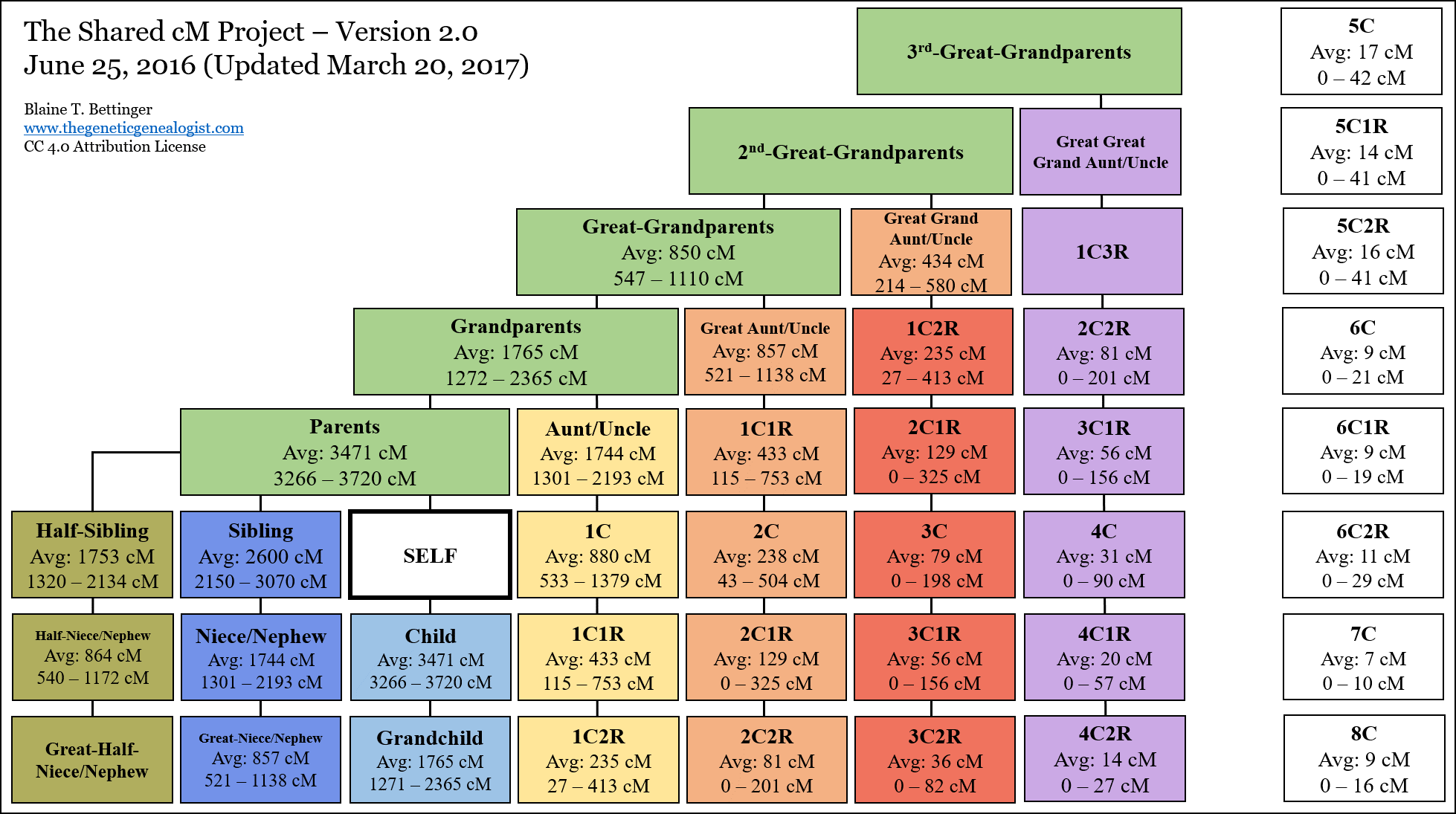
When I went to the Institute for Genetic Genealogy last week Blaine Bettinger recommended noting the shared DNA for each match, which totally makes sense, so I've been methodically going in and adding that information to each cousin match profile.  I had just ignored the shared DNA for a long time on Ancestry because I thought it was useless information without a chromosome browser, but even just knowing the amount of estimated shared data can be helpful, as seen in the following chart (by Bettinger):
The chart gives you typical amounts as well as the possible range of shared DNA.  If you have an ancestor match with someone at the estimated 5th cousin match (shared possible range 0-42cM), but actually share 235cM, you or the other person may not have all the correct info on your trees.  I have just such an issue with a match on my mom's side.
From: "Shared cM Project v2 updated". Via  - http://isogg.org/wiki/File:Shared_cM_Project_v2_updated.png#mediaviewer/File:Shared_cM_Project_v2_updated.png


Dad and I share 3,483 centimorgans shared across 39 DNA segments, by Ancestry's calculations.


NOTE:
At GEDmatch the cumulative numbers are presented differently, because it's a different program--and they do tell you approximately where you match, and you have control over the minimum segment cM (I think Ancestry's is 5(?)cM, GEDmatch default is 7cM):


Comparing Kit (*Pat) and (Christine Hartley)

Minimum threshold size to be included in total = 500 SNPs
Mismatch-bunching Limit = 250 SNPs
Minimum segment cM to be included in total = 7.0 cM

Largest segment = 281.5 cM
Total of segments > 7 cM = 3,587.0 cM
24 matching segments
Estimated number of generations to MRCA = 1.0


Comparing Kit (*George) and (Christine Hartley)

Minimum threshold size to be included in total = 500 SNPs
Mismatch-bunching Limit = 250 SNPs
Minimum segment cM to be included in total = 7.0 cM

Largest segment = 281.5 cM
Total of segments > 7 cM = 3,586.8 cM
25 matching segments
Estimated number of generations to MRCA = 1.0


© 2016 Copyright, Christine Manczuk, All Rights Reserved.

Tuesday, October 23, 2018

AncestryDNA Now Includes Automatic Display of Amount DNA Shared in Matching Lists

"Shared DNA:..." now shows at a glancethe amount of DNA shared with cousin matches.

For years now I've been methodically going through DNA matches and adding the amount DNA shared in the notes section of each match, but now it shows up as part of the results list.  One less step to do!


© 2018 Copyright, Christine Manczuk, All Rights Reserved.

Friday, June 23, 2017

A Helpful DNA Relationship Chart (Especially for AncestryDNA Users) - Shared cM Project Chart

Blaine Bettinger's shared cM chart available at the Autosomal DNA Statistics page of the International Society of Genetic Genealogy Wiki.  I use this all the time when I am analyzing my AncestryDNA matches.

Although AncestryDNA refuses to offer a chromosome browser, they do offer some helpful bits of information.  You can't see where you share DNA with any given cousin match, but you can see the total cM shared and how many segments shared.

A typical scenario: no tree, no chromosome browser, but at least I can see that Ancestry is confident of this match and it tells me how much DNA is estimated to be shared.  AncestryDNA estimated 4th cousin (avg 31 cM shared according to chart above), but it could be anything from a 1st cousin 2x's removed to a 4th cousin 1x's removed, but too much for a 5th cousin (unless there are other people you share that you don't know about).

This chart is very helpful to immediately determine a likely set of possible relationships.  I like that it includes both the average amount shared as well as includes the range of possible shared cM.


© 2017 Copyright, Christine Manczuk, All Rights Reserved.

Tuesday, October 20, 2015

DNA.LAND Results In!

DNA.LAND just began, so I think it likely there will be more features and more matches, but as of this writing they had 7107 genomes upload.  You upload your DNA file from AncestryDNA, 23 and Me, or FamilyTreeDNA, then DNA.LAND in turn gives you relative matches (if you have any) and their ethnicity estimate.

Since this is an American database, and my mom has much deeper American colonial ancestry, she has always had about twice as many DNA matches as my father, whose maternal lines are all from Scandinavia. As expected, my mom has the first matches, to what is likely a man and his mother (or possibly aunt), based on the names and email given (which I've blanked out):

Mom's matches so far.

A detailed look at the right side shows recent and ancient shared segments.  At this point you can't click on any of the chart for more information, including the exact location of the matches, but again, this is a brand-new site:


ETA: the [Show/Hide Table] DOES show where the matches are, my mistake!

Dad doesn't have any relative matches yet.

DNA.LAND is using Dr. Joe Pickrell's Ancestry program for the ethnicity estimates.  According to the FAQs on DNA.LAND:
Ancestry detection is an experimental feature and we are currently working to improve it, including a feedback page so that users can provide input to help us improve the algorithm.

I will show the ethnicity estimates for my parents using results from AncestryDNA, Eurogenes K13 on GEDmatch (I think a good standard test for people of mostly or all European ancestry), FamilyTreeDNA, and DNA.LAND.

Mom's AncestryDNA estimate

Mom's Eurogenes K13 (from GEDmatch)

Mom's FamilyTreeDNA estimate


Mom's DNA.LAND ethnicity estimate.  This is way less specific than the others.
My mom's ethnicity estimates typically include quite a bit of Iberian, which surprised me at first but makes sense since she has some known French ancestors in Virginia.  She also tends to have Caucasus area indicators.  Otherwise she is mostly English/Scottish/Irish with some German, so even the simple DNA.LAND estimate is reasonable.

My dad is half Scandinavian, and about 1/4 English and 1/4 German (according to his paper trail).  He has had some surprises in his estimates--either about 1% Native American (AncestryDNA and Eurogenes K13) or about 6% Ashkenazi Jewish (FamilyTreeDNA and DNA.LAND).  Like Superman and Clark Kent, those two ethnicities never show up together in one test.  I cannot account for either of these ethnicities in his paper trail, so I am curious what his 1.22% other is in DNA.LAND.

I'm guessing that it is likely South Asian, as DNA.LAND seems similar to FamilyTreeDNA.

Dad's AncestryDNA
Dad's Eurogenes K13


Dad's FamilyTreeDNA estimate

Dad's DNA.LAND estimate

So far so good for a new site.  I look forward to what DNA.LAND will turn into.


© 2015 Copyright, Christine Manczuk, All Rights Reserved.

Saturday, November 4, 2017

Legacy Family Tree Webinar: "Advanced Autosomal DNA Techniques used in Genetic Genealogy" by Tim Janzen


MyHeritage is the one main DNA company I have not done DNA with yet.  I'm still getting used to 23andMe, and will soon have Living DNA to figure out, and am tapped out on learning new DNA companies for the year!  Maybe next year.

But this webinar, Advanced Autosomal DNA Techniques used in Genetic Genealogy, originally presented in Israel by Tim Janzen for MyHeritage One-Day Genealogy Seminar on October 29, 2017, is a great way to see how to apply advanced techniques in DNA analysis (regardless of which company you use, I think):
This presentation will introduce some advanced techniques used by genetic genealogists including the use of triangulated groups, chromosome mapping, visual phasing, and phasing. Triangulated groups are clusters of matches who all share the same DNA segment and therefore all descend from a common ancestor. All serious genetic genealogists organize their matches into triangulated groups and then look for the shared ancestor common to everyone in each triangulated group. Chromosome mapping is the process of determining which portions of your DNA came from which ancestors and/or which geographic region or population. Chromosome mapping is essential to genetic genealogists. It allows you to focus your attention on a portion of your pedigree chart when you search for a shared ancestor with a match who shares a segment of DNA with you that you have mapped to a specific ancestor. Visual phasing is a powerful technique that helps you refine your chromosome maps if you have autosomal DNA test results from 3 or more siblings.

Runs 1 hour 2 minutes


© 2017 Copyright, Christine Manczuk, All Rights Reserved.

Saturday, July 2, 2016

Free Saturday Night Webinar from Legacy Family Tree: "Circles of Triangles? - What Shape is Your DNA?"


Genetic genealogist and microbiology graduate Diahan Southard presents "Circles of Triangles? - What Shape is Your DNA?" (runs 1 hour 42 minutes) from Legacy Family Tree Webinar.

The description:
As we march forward into another year of genetic genealogy much is being discovered about the ways in which we can analyze our autosomal DNA data. There is a hot debate over two seemingly competing ideas: the DNA Circle, or the Triangulation method. The DNA Circle was pioneered by AncestryDNA and relies on small shared segments and complete family trees. The Triangulation method requires a chromosome browser and detailed calculations of shared amounts of DNA. We will cover questions like, Which is the best route to take? Do I need a chromosome browser? How can I use these methods in my own genealogy? Autosomal DNA is an ever changing field, this lecture will cover the latest methods of analysis and interpretation for the non-scientist genetic genealogist.

This webinar is free through July 6.  I recommend subscribing to this site for full access to all their amazing, affordable genealogy webinars.


© 2016 Copyright, Christine Manczuk, All Rights Reserved.

Thursday, August 9, 2018

DNA Match Linking a Speculative Hartley Relative to Solomon Hartley's Brother George


Any kind of breakthrough on my Hartley side is always exciting because my earliest known Hartley ancestor (4th great grandfather Solomon Hartley 1775-1815) has proven to be especially difficult to figure out.

For a long time I have speculatively linked George Hartley (1763-1824, rigger in Philadelphia and likely brother of my Solomon Hartley) to George's possible son Samuel, whose descendants lived in Rappahannock/Page counties in Virginia and later in West Virginia.

Today I checked for DNA matches for Hartleys in Virginia and West Virginia.  My dad has 2 DNA matches to Samuel Hartley's descendants, who also share/match known or suspected Hartley matches on AncestryDNA.  I consulted the shared cM chart and the amounts shared was reasonable given the relationships--respectively, 5th cousin (20 cM shared) and 5th 1x removed cousin (10.9 cM shared).


Will this help me figure out Solomon and George's ancestry?  I don't know.  But how cool that I was able to expand the Hartley clan through autosomal DNA and move the relationship from speculative to likely.


© 2018 Copyright, Christine Manczuk, All Rights Reserved.

Tuesday, May 10, 2016

Tuesday's Rant: Ancestry, Get a Chromosome Browser Already!

Come ON.

The potential for finding connections is tremendous due to their large database of DNA testers and trees, but for some reason the chromosome browser remains elusive.

Why?

Now, you can actually see how much total DNA in centimorgans across 1 or more segments you share with any cousin match:


What exactly am I supposed to do with this info?


But so what??  Shouldn't you see WHERE you match??


So, what can you do now on AncestryDNA?

You can search your cousin matches by last name and/or location:
Actually, this is a great function.  I wish it would allow custom locations for the search (you have to use whatever is in the preset locations, and not locations actually that have been added by users to their trees), but otherwise it is very handy.

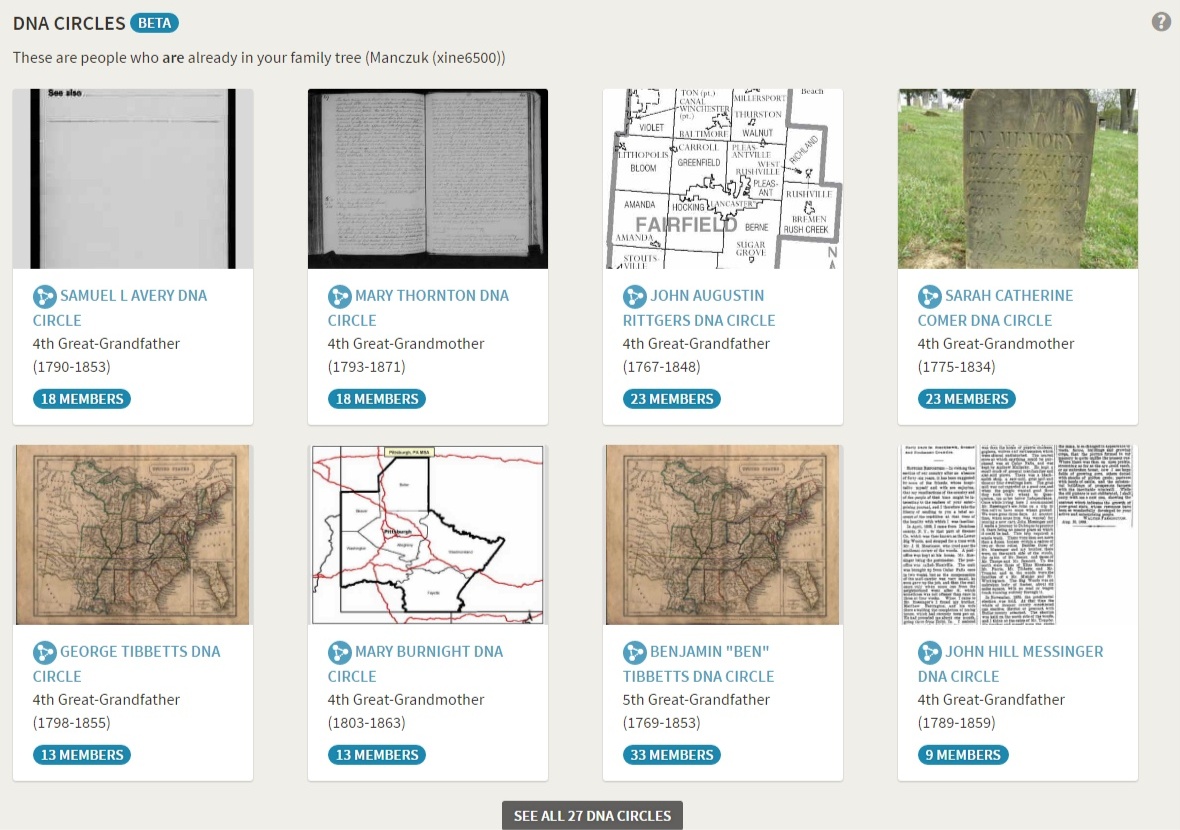
Since 2014 Ancestry has provided "DNA Circles," which shows how many people have trees and shared DNA around certain of your own ancesters:
These are basically "confirmed" matches, although if everyone is claiming the wrong ancestor it can be wrong on that level, but this shows not only your cousin matches with ancestor hints, but also people that your cousins might match up with that you don't have on your cousin list directly.  SERIOUSLY, I could really use a chromosome browser with this one--so I could start my chromosome mapping in earnest.  Arghhhh.

Since 2015, Ancestry has provided "New Ancestor Discoveries," which shows people that are not on your tree but might be related since you match so many other people who do have them as ancestors:
I'm related to people who claim these people as ancestors.  Gee, I sure could use a chromosome browser to analyze these!

Last week "AncestryDNA’s Cutting-Edge Science Gets Even Sharper" apparently applied refinements to all the cousin matches, a move which I am agnostic about, but has upset a lot of people (most due to lost cousin matches, which at least can be downloaded for now).  I actually would prefer to "lose" matches instead of having too many false ones.


But you know what I really want?  A chromosome browser on Ancestry!

Why does this have to be like squeezing blood from a stone?  I know Ancestry has smart people doing really interesting stuff with the DNA, but why not a chromosome browser?

Yes, I'm on GEDmatch, which is insanely brilliant.
I've transferred my DNA to Family Tree DNA (which has a chromosome browser and a limited amount of trees).
I've transferred my DNA to DNA.LAND, which is limited (but interesting, and free).


But my genealogical tree is on Ancestry, and I have loads of cousin matches on Ancestry.


Ancestry, Get a Chromosome Browser Already!


© 2016 Copyright, Christine Manczuk, All Rights Reserved.

Tuesday, October 18, 2016

Please Let Me Have Been Barking Up the Wrong Tree!

Job Taylor, wife Betsey, and possible children Simeon Taylor, Betsey Taylor, and George Taylor.  All other records I find of "Simeon" list him as Simon.  1850 U.S. census, Johnson County, Iowa, population schedule, Washington township, p. 130 (stamped), dwelling 67, family 67, Job Taylor; digital image, Ancestry.com (http://www.ancestry.com: accessed 18 Oct 2016); citing NARA microfilm publication M432, roll 185.

I've spent every which way trying to figure out Sarah Lynchard and Thomas Taylor, and have been disappointed that not one of my mother's DNA matches seems to track in any meaningful way with what I know of those two.  A doubt has been growing in my mind that they are not actually our ancestors.  The woman I thought was their daughter, Elizabeth Taylor (b abt 1845 in Ohio), married George Marion Tomlinson in 1860, and my mother has plenty of DNA confirmation for those Tomlinsons.  But no Taylors from Maryland (well, some moderate matches back in the 1600s but that isn't very promising considering how common the Taylor name is).

So I decided yesterday to get back to basics.  First, was the Elizabeth Taylor who married Tomlinson the daughter of Thomas Taylor and Sarah Lynchard?  Why was I assuming that?  I have no direct evidence that she was, except that she was in the right place (Washington County, Iowa in 1860) and of marriageable age (although I was pushing it, as she was only about 14 or 15 in 1860).

When I had decided to settle on Thomas Taylor and Sarah Lynchard as the parents a few years ago, I thought I had exhausted the likely Elizabeth Taylors in the area of marriageable age.  But being new to the game, I managed to overlook a certain BETSEY Taylor (b abt 1835 in Ohio) who lived in the area between Washington County, Iowa and neighboring Johnson County, Iowa.  An area somewhat closer to where George Tomlinson was living in 1860.  She would have been about 25 (George would have been about 21).

And when I checked my mother's highest Taylor DNA matches, sure enough she had both a Very High Confidence match (51 centimorgans shared across 3 DNA segments) and a Good match (19.2 centimorgans shared across 3 DNA segments) to descendants of this Betsey Taylor's brother, Simon Taylor , who lived most of his life in Washington County, Iowa.

Hello!  Could this be my big Taylor breakthrough, finally?


© 2016 Copyright, Christine Manczuk, All Rights Reserved.

Tuesday, August 29, 2017

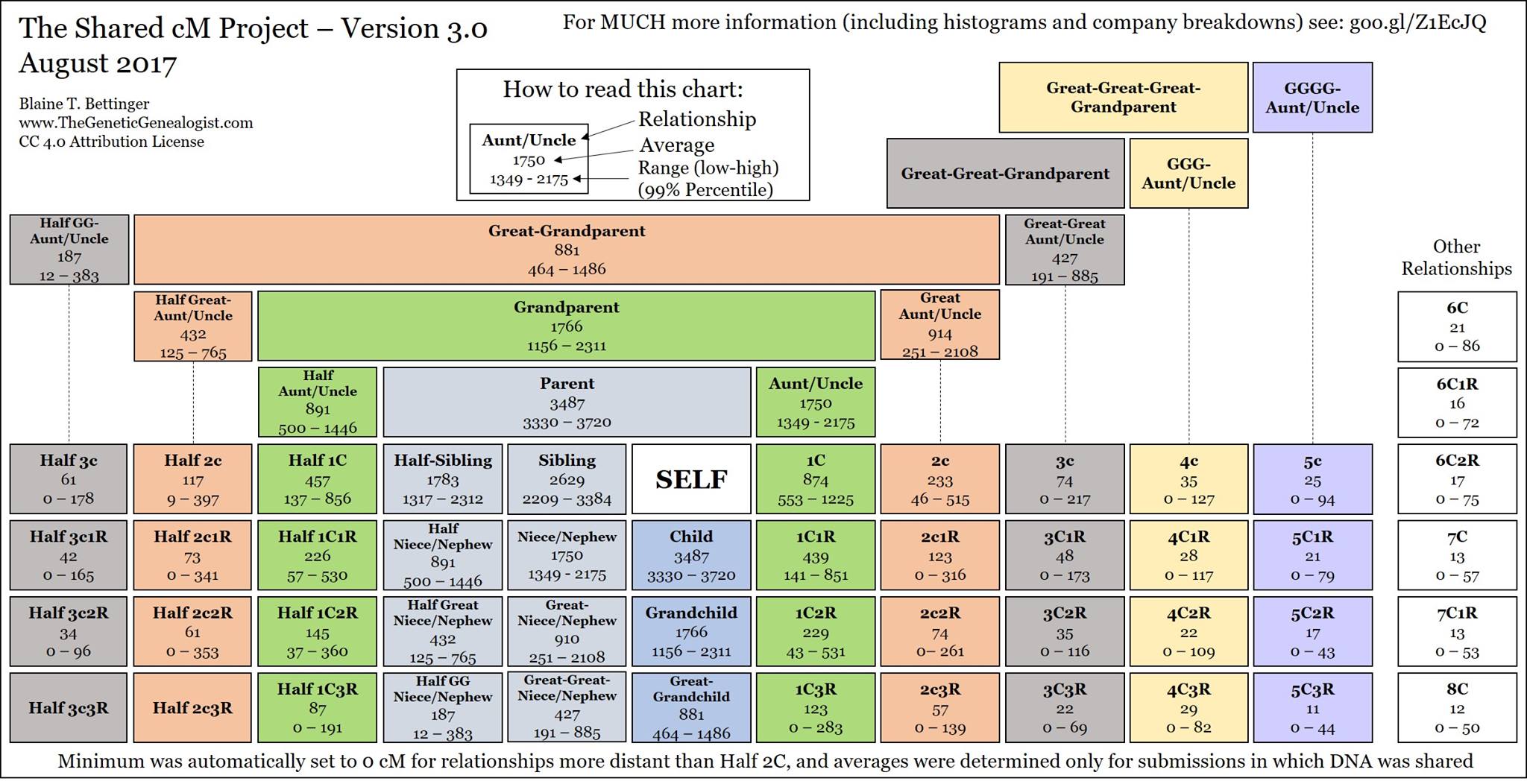
Fantastic Find: Blaine Bettinger Has Updated His "Shared cM Project" Chart

Blaine Bettinger's new chart.  See the entire article at the ISOGG site here.


After attending the genetic genealogy conference last year I learned to use the Shared cM Project chart to navigate my DNA matches at Ancestry.  I used my parents as examples of how to find the amount shared, but you can use it for any DNA match to get a ballpark idea of how they might be related to you.

I highly recommend keeping this chart handy if you are trying to analyze your DNA matches.


© 2017 Copyright, Christine Manczuk, All Rights Reserved.

Saturday, October 15, 2016

Comparing First Cousins: Elizabeth Taylor, Archibald Mullenix, and Elizabeth Henrietta Mullinex (Updated: They Aren't Cousins At All)

Elizabeth Taylor (1844-1863), who married George Tomlinson. Courtesy of Olive Kennedy.

I am deeply uneasy about my 2nd great grandmother Rufina Tomlinson's maternal upline through her mother Elizabeth Taylor, primarily because I have not found one single confident DNA cousin match for my mother to either of Elizabeth's parents (Thomas Taylor and Sarah Lynchard).  In contrast, we have plenty of Rufina's father George Tomlinson cousin matches.  Am I barking up the wrong tree?  Or did we simply not get much of their DNA?

Or, do we already have a bunch of DNA matches but they are all to people who do not have public trees for me to compare?  I'm hoping that is what is happening, and that more Taylor/Lynchard descendants just need to put up both their DNA and develop their trees [let's get cracking on that, people!].

Although I don't put too much stock in looks to discover if people are related, I feel a little better when comparing the photo above of Elizabeth Taylor to known photos of her first cousins through her mother Sarah Lynchard's sister Mary Polly Lynchard Mullenix's children, Archibald Mullenix and Elizabeth Henrietta Mullenix.

What struck me was Archibald Mullenix's (1846-1916) jawline compared to Elizabeth Taylor's jawline.  They are quite similar. Image shared by Ancestry user scoutmaster87.

Elizabeth Henrietta Mullenix (1852-1895). Dark hair seemed to run in the Lynchard side, although I think I read that the Mullenix's were dark.  I haven't a clue what a Lynchard looks like. Image shared by Ancestry user DawnOBrien41.


And Rufina:

Daughter of Elizabeth Taylor and George Tomlinson.  Her jawline is similar to my eyes as to her mother and uncle Archibald. Courtesy of Olive Kennedy.

UPDATE 2018:   This kind of comparison is pretty worthless.  Similar jawlines notwithstanding, I proved a while back that we were not related to the Lynchard/Mullenix's at all, but a different Taylor family in Iowa (Job Taylor and Betsey LNU).


© 2016 Copyright, Christine Manczuk, All Rights Reserved.

Thursday, October 25, 2018

More New Features at AncestryDNA

My son's view of his matches.  There are THREE new features at AncestryDNA.

What I missed in my post on Tuesday (1: "AncestryDNA Now Includes Automatic Display of Amount DNA Shared in Matching Lists") is that there two other new features to play with at AncestryDNA.


2: Matches Map (Beta)
My son's matches (4th cousin and closer) that Marc has in living Southern California.  My mom and I are at bottom.  These locations are not historical.


You are mapped if you volunteer your location.


3: Compare

My son's view of his grandmother Pat's profile.


What ethnicities he shares with his grandmother.


People my son and grandmother Pat have in common (there is a link to more matches if that applies). The presentation of this information set  reminds me a little of 23andme.


© 2018 Copyright, Christine Manczuk, All Rights Reserved.

Tuesday, September 4, 2018

Thursday, August 27, 2015

Hat Tip & Fantastic Find, Combined: AncestryDNA Shared Matches Appear

Fellow native San Diego area blogger (and distant cousin) Randy Seaver posted yesterday about Ancestry.com's new tools  "See Your DNA Matches in a Whole New Way" and gave us an example of how "Shared Matches" worked for him on a second cousin.

Here's the video from Ancestry.com that accompanied their post.


Check it out.


© 2015 Copyright, Christine Manczuk, All Rights Reserved.

Friday, August 31, 2018

Family Friday: Ashtabula Lyle (1857 - 1937) & Her Husband Seth P. Thomas (1853 - 1940)

I don't know why this second cousin, three times removed*, was named Ashtabula, the name of a city and county located on Lake Erie, far to the north of her birthplace in downstate in Meigs County, Ohio. Perhaps her parents just liked how this Native-American-derived word sounded.**


Ashtabula and Seth were married in Gallia County, Ohio, in 1885 and seem to have lived in that county for their entire lives. They had four children.

[Ancestry.com. Ohio, County Marriage Records, 1774-1993 [database on-line]. Lehi, UT, USA: Ancestry.com Operations, Inc., 2016. Original data: Marriage RecordsOhio Marriages. Various Ohio County Courthouses.]


Both of these portraits were found on the Ancestry.com family tree of VickieHill56 who doesn't appear to be a DNA match of mine.


*This is how we're related through my Webb lineage:

[Ancestry.com]


**Here's how Wikipedia translates it: The name Ashtabula is derived from ashtepihəle, which means 'always enough fish to be shared around' in the Lenape language

© 2018 Copyright, Christine Manczuk, All Rights Reserved.

Friday, August 10, 2018

Family Friday: Rosie, Winnie, Polly & Lula

Fortunately someone noted the full names of this quartet so we don't have to guess who's who:
                       Rosie McGowan nee Joslin (my first cousin, three times removed)
                                Winnie McGowan Northrup (Rosie's sister-in-law)
                              Polly Worden Joslin (my third great aunt)
                                  Lula Northrup (presumably Winnie's daughter)

[Posted to her ancestry.com public tree by jeanandorf (who's not related to me
but manages two DNA tests of distant Worden cousins]

The location isn't mentioned but it's almost certainly in Jones County, Iowa.

I've posted pictures of Polly before that were shared with my by another cousin.


© 2018 Copyright, Christine Manczuk, All Rights Reserved.

Wednesday, October 11, 2017

Working on Wednesday: Ross Lloyd Hughes (1878 - 1967) Stationary Engineer

Abandoning, at least for the moment, the farther reaches of my family tree, my attention was drawn to the career of Ross Lloyd Hughes who's the oldest child of Lewis Logan Slater's sister Serena Adeline and her husband Dr. Ezra Hughes. (So he's my first cousin, twice removed.*)

[Courtesy of Vicki D. via Ancestry.com]


In the 1900 Federal Census he was a single man working as a farm laborer in Kansas but by the end of the next year he was living in Blaine County, Oklahoma Territory, where he married Arizona native Blanche Rowe.

[Ancestry.com. Oklahoma, County Marriages, 1890-1995 [database on-line]. Lehi, UT, USA: Ancestry.com Operations, Inc., 2016.
Original data: Marriage Records. Oklahoma Marriages. FamilySearch, Salt Lake City, UT.]


I don't know where these pictures were taken but they're each holding the same branch of that leafless tree.

[Courtesy of Vicki D. via Ancestry.com]

[Courtesy of Vicki D. via Ancestry.com]

From another of Cousin Vicki's photos we can place the couple in North Dakota in 1906 at the Fort Berthold Indian Mission** in Elbowoods.

[Courtesy of Vicki D. via Ancestry.com]


This double portrait of Ross and Blanche, dated 1909, was taken the year after the fire mentioned at the top of the preceding picture.

[Courtesy of Vicki D. via Ancestry.com]


And the 1910 Federal Census found the couple and their two children residing at the Vermillion School at Pipestone Mission in Minnesota. (For some reason, the enumerator listed both adults as Canadian-born which they clearly weren't.) Ross's occupation was given as Eng[ineer} and Blanche was listed as a Teacher.***

[Year: 1910; Census Place: Township 62, Saint Louis, Minnesota; Roll: T624_724; Page: 8B; Enumeration District: 0244; FHL microfilm: 1374737. Ancestry.com. 1910 United States Federal Census [database on-line]. Provo, UT, USA: Ancestry.com Operations Inc, 2006.
Original data: Thirteenth Census of the United States, 1910 (NARA microfilm publication T624, 1,178 rolls). Records of the Bureau of the Census, Record Group 29. National Archives, Washington, D.C.]


Eight years later 40-year-old Ross, still residing at Pipestone Mission, registered for the draft and gave his occupation as stationary engineer.


[Registration State: Minnesota; Registration County: Pipestone; Roll: 1675774. Ancestry.com. U.S., World War I Draft Registration Cards, 1917-1918 [database on-line]. Provo, UT, USA: Ancestry.com Operations Inc, 2005. Original data: United States, Selective Service System. World War I Selective Service System Draft Registration Cards, 1917-1918. Washington, D.C.: National Archives and Records Administration. M1509, 4,582 rolls. Imaged from Family History Library microfilm.]


Subsequent census records (1920, 1930, and 1940) confirm that Ross remained at Pipestone as a stationary engineer at least through 1942 when he again registered for the draft.


[Ancestry.com. U.S., World War II Draft Registration Cards, 1942 [database on-line]. Lehi, UT, USA: Ancestry.com Operations, Inc., 2010. Original data: United States, Selective Service System. Selective Service Registration Cards, World War II: Fourth Registration. Records of the Selective Service System, Record Group Number 147. National Archives and Records Administration.]

[Courtesy of Vicki D. via Ancestry.com]


After his wife died in 1960, Ross went to live with one of his sisters in Oklahoma where he died in 1967. His body was taken back to Minnesota where he's buried next to Blanche in the Old Woodlawn Cemetery in Pipestone.


*All of the pictures of Ross Lloyd and Blanche in this post were originally shared by his great granddaughter Vicki D. in her Ancestry.com public tree (And she's a 5th-8th cousin in my Ancestry DNA matches).
**You can read more about the history of Indian Missions in North Dakota. including the early history of Fort Berthold, here.
***Here's a history of American Indian boarding schools in Minnesota (and elsewhere), and if you really want to get into the subject Adam Fortunate Eagle's memoir Pipestone: My Life in an Indian Boarding School is available from Amazon (and other sources).


© 2017 Copyright, Christine Manczuk, All Rights Reserved.